Raccoon Removal in North Ridgeville, OH
Something heavy walking the barn loft at night, or muddy handprints on the siding by the downspout? North Ridgeville raccoons feed at ponds and fields and den wherever a structure offers height and quiet. Call us and tell us about the job — we will confirm the local crew for your county before any work starts.
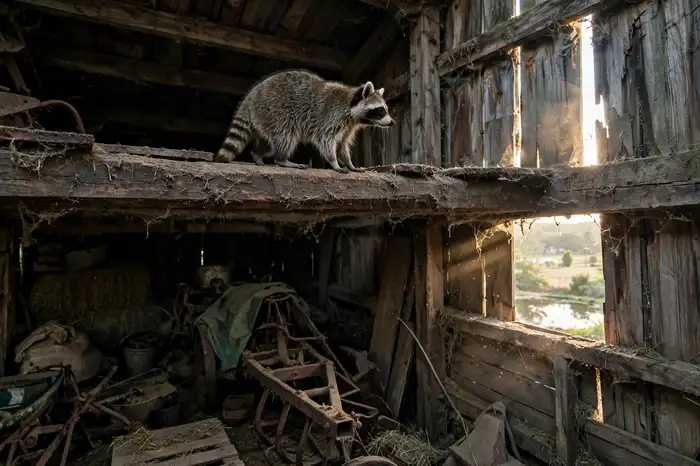
Raccoons in your North Ridgeville home
Few Ohio animals are as well suited to North Ridgeville as the raccoon. The farm ponds give it water to forage in, the fields and gardens give it food, the ditches give it covered travel, and the properties give it a menu of dens: a barn loft, an attic, an uncapped chimney, a hollow tree at the fencerow. A female choosing a spring den here is spoiled for choice, and she will pick the quietest, highest, driest option she can reach.
Two facts shape every raccoon job. Kits remain in the den for weeks, unable to travel, and Ohio law does not permit a captured raccoon to be carried away and released somewhere else. So the work is methodical — find the family, account for every kit, get the animals out in the way the law allows, and only then close the structure.
The law first: no off-property release for raccoons
Ohio Administrative Code 1501:31-15-03(E)(3) is plain: a captured raccoon is released on the same property or humanely euthanized. Driving one to a woods or a farm and letting it go is unlawful, and the reasoning is disease — raccoons are a principal rabies vector, and moved animals move rabies with them. Our crew leads with exclusion, fitting one-way doors and sealing so a raccoon can leave a structure under its own power where that can work, and handles any animal that must be taken directly exactly as the rule requires. Anyone offering to haul your raccoon away for release is offering an illegal service.
Barn lofts, chimneys and attics, in that order of history
Barns were raccoon housing long before subdivisions arrived, and a loft over stored equipment remains a favorite maternity den: high, dry, rarely disturbed. Chimneys on houses whose fireplaces see little use come next — a female will raise kits on the smoke shelf of an uncapped flue. Attics round out the list, usually entered at a pulled soffit or a roof return. The entry point matters less than the order of operations: nothing gets capped, paneled or sealed until the family is confirmed out.
Accounting for the kits
Spring litters are where raccoon jobs go wrong when they are rushed. Kits chirp and chatter, but a young litter can be quiet, tucked into insulation or a wall top where nobody thinks to look. If the mother is put out and the den sealed with kits inside, they die there — a worse problem, in a harder place, with odor guaranteed. Our crew inspects with lights and cameras and builds the removal around locating every kit before a door is fitted or an opening closed.
Latrines, in lofts as much as attics
Raccoons defecate in one chosen spot, and in a barn loft or a big attic that spot can accumulate for a long time before anyone climbs up. The droppings can carry raccoon roundworm, whose eggs persist in the material and are a genuine concern where children play or feed is stored below. A complete job removes the contaminated material and sanitizes the area. Whether a whole attic's insulation needs replacing is a separate question — often only the latrine area does, and a straight answer about that is part of honest work.
Repairs a raccoon cannot simply undo
A raccoon tests repairs with strong paws and real leverage. Entries are closed in heavy-gauge metal: a sound chimney cap, reinforced vent screening, flashing at roof seams, and door and loft gaps on outbuildings closed to a standard that keeps a determined animal out. Wood patches fail. The crew also walks the rest of the structure, because a raccoon denied at the soffit will try the gable vent next, sometimes the same night.
Food: ponds are fixed, habits are not
No one can un-dig the farm pond or fence the ditch, and raccoons will commute through North Ridgeville properties forever. What can change is the menu at the house: trash secured, pet food indoors at night, sweet corn and garden waste not left at the field edge by the deck, and feed in outbuildings kept in closed metal containers. Sealing plus a leaner menu is what keeps a solved raccoon problem solved.
Common raccoon questions in North Ridgeville
There are raccoons in my North Ridgeville barn — what should I do?+
Can you trap a raccoon and release it in the woods?+
I hear chattering from my chimney — baby raccoons?+
A raccoon is out in the daytime and seems unafraid — is that rabies?+
How much does raccoon removal cost in North Ridgeville?+
Other North Ridgeville problems that come with raccoons
Our wildlife crew handles these closely related problems — the ones that most often turn up with a raccoon issue.
Got more than raccoons in North Ridgeville?
Raccoons are rarely the only thing using an attic or yard in North Ridgeville. See everything we handle locally on the North Ridgeville wildlife removal hub, or jump to Ohio wildlife removal.
Serving all of Lorain County
North Ridgeville is one part of Lorain County. See wildlife removal in Lorain County, OH for the county-wide picture — the animals we get called about most, and the other towns we cover.
One call to your North Ridgeville raccoon crew
The longer raccoons stay in the attic, the more they chew and the bigger the cleanup. Call us and tell us about the job — we will confirm the local crew for your county before any work starts.
- Local to Lorain County. ODNR-compliant handling — call to ask about licensing and insurance.
- Humane exclusion. One-way doors and steel sealing, not poison.
- Done right. Removal, exclusion and cleanup.