Dead Animal Removal in North Ridgeville, OH
An odor strengthening in one room, around the barn, or under the deck, with nothing visible to explain it? Something has likely died inside a structure — and on a rural-suburban property the list of hiding places is long. Call us and tell us about the job — we will confirm the local crew for your county before any work starts.
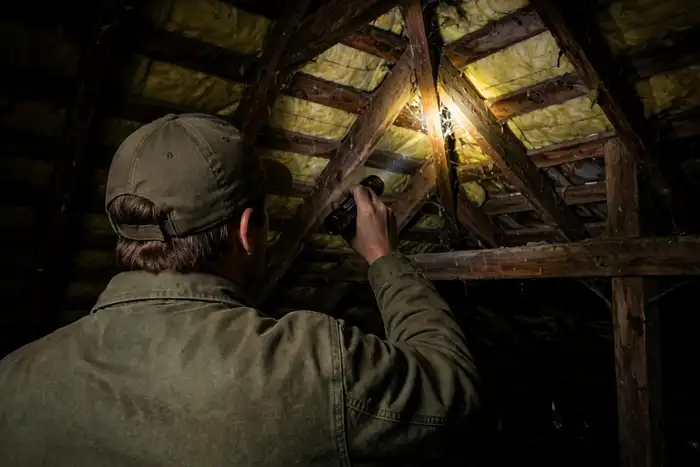
A dead animal in your North Ridgeville walls, attic, barn or under the deck
The dead-animal call in North Ridgeville usually starts with a smell that has a geography: worst in one room, or on one side of the barn, or drifting from under the deck on warm afternoons, sometimes with flies clustering at a window. The source is concealed — a wall cavity, insulation in an attic or loft, a den beneath a structure — and the work is finding it with as little opening of the building as possible, removing it, and cleaning the spot so the odor ends at the source.
Winter writes most of these calls. Animals den through the cold in porches, barns, crawlspaces and attics here, and some die in them — an opossum under a deck, a raccoon in a loft or flue, rodents in a wall. Cold suppresses the evidence, and the spring thaw delivers it all at once, which is why so many of these calls arrive in the same few weeks of the year.
Where they die on a rural-suburban property
The map follows how the animals live. Mice and rats die in wall cavities and beneath floors, frequently after eating poison elsewhere. Squirrels die in attics and lofts. Raccoons die in chimneys, lofts and large attics. Opossums and skunks die in dens under decks, porches, sheds and barn edges. The season, the structure and the place where the smell runs strongest together let a crew narrow a whole property down to one section of one building.
Why thaw week is odor week
Decomposition slows hard in the cold — a mixed mercy. An animal that died in a wall or under a deck in January may announce itself only faintly until a mild spell, or the general thaw, lets the odor build and travel. Households then face a powerful smell attached to no remembered animal activity at all. The crew works backward from the evidence in hand: odor geography, fly behavior, entry points, and any noises heard back in the winter, rather than assuming the animal lies near where it was last noticed.
The poison connection, in houses and barns alike
A large share of in-wall deaths trace to rodent bait — set in the house, the barn or a neighboring property. A poisoned rat or mouse retreats to its harbor, inside a wall, under a floor or deep in stored material, and dies there. Mention any baiting when you call, whoever set it, because it points to the species and therefore to the size of the space being searched — and ask about the sealing-and-trapping alternative that keeps poison out of the walls for good.
Locating and removing it, methodically
The search has a discipline: odor compared room by room and building by building, fly activity noted, the building's cavities and den spaces mapped against both. Once located, the carcass and the heavily contaminated material around it come out, and the area is cleaned and treated so the source is removed rather than perfumed over. Most jobs avoid cutting altogether; where a modest opening in a wall or a loft floor is the only route in, the crew keeps it small and placed with intention.
Ask about repair before the first cut
If an opening proves necessary, know that most wildlife crews do not do drywall, plaster or finish repair. Ask at the outset what is included, so the patching is planned rather than discovered. In a barn or outbuilding the question is simpler; in a finished room of the house it deserves a sentence before work begins, not after.
Closing the route the animal used
Dead or alive, the animal entered through something: a vent, a foundation gap, an open deck void, a barn door line. Once the carcass is removed, that route gets found and closed or screened, or the property rehearses the same call next winter with the next tenant. Removal, cleanup and closure together are the complete job — any one alone is a partial one.
Common dead animal questions in North Ridgeville
There is a dead-animal smell at my North Ridgeville property — what do I do?+
How long will the smell last if I do nothing?+
Why did this begin in spring when I heard nothing all winter?+
I put out rat poison in the barn and now there is a terrible smell — connected?+
How much does dead animal removal cost in North Ridgeville?+
Other North Ridgeville problems that come with dead animals
Our wildlife crew handles these closely related problems — the ones that most often turn up with a dead animal issue.
Got a live animal problem in North Ridgeville too?
An animal that died inside a structure almost always entered alive through an opening that is still there — sealing it is part of finishing the job. See everything we handle locally on the North Ridgeville wildlife removal hub, or jump to Ohio wildlife removal.
Serving all of Lorain County
North Ridgeville is one part of Lorain County. See wildlife removal in Lorain County, OH for the county-wide picture — the animals we get called about most, and the other towns we cover.
One call to your North Ridgeville dead animal crew
Left alone, a dead-animal odor can linger for weeks, and winter cold slows the process rather than stopping it. Call us and tell us about the job — we will confirm the local crew for your county before any work starts.
- Local to Lorain County. ODNR-compliant handling — call to ask about licensing and insurance.
- Find it, remove it, clean it. Tracing odor and fly activity to the source, removing the carcass, and treating the area rather than masking the smell.
- Done right. Removal, exclusion and cleanup.