Rodent Control in Elyria, OH
It starts with the first cold night: scratching in a wall, droppings in the basement, something in the attic that was not there in August. Call us and tell us about the job — we will confirm the local crew for your county before any work starts.
Rodents in your Elyria home
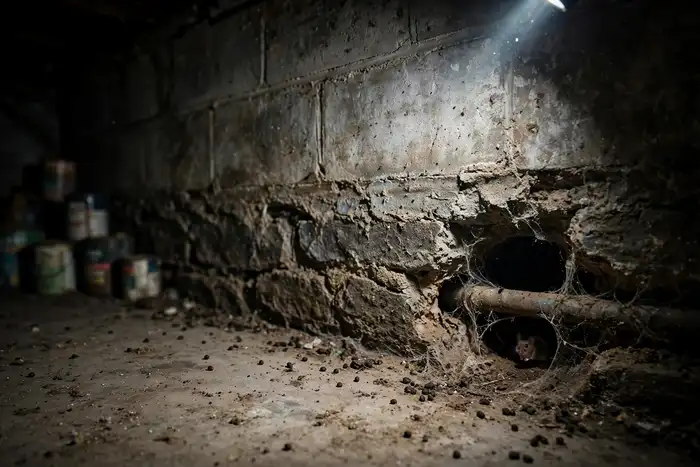
Elyria's rodent year has a starting gun: the first hard frost. House mice that spent the summer in garages, woodpiles and the grass along the river move on houses all over town within the same few weeks, looking for exactly what an older Elyria home offers — a basement with gaps around pipes, warm wall voids, and an attic above it all. A mouse needs a gap little wider than a pencil, and a century-old foundation that has been through a hundred freeze–thaw cycles usually offers several.
Rats and yard rodents write different chapters of the same story. Norway rats work the older housing and the low ground near the river — burrowing along foundations, living in crawlspaces and basements, following food and water. And through the winter, hidden under the lake-effect snow, voles graze winding trails across lawns and girdle young shrubs, a whole season of damage nobody sees until the snow melts off in spring. One crew, three very different problems — the first job is knowing which one you have.
House mice: the fall invasion
Signs of mice are small but specific: droppings like dark grains of rice in basement corners, under sinks and along walls; a musky smell in a closed pantry; shredded material — insulation, paper, fabric — gathered into nests in quiet voids; and light scratching in walls after the house quiets down. Mice breed year-round indoors, so a pair that enters in October is a colony by February. Because they travel along walls and pipes, the droppings map their routes, and that map tells our crew where they are getting in and where traps belong.
Norway rats in older housing
Rats are a heavier problem in every sense. A Norway rat is a burrower: look for holes at the base of a foundation, runs along walls, grease marks where bodies rub the same path nightly, and droppings far larger than a mouse's. They favor the ground floor of a house's world — basements, crawlspaces, sewers and drains, and the sheltered ground along the river corridor. A rat in the living space of an older Elyria home usually means a foundation or plumbing opening that has gone unnoticed, sometimes for years, and finding it matters more than any trap.
Voles and moles: the yard chapter
Some rodent calls are not about the house at all. Voles spend winter under the snowpack in surface runways, eating grass and the bark of young trees and shrubs; at snowmelt, Elyria lawns reveal the whole map at once — winding dead trails and girdled plantings. Moles are not rodents at all, but their work is confused with vole damage constantly: moles are the tunnellers, pushing up ridges and mounds hunting worms and grubs, while voles travel the surface under cover. The distinction decides the treatment, and our crew reads the yard before recommending anything. Yard work is seasonal in the opposite direction from house work — spring, at snowmelt, is when the evidence is freshest.
Why bait alone fails in an Ohio winter
Poison bait treats the animals inside today and nothing else. It does not close a single gap, so the fall pressure that sent the first mice in sends their replacements; and a poisoned mouse or rat typically dies where it nests — in a wall void or under a floor — trading a rodent problem for a dead-animal odor problem in the middle of heating season, when the house is closed up tight. Bait has a limited place in some programs, but in an older Elyria house the foundation of control is physical: find the entries and close them with materials rodents cannot chew.
Exclusion: sealing an older house properly
Our crew inspects the whole route a rodent travels: foundation penetrations where pipes, wires and vents pass through, the basement window frames, the gap under a garage door, crawlspace vents, and up top the roofline and chimney flashing where a rat or squirrel-sized problem can begin. Everything found is sealed with steel — copper or steel mesh packed into penetrations, hardware cloth over vents, flashing at the roofline — because rodents chew through foam, wood and caulk as a matter of routine. Trapping clears the animals already inside, and a follow-up confirms the scratching has actually stopped before the job is called done.
Food, clutter and the basement habits that help
An older Elyria basement often doubles as storage, and stored food — pet food in an open bag, birdseed, a pantry overflow — is a rodent subsidy. Sealed hard containers, pet food fed and put away, and clutter cleared from along foundation walls (so runs and droppings are visible early) all reduce what a house offers. Outside, woodpiles and dense brush against the foundation are staging areas; moving them a few feet off the wall removes the covered approach mice use to find your gaps in the first place.
Common rodent questions in Elyria
Why do mice get into my Elyria house every fall?+
How can I tell mice from rats?+
My lawn is covered in winding dead trails after the snow melted — what did that?+
Will poison get rid of the mice in my walls?+
How do you seal a house against mice?+
How much does rodent control cost in Elyria?+
Other Elyria problems that come with rodents
Our wildlife crew handles these closely related problems — the ones that most often turn up with a rodent issue.
Got more than rodents in Elyria?
If mice found four ways into an Elyria house, a squirrel or a bat will eventually find the fifth. See everything we handle locally on the Elyria wildlife removal hub, or jump to Ohio wildlife removal.
Serving all of Lorain County
Elyria is one part of Lorain County. See wildlife removal in Lorain County, OH for the county-wide picture — the animals we get called about most, and the other towns we cover.
One call to your Elyria rodent crew
Rodents breed fast and Elyria winters are long — every week inside is more droppings, more chewing and a bigger colony by spring. Call us and tell us about the job — we will confirm the local crew for your county before any work starts.
- Local to Lorain County. ODNR-compliant handling — call to ask about licensing and insurance.
- Seal, then trap. Every entry closed with steel, the animals inside trapped out, and the yard damage read for what it is.
- Done right. Removal, exclusion and cleanup.