Raccoon Removal in Elyria, OH
Heavy thumping overhead at night, like something with real weight walking your attic — that is a raccoon, and in Elyria it usually came up from the river. Call us and tell us about the job — we will confirm the local crew for your county before any work starts.
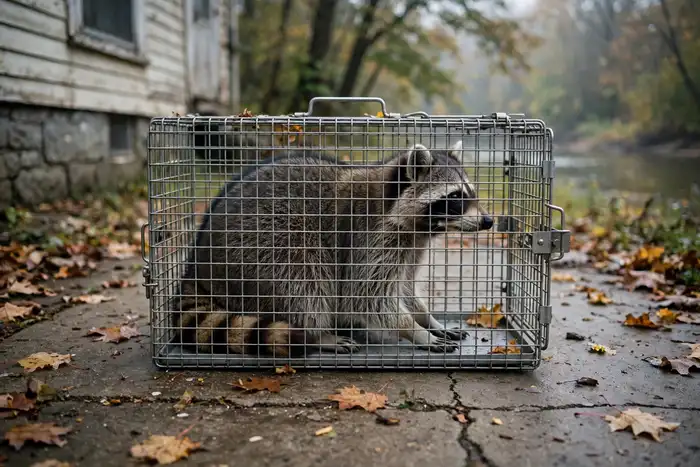
Raccoons in your Elyria home
The Black River corridor is raccoon habitat from end to end — water, fish and frogs along the banks, woods for cover, and the trash cans and pet food of a whole city within a short night walk. Elyria raccoons live well, and when a female looks for a place to raise kits in spring, she looks for something that works like a hollow tree: dark, dry, off the ground. In an older Elyria neighborhood, that description fits an uncapped chimney or a quiet attic better than anything in the woods.
You will hear her before you see her. A raccoon in an attic sounds heavy — thumps, slow walking, sometimes a chattering or chirping when kits are old enough to be vocal. She will also establish a latrine, returning to the same corner of the attic, and that concentrated waste is a genuine health concern. This is a job with legal rules attached, and it is worth understanding them before anyone sets a trap.
Ohio law: raccoons are not relocated
People often picture raccoon removal as trapping the animal and letting it go in a park or out in the country. In Ohio that is illegal. Raccoons are on the list in OAC 1501:31-15-03(E)(3): a captured raccoon must be released on site or euthanized — it cannot be transported and released elsewhere, largely because raccoons are one of Ohio's main rabies carriers and moving them moves the disease. So our crew's first tool is not a trap at all. It is exclusion: getting the raccoon out of the structure and sealing the structure so she cannot come back, with any hands-on handling done the way the rule requires by a licensed operator.
Chimneys: the favorite Elyria den
A masonry chimney on an older Elyria home, serving a fireplace that is rarely lit, is close to a perfect raccoon den. The female climbs down the flue and settles on the smoke shelf above the damper, where kits stay warm and unreachable. Signs include smudged paw marks around the chimney top, scratching or chattering sounds coming through the fireplace, and a strong smell near the hearth. Never light a fire to drive her out — it can kill the kits and drive a panicked animal into the house. A chimney raccoon is removed from the top, and the fix afterward is a proper heavy-gauge cap.
Attic entries and raccoon strength
Where a raccoon wants in an attic, she works the weak points: a soffit corner softened by winters of gutter overflow, a louvered vent she can pull loose, the seam where a porch or addition roof meets the main wall. Raccoons have strong, dexterous front paws and real body weight behind them, so a screen or thin board that stops a squirrel will not stop a raccoon. Sealing after a raccoon job means heavy metal — secure flashing, reinforced vent covers, a real chimney cap — installed so a returning animal cannot peel it back.
Kits come first
Raccoon kits in Ohio are born in spring, and for their first weeks they cannot travel. Any plan that simply chases or seals out the mother in that season strands the kits in the attic or chimney, where they will die and create a far worse problem than the live raccoon did. Our crew locates the kits — often with a camera in the attic or down the flue — and builds the removal around getting the entire family out. Only when every kit is accounted for does the sealing begin.
The latrine and rabies
Two health issues ride along with attic raccoons. Their latrine droppings can carry raccoon roundworm eggs, which persist in insulation and are dangerous to people, particularly children — the contaminated material needs to come out and the area needs sanitizing, though a good crew will tell you honestly how much actually has to go rather than selling a full attic gut. And raccoons are one of Ohio's primary rabies-vector species, along with skunks, foxes and bats. Keep pets' rabies vaccinations current, and never corner or handle a raccoon yourself, however slow or tame it seems in daylight — a raccoon out and unafraid in the daytime deserves distance and a call.
Cutting off what draws them
A sealed house solves the den problem; the yard decides whether raccoons keep visiting. Trash cans with locking or weighted lids, pet food brought in at night, fallen fruit picked up, and bird feeders taken in during an active problem all lower the draw. Near the river, some raccoon traffic is simply a fact of the address — the goal is a house they cannot get into and a yard that does not reward the visit.
Common raccoon questions in Elyria
There is a raccoon in my Elyria attic — what should I do?+
Can you trap the raccoon and release it at a park?+
A raccoon is in my chimney. Can I light a fire to smoke it out?+
How do I know if there are baby raccoons up there?+
Is the raccoon droppings cleanup really necessary?+
How much does raccoon removal cost in Elyria?+
Other Elyria problems that come with raccoons
Our wildlife crew handles these closely related problems — the ones that most often turn up with a raccoon issue.
Got more than raccoons in Elyria?
Raccoons are rarely the only thing using an attic or yard in Elyria. See everything we handle locally on the Elyria wildlife removal hub, or jump to Ohio wildlife removal.
Serving all of Lorain County
Elyria is one part of Lorain County. See wildlife removal in Lorain County, OH for the county-wide picture — the animals we get called about most, and the other towns we cover.
One call to your Elyria raccoon crew
The longer raccoons stay in the attic, the more they chew and the bigger the cleanup. Call us and tell us about the job — we will confirm the local crew for your county before any work starts.
- Local to Lorain County. ODNR-compliant handling — call to ask about licensing and insurance.
- Humane exclusion. One-way doors and steel sealing, not poison.
- Done right. Removal, exclusion and cleanup.