Bat Removal & Exclusion in Elyria, OH
A scatter of small droppings under a gable vent, or a soft fluttering in the attic wall on a winter night — bats in an Elyria home are a timing problem before they are anything else. Call us and tell us about the job — we will confirm the local crew for your county before any work starts.
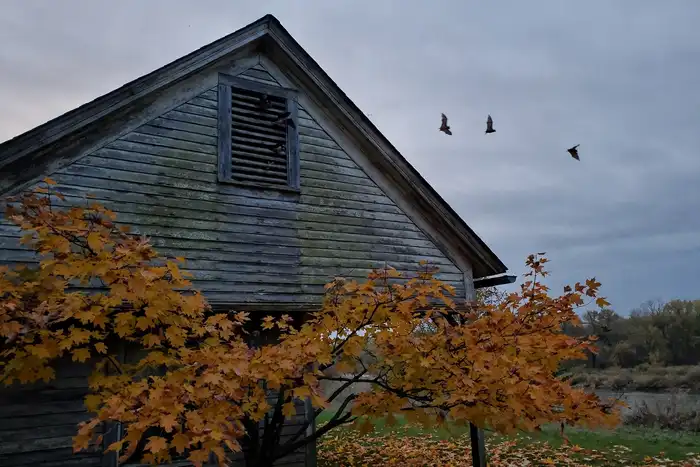
Bats in your Elyria home
Elyria's bats are mostly big brown bats, well suited to a river town: they hunt insects over the Black River at dusk and roost by day in the warm, dry peaks of older houses. The entries they use are modest — a gap behind a lifted piece of chimney flashing, an unscreened gable vent, a soffit seam that freeze and thaw pried open over the years. A big brown bat needs an opening well under an inch wide, so the houses around downtown Elyria, with their layered old trim and masonry, offer more doors than their owners would guess.
What makes Ohio bat work different from almost every other animal on this page is the calendar. Big brown bats do two things inside Ohio attics that the law protects: they raise flightless pups in summer colonies, and they hibernate in the attic through winter. Exclusion — the only legal way to remove bats from a structure — is closed for much of the year as a result. Getting the timing right is not fine print here; it is the job.
Ohio's bat windows, in plain terms
Under OAC 1501:31-15-03(H)(5), bat exclusion in Ohio is barred May 16 through July 31 when five or more bats are present, because that is maternity season and the pups cannot fly — sealing the exits strands them inside. It is also barred October 15 through March 31 for bats generally, because big browns hibernate in place and an exclusion then traps or kills animals that cannot leave. Both blackouts can only be overridden with prior written permission from the ODNR Division of Wildlife. That leaves two legal windows: April 1–May 15 and August 1–October 15. If you are reading this in June with droppings under the vent, the honest plan is an inspection now and an exclusion booked for August.
Signs of a colony in an Elyria home
Bats are quiet tenants. The common first sign is guano — small, dark, crumbly droppings piled on the ground, a porch or a window ledge directly below the entry gap, or accumulating in the attic under the roost. Homeowners also report faint scratching or squeaking at dusk, a musky, sweetish smell in a warm attic, and staining around a gap where the colony squeezes in and out at night. A dusk watch — standing outside at sunset and seeing where bats pour out — is how our crew confirms which gaps are live before any plan is made.
A bat in the living room
A bat flying in a bedroom is a different matter from a colony in the attic, and it comes with a health step. Bats are Ohio's most frequently confirmed rabies species, so a bat found in a room where someone was sleeping, or with a child or pet that may have had contact, should not simply be let out the window — contact your doctor or the county health department about whether the bat should be tested, and do not handle it bare-handed. Our crew can advise on the safe way to contain one. Bats that stay in the attic are not aggressive; the living-space encounter is the one to treat seriously.
How exclusion works when the window opens
Exclusion is a one-way exit. The crew seals every secondary gap on the structure with metal and sealant, then fits a bat valve over the main exit: bats drop out at dusk to feed and cannot climb back in. Over several nights the colony leaves on its own for a natural roost — no trapping, no handling. Once exit watches and an attic check confirm the house is empty, the valve comes off and that final gap is sealed permanently. Only a licensed Commercial Nuisance Wild Animal Control Operator may do this work for hire in Ohio, and our crew works under that ODNR license.
What not to do, and the guano question
Do not caulk the entry gap when you find it — with a colony inside, that traps bats in your walls in any season. Mothballs, bright lights and ultrasonic devices do not clear a colony and are not a legal substitute for exclusion. As for guano: a small accumulation under one vent is a modest cleanup; years of colony droppings in an attic is a bigger one, because dried guano can harbor a fungus associated with histoplasmosis and should be removed with proper protection. We will tell you plainly which situation your attic is — full insulation replacement is suggested far more often than it is truly needed.
Common bat questions in Elyria
I found bats in my Elyria attic in July — can they be removed now?+
Why can't bats be excluded in winter?+
How do I know bats are in my attic if I never hear them?+
A bat got into my bedroom — what do I do?+
Can I seal the gap where the bats come out?+
How much does bat removal cost in Elyria?+
Other Elyria problems that come with bats
Our wildlife crew handles these closely related problems — the ones that most often turn up with a bat issue.
Got more than bats in Elyria?
On an older Elyria home, the gap a bat colony uses is seldom the only opening winter has made in the roofline. See everything we handle locally on the Elyria wildlife removal hub, or jump to Ohio wildlife removal.
Serving all of Lorain County
Elyria is one part of Lorain County. See wildlife removal in Lorain County, OH for the county-wide picture — the animals we get called about most, and the other towns we cover.
One call to your Elyria bat crew
With bats, waiting for the legal window is not delay — it is the law working as intended, and an inspection now is what gets your exclusion scheduled the moment the window opens. Call us and tell us about the job — we will confirm the local crew for your county before any work starts.
- Local to Lorain County. ODNR-compliant handling — call to ask about licensing and insurance.
- Timed, one-way exclusion. Valves fitted inside the legal windows, every other gap sealed, and the entry closed permanently once the colony is out.
- Done right. Removal, exclusion and cleanup.