Dead Animal Removal in Elyria, OH
A smell that grows a little stronger each day, in a house closed tight against an Ohio winter — something died where you cannot see it, and waiting it out is a long option. Call us and tell us about the job — we will confirm the local crew for your county before any work starts.
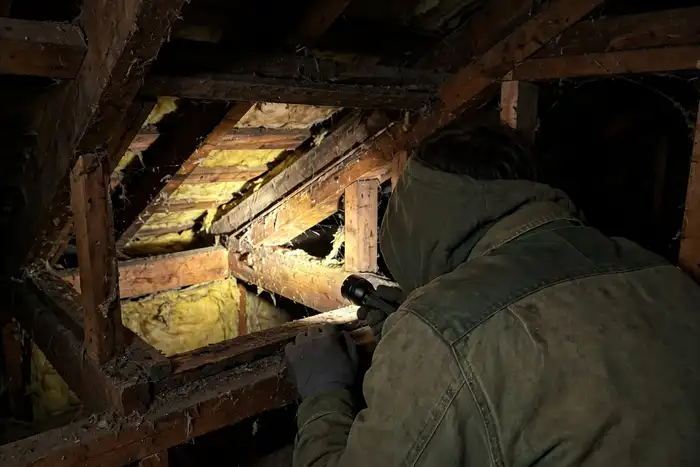
A dead animal in your Elyria walls, attic or basement
Dead-animal calls in Elyria spike in winter, and the reason is the fall that came before it. The animals that pushed into attics, walls and basements at the first frost sometimes do not leave: an older animal, a sick one, a mouse that ate bait and crawled into a wall void, a squirrel that got trapped in a chimney or a wall cavity it could not climb out of. In a heated, closed-up winter house the odor builds steadily and has nowhere to go, concentrating in the rooms nearest the source and riding the heating system through the rest.
There is no home remedy that shortens this meaningfully — scented sprays layer over the smell without touching it. The real fix has three parts: locate the animal as precisely as possible before anything is opened, remove it along with the material immediately around it, and then find and seal the entry the animal used, because that entry is how the next tenant arrives. On an older Elyria home, locating carefully matters twice over: plaster walls and finished basements are not surfaces you want opened on a guess.
How the location is narrowed down
An experienced crew reads the house the way the odor does. Smell is strongest nearest the source and follows air currents — up through wall voids from a basement, down from an attic through light fixtures and vents. The history helps: where scratching was heard in the fall, which room had a rodent problem, whether a chimney went unused and uncapped. Flies at a particular window in winter are another quiet clue, gathering near the wall where a carcass lies. Most attic and basement cases are found without cutting at all; wall cases are located to a single stud bay before any small opening is discussed — and discussed with you first.
The usual stories behind a winter smell
A few patterns account for most Elyria calls. Rodent bait is the first: a poisoned mouse or rat dies in a wall or under a floor instead of outside, which is one of the strongest arguments against bait-only rodent control. The second is the sealed-in animal — a well-meant repair closed an entry while a squirrel or raccoon young were still inside. The third is simple age and weather: an animal that denned in the attic or chimney for winter shelter died there. Each story ends the same way, but knowing which one you have tells the crew where to look first and what to fix afterward.
Removal and cleanup, handled plainly
Once located, the carcass is removed, along with insulation or material in immediate contact with it, and the area is cleaned and treated with an enzymatic deodorizer that works on the source rather than perfuming over it. The crew handles this discreetly and without drama — it is a routine part of winter wildlife work in Lorain County, not a catastrophe, and most jobs are finished the same visit. If reaching the animal requires opening a wall or ceiling, we will tell you in advance; patching drywall or plaster is typically a separate trade, and we will be straight about that before anything is cut.
How long it would last if left alone
Homeowners ask, reasonably, whether it is simpler to wait. In a warm interior space, a dead-animal odor commonly runs two weeks or more from the first notice to the end, longer for a larger animal, and winter makes it feel worse because the house stays shut and the furnace keeps moving the air — and the smell — from room to room. Waiting also leaves the entry open and the den site marked for the next animal. Removal ends the smell at its source, usually the day of the visit.
Sealing the entry afterward
A dead animal indoors is proof of an open door: a gable vent without a screen, a chimney without a cap, a foundation crack wide enough for a mouse, a soffit gap winter pried open. Our crew finds it and closes it in steel or masonry-appropriate material as part of the follow-through. Skip this step and the odds are good — especially in a river town with this much wildlife traffic — that the same smell introduces itself again in a season or two, from the same doorway.
Common dead animal questions in Elyria
There is a dead-animal smell in my Elyria home — what do I do?+
Why did this happen in winter?+
Will you have to cut into my wall?+
How long does the smell last if I do nothing?+
I used mouse poison and now there is a smell — is that connected?+
How much does dead animal removal cost in Elyria?+
Other Elyria problems that come with dead animals
Our wildlife crew handles these closely related problems — the ones that most often turn up with a dead animal issue.
Got a live animal problem in Elyria too?
An animal that died inside got inside while it was alive — the opening it used is still there, and it will be used again. See everything we handle locally on the Elyria wildlife removal hub, or jump to Ohio wildlife removal.
Serving all of Lorain County
Elyria is one part of Lorain County. See wildlife removal in Lorain County, OH for the county-wide picture — the animals we get called about most, and the other towns we cover.
One call to your Elyria dead animal crew
The smell ends when the source is out — and the entry it used gets sealed, or the next animal follows it in. Call us and tell us about the job — we will confirm the local crew for your county before any work starts.
- Local to Lorain County. ODNR-compliant handling — call to ask about licensing and insurance.
- Find it, remove it, close the way in. Locating by odor pattern and access points first, so any opening made is small and in the right place.
- Done right. Removal, exclusion and cleanup.