Groundhog Removal in Elyria, OH
A mound of fresh dirt beside the deck and a hole big enough to lose a boot in — a groundhog has decided your yard is the safe side of the riverbank. Call us and tell us about the job — we will confirm the local crew for your county before any work starts.
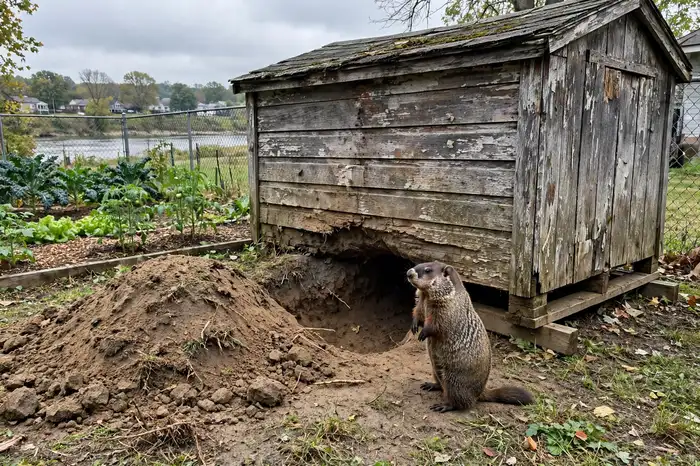
Groundhogs in your Elyria home
The groundhog — the woodchuck, same animal — is Elyria's most industrious digger. The soft slopes along the Black River are natural burrowing ground, and from there it is a short move into the yards above: under a deck, beneath a shed, along a fence line, or against a foundation where the soil is easy and the digging is hidden. A groundhog burrow is not a single hole. It is a system, with more than one entrance, chambers below the frost line, and enough moved earth to undermine what sits above it.
Groundhogs are also Ohio's most seasonal nuisance. They are true hibernators: by late fall they vanish underground, and from roughly late October through February the yard goes quiet and it is easy to believe the problem solved itself. It did not. The same animal wakes in late winter, hungry and ready to dig, and spring is when burrows expand, young are born below ground, and gardeners across Elyria discover last year's tenant never left.
What a burrow does under a structure
A lone hole in the middle of a lawn is mostly an ankle risk and an eyesore. A burrow under a deck, shed slab, patio or foundation is structural. Groundhogs excavate along the underside of whatever gives them a roof, and the tunnels can run for yards, voiding the soil that supports a slab edge or a foundation footing. Over seasons, that shows up as cracked, settling concrete and decks that shift. The main entrance usually has the telltale dirt mound; the quieter escape hole, often without a mound, is the one people miss — and the one that matters when you try to close the system.
The hibernation calendar runs the job
Timing shapes groundhog work in a way southern wildlife work never deals with. Late winter and spring emergence — when the animal is active, feeding and findable — is prime removal season, before young are old enough to complicate things and before the burrow gets its summer expansion. Summer work is straightforward while the animal is above ground daily. By mid-fall the groundhog is fattening and spending more time below, and once it is sealed in for hibernation, there is nothing to remove until it wakes. Our crew will tell you honestly where your problem sits on that calendar rather than sell a winter trapping program for an animal that is asleep.
Gardens, and the river-to-yard pipeline
If you garden in Elyria, a groundhog is not an abstract problem — it will take beans, greens, melons and young plants with an efficiency that fencing at ground level barely slows, since groundhogs climb better than their shape suggests. Yards backing onto the river valley or onto open ground get first and heaviest pressure, because the animal is commuting from bank habitat. But a burrow, once dug under your deck, is its own reason for the animal to stay — food becomes a bonus, not the cause. Removing garden access without addressing the burrow under the structure rarely ends the conflict.
How removal and proofing work
Our crew maps the burrow system first — every entrance, not just the mounded one — then removes the animal using traps placed at the burrow mouths, the method Ohio's rules for woodchucks are written around. Groundhogs are not on Ohio's no-relocation list, but release, where it is used, still follows state rules about where nuisance wildlife may be let go. After removal, the open system is dealt with: entrances closed, and the structure proofed with buried steel screening around the deck, shed or foundation edge so the next groundhog prospecting the site digs into mesh instead of a ready tunnel. An unproofed, empty burrow in good habitat is an invitation; a collapsed, screened one is not.
What does not work
Filling the hole with dirt alone is the classic wasted afternoon — a groundhog digs for a living and will reopen it or start a new entrance a foot away, sometimes the same day. Mothballs and ammonia rags in the burrow do not hold either, and should not be used around a home. Smoke and flooding attempts are ineffective on a multi-chamber system and can drive water where you do not want it. The system has to be emptied and then physically closed against digging; there is no scent-based shortcut.
Common groundhog questions in Elyria
A groundhog is under my Elyria deck — will it damage anything?+
The groundhog disappeared in November. Is it gone?+
Can I just fill in the burrow holes?+
When is the best time for groundhog removal in Ohio?+
Will another groundhog move into the old burrow?+
How much does groundhog removal cost in Elyria?+
Other Elyria problems that come with groundhogs
Our wildlife crew handles these closely related problems — the ones that most often turn up with a groundhog issue.
Got more than groundhogs in Elyria?
Groundhogs are rarely the only thing using an attic or yard in Elyria. See everything we handle locally on the Elyria wildlife removal hub, or jump to Ohio wildlife removal.
Serving all of Lorain County
Elyria is one part of Lorain County. See wildlife removal in Lorain County, OH for the county-wide picture — the animals we get called about most, and the other towns we cover.
One call to your Elyria groundhog crew
The longer groundhogs stay in the attic, the more they chew and the bigger the cleanup. Call us and tell us about the job — we will confirm the local crew for your county before any work starts.
- Local to Lorain County. ODNR-compliant handling — call to ask about licensing and insurance.
- Humane exclusion. One-way doors and steel sealing, not poison.
- Done right. Removal, exclusion and cleanup.