Skunk Removal in Elyria, OH
A musky smell seeping up through the floor, or a black-and-white shape ambling across the yard at dusk — a skunk has moved in under something, and in Elyria that something is usually a porch. Call us and tell us about the job — we will confirm the local crew for your county before any work starts.
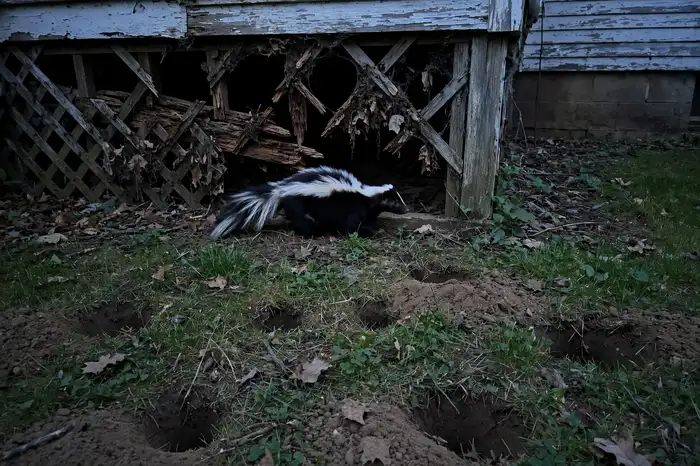
Skunks in your Elyria home
Striped skunks are built for the edges of an Elyria neighborhood: they patrol lawns at night for grubs and insects, and by day they want a dark, dry hole close to the food. The space under a porch, deck or shed — especially on older in-town homes where the skirting has a gap or the lattice has rotted at ground level — is exactly that hole. One skunk under a porch is a smell problem waiting for a dog to trigger it; a mother under there in spring is a family, and the problem compounds.
Skunks also follow the river. The Black River banks and the wooded lots behind Elyria's subdivisions give them den sites and cover, and they work outward into yards from there. The signs are distinctive once you know them: shallow cone-shaped holes dug in the lawn overnight, a faint musk that comes and goes, and — when one is living under the house — a smell that strengthens in the evening as it wakes up and moves.
The Ohio rule for skunks: no relocation
As with raccoons, Ohio law is direct: skunks are listed in OAC 1501:31-15-03(E)(3), so a captured skunk must be released on site or euthanized — it cannot be trapped and let go in a field across the county. Skunks are also one of Ohio's main rabies-vector species, which is the reason behind the rule. Our crew therefore works the problem at the structure: exclusion that lets a skunk leave a den space and not return, careful handling where the law requires it, and steel screening that ends the den for good. Anyone offering to relocate a skunk for you in Ohio is offering something the state forbids.
Where Elyria skunks den
Under porches first — the older the porch, the better the odds, because skirting and lattice fail at ground level where nobody looks. Under decks built low to the ground, under sheds set on skids, and in the occasional groundhog burrow a skunk adopts as a ready-made apartment. In winter, several skunks may share a den through the coldest weeks, which is why a faint winter smell can suddenly become a serious one on the first warm evening when the whole household wakes up at once.
Spray: prevention beats cleanup
Almost every bad skunk story starts with a dog. A skunk under a porch can coexist quietly for weeks until a curious dog corners it at the den mouth, and then the spray is in the yard, on the dog, and drifting through every open window and the basement. Skunks warn first — stamping, turning, tail up — but a dog rarely reads it. Until the den is cleared, keep dogs leashed in the yard after dark and close pet doors at night. After a spray event, our crew can treat the den area; the practical priority is still getting the animal out and the space screened so it does not repeat.
Spring is skunk season
Skunks breed in late winter, and by spring the complaints peak: mothers denning under structures with young, males wandering and spraying during the mating weeks, and every skunk in the county more active as the ground thaws and grubs become available. A smell that starts in February or March is worth a call then, not after the litter is born under the porch. Fall matters too — skunks feed heavily to fatten for winter and choose their winter dens, so screening a known den space in autumn prevents the cold-weather version of the problem.
Screening the den shut
Removal without closure is a short reprieve: a good den under a porch will be re-let to the next skunk, sometimes within the season. The lasting fix is buried steel screening around the porch, deck or shed — mesh trenched into the ground and bent outward underground so a digging animal hits an apron it cannot get under. Our crew installs it after the space is confirmed empty, including checking for young in spring. Screening is also the answer for the homeowner who has no skunk today but a porch gap and a river at the end of the street.
Lawn digging and what it means
The cone-shaped holes a skunk digs hunting grubs are mostly cosmetic and fill back in, but a yard being worked nightly is information: skunks are feeding there, and a den is probably close. Grub treatment alone rarely ends visits, because skunks eat widely — insects, fallen fruit, garbage, pet food. What ends them is removing the den option and the easy food: secure trash, feed pets indoors, and screen the under-structure spaces.
Common skunk questions in Elyria
A skunk is living under my Elyria porch — what do I do?+
Can you trap and relocate the skunk somewhere rural?+
My dog got sprayed — will it happen again?+
Why do I smell skunk in my basement in winter?+
Do skunks carry rabies in Ohio?+
How much does skunk removal cost in Elyria?+
Other Elyria problems that come with skunks
Our wildlife crew handles these closely related problems — the ones that most often turn up with a skunk issue.
Got more than skunks in Elyria?
Skunks are rarely the only thing using an attic or yard in Elyria. See everything we handle locally on the Elyria wildlife removal hub, or jump to Ohio wildlife removal.
Serving all of Lorain County
Elyria is one part of Lorain County. See wildlife removal in Lorain County, OH for the county-wide picture — the animals we get called about most, and the other towns we cover.
One call to your Elyria skunk crew
The longer skunks stay in the attic, the more they chew and the bigger the cleanup. Call us and tell us about the job — we will confirm the local crew for your county before any work starts.
- Local to Lorain County. ODNR-compliant handling — call to ask about licensing and insurance.
- Humane exclusion. One-way doors and steel sealing, not poison.
- Done right. Removal, exclusion and cleanup.