Squirrel Removal in Cleveland, OH
Running and scratching overhead that starts with the first cold snap? In Cleveland that is the sound of fall — squirrels moving into older attics for the winter through gaps the last few winters opened. Call us and tell us about the job — we will confirm the local crew for your county before any work starts.
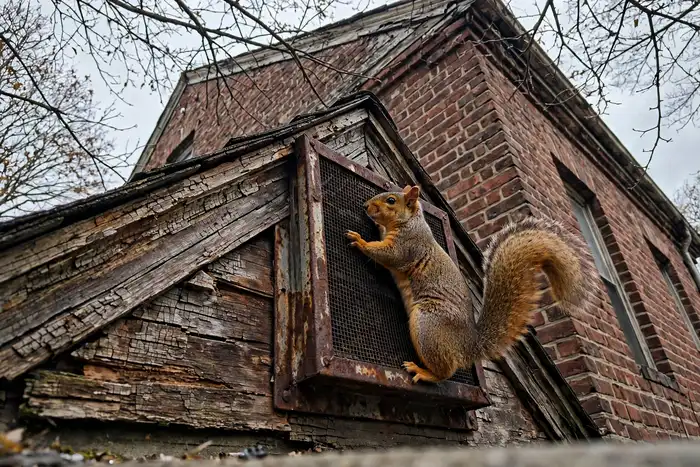
Squirrels in your Cleveland home
Cleveland's squirrel season has a date on it, even if it moves a little each year. Through summer, gray squirrels are content in the big street trees that shade the older neighborhoods. When the nights turn cold, they start testing houses — and a century of freeze and thaw has left most older roofs with something to test: a lifted soffit corner, a gable vent with rusted screening, flashing around a chimney that no longer sits tight. A squirrel needs only a small opening and a place to stand while it works.
Once inside, a big old Cleveland attic suits them well. Tall colonials and brick doubles have deep, quiet roof spaces, often with older insulation they shred for nesting. The chewing is the real problem — wiring, wood and ductwork all get gnawed — and in a house that may still carry aging wiring, chewed insulation off a wire is not something to leave until spring.
Fall is when Cleveland squirrels move in
Attic calls climb sharply in fall because squirrels are settling in for winter, not just passing through. A summer squirrel may explore and leave; a fall squirrel is choosing a den it intends to keep for months, and it will defend and repair that choice. That is why a noise that starts in October rarely resolves on its own, and why sealing in early fall — before the push — is the cheapest squirrel work there is in this city.
Gray squirrels by day, flying squirrels by night
When you hear the noise helps identify the animal. Gray squirrels are busiest in the morning and again late in the day. Noise that begins after dark and runs in bursts through the night often means flying squirrels, which are genuine attic animals in northeast Ohio and travel in small groups. Flying squirrels fit through much smaller gaps than grays, so the sealing standard is tighter — finding one small opening matters as much as finding the obvious one.
How they get into an older Cleveland roof
The entries follow the freeze-thaw map: soffits pried at the corners, fascia softened where gutters have overflowed for years, gable vents whose screening has rusted, and the joint where a porch roof meets the main wall. On brick doubles, squirrels climb the brick itself or a downspout; cutting branches back helps but does not seal a house a squirrel can climb. Our crew inspects the whole roofline, because an old house usually has more than one candidate opening.
Babies, wiring and why waiting costs more
Squirrels raise litters in late winter and again in late summer, and sealing a mother out while young are still in the attic means she will chew a new entry — often through a worse place than the first. Checking for young comes before any closing. The other cost of waiting is wiring: squirrels chew constantly, and gnawed wiring in an attic full of dry, shredded insulation is a fire risk that grows the longer they stay.
What the pro does: one-way doors, then metal
The standard job is exclusion. Our wildlife crew fits a one-way door over the active entry so squirrels leave to feed and cannot return, confirms the attic is empty and no young remain, then closes every opening with metal — flashing, steel mesh and hardware cloth fitted to survive winter. Openings a squirrel could reopen in wood or foam get metal, full stop. Trimming limbs off the roof is a useful extra, never the fix itself.
Keeping the next squirrel out
A sealed house stays sealed if the weak points are watched: gutter overflows that rot fascia, vent screens that rust, and the porch-roof joint that opens as it ages. A quick look at the roofline each fall, before the entry peak, catches most of it. Bird feeders tight against the house also concentrate squirrels at the walls all winter — moving them out into the yard lowers the pressure on the house itself.
Common squirrel questions in Cleveland
I hear scratching in my Cleveland attic in the morning — is it squirrels?+
Why do squirrels only get into my house in the fall?+
Can I just seal the hole where squirrels are getting in?+
Are attic squirrels really a fire risk?+
How much does squirrel removal cost in Cleveland?+
Other Cleveland problems that come with squirrels
Our wildlife crew handles these closely related problems — the ones that most often turn up with a squirrel issue.
Got more than squirrels in Cleveland?
Squirrels are rarely the only thing using an attic or yard in Cleveland. See everything we handle locally on the Cleveland wildlife removal hub, or jump to Ohio wildlife removal.
Serving all of Cuyahoga County
Cleveland is one part of Cuyahoga County. See wildlife removal in Cuyahoga County, OH for the county-wide picture — the animals we get called about most, and the other towns we cover.
One call to your Cleveland squirrel crew
The longer squirrels stay in the attic, the more they chew and the bigger the cleanup. Call us and tell us about the job — we will confirm the local crew for your county before any work starts.
- Local to Cuyahoga County. ODNR-compliant handling — call to ask about licensing and insurance.
- Humane exclusion. One-way doors and steel sealing, not poison.
- Done right. Removal, exclusion and cleanup.