Raccoon Removal in Cleveland, OH
Heavy thumping overhead, like something walking rather than scurrying? In Cleveland that is usually a raccoon — often a mother in an uncapped chimney or a big old attic, close to lakefront and alley food. Call us and tell us about the job — we will confirm the local crew for your county before any work starts.
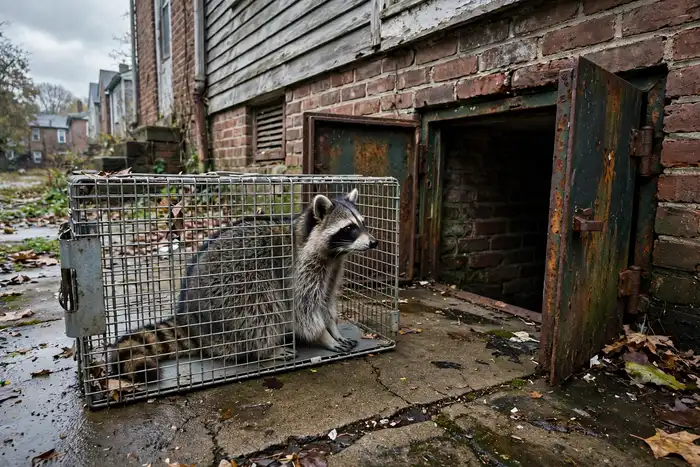
Raccoons in your Cleveland home
Raccoons thrive in Cleveland because the city feeds them and houses them at the same time. Alleys, unsecured trash and the rich shoreline along Lake Erie handle the food. The housing handles the rest: generations of homes with uncapped masonry chimneys, tall attics and porch roofs a strong animal can climb and peel at. A female raccoon in spring is looking for exactly what an unused flue offers — dark, dry, off the ground and warm.
The sound gives her away. A raccoon moves like a small dog overhead, and a litter adds chattering and chirping. What shapes the job is Ohio law and biology together: kits cannot leave on their own for weeks, and a raccoon cannot legally be relocated in this state. That combination is why raccoon work here is planned, not improvised with a hardware-store trap.
Ohio law: raccoons are not relocated
Under Ohio Administrative Code 1501:31-15-03(E)(3), a captured raccoon must be released on the same property or humanely euthanized — taking one out to the country and letting it go is unlawful. The rule exists because raccoons are a leading rabies vector, and moving them moves disease; northeast Ohio sits in the oral rabies vaccine baiting area working to hold raccoon-variant rabies back. Our crew leads with exclusion — one-way doors and sealing that let a raccoon leave the structure on its own where that is possible — and handles any captured animal exactly as Ohio rules require. Anyone who offers to relocate a Cleveland raccoon is offering something illegal.
The uncapped chimney on an older home
Many Cleveland colonials and doubles still have original chimneys serving fireplaces that are rarely lit. A cold, uncapped flue is a ready den, and a female will raise kits on the smoke shelf above the damper. Soot-darkened paw prints around the flue, debris in the firebox and chattering from the chimney are the usual signs. Capping a chimney before the family is out traps them inside the flue, so the cap is the last step of the job, never the first.
Finding the kits before anything closes
Raccoon litters arrive in spring, and for their first weeks the kits cannot climb or follow their mother out. If she is excluded or caught and the entry is sealed, the kits die in the attic or chimney — trading a raccoon problem for a dead-animal problem in the hardest place to reach. Our crew locates kits with cameras and inspection before anything is closed, and the removal plan is built around accounting for every one of them.
The latrine in a big old attic
Raccoons use one spot as a latrine, and in a spacious older attic that spot can grow for a long time before anyone notices. The droppings can carry raccoon roundworm, whose eggs persist and are a genuine health concern, particularly for children. A raccoon job therefore includes removing contaminated material and sanitizing the area. Full attic insulation replacement is sometimes sold as automatic; often only the affected area needs to come out, and a straight answer about which is part of the work.
Sealing against an animal that can pry
A raccoon that opened a soffit or lifted vent screening once will test the repair. Entries get closed with heavy-gauge metal: a proper chimney cap, reinforced vent covers, and flashing at porch-roof seams and roof returns. Wood and foam do not hold a raccoon. On a brick double, the crew also checks where the two halves and the shared chimney meet, because those junctions age into gaps.
Food around a Cleveland house
Sealing works best when the yard stops advertising. Trash cans with lids that actually latch, pet food brought in at night, and grills and bird seed kept away from the house all lower the odds the next raccoon investigates the roofline. Near the lake and along creek corridors the background pressure never reaches zero — which is exactly why the sealing has to be metal and complete.
Common raccoon questions in Cleveland
There is a raccoon in my Cleveland attic — what should I do?+
Can you trap a raccoon and release it in the country?+
I hear chattering in my chimney — is that baby raccoons?+
A raccoon is out in daylight and acting strangely — what do I do?+
How much does raccoon removal cost in Cleveland?+
Other Cleveland problems that come with raccoons
Our wildlife crew handles these closely related problems — the ones that most often turn up with a raccoon issue.
Got more than raccoons in Cleveland?
Raccoons are rarely the only thing using an attic or yard in Cleveland. See everything we handle locally on the Cleveland wildlife removal hub, or jump to Ohio wildlife removal.
Serving all of Cuyahoga County
Cleveland is one part of Cuyahoga County. See wildlife removal in Cuyahoga County, OH for the county-wide picture — the animals we get called about most, and the other towns we cover.
One call to your Cleveland raccoon crew
The longer raccoons stay in the attic, the more they chew and the bigger the cleanup. Call us and tell us about the job — we will confirm the local crew for your county before any work starts.
- Local to Cuyahoga County. ODNR-compliant handling — call to ask about licensing and insurance.
- Humane exclusion. One-way doors and steel sealing, not poison.
- Done right. Removal, exclusion and cleanup.