Wildlife Removal in Cleveland, OH
Cleveland houses were built for a colder, harder century — brick doubles and colonials with deep basements, tall attics and chimneys that have seen a hundred winters. Animals read that housing stock as shelter, and they usually come in low, at the foundation, before they ever reach the roof. Call us and tell us about the job — we will confirm the local crew for your county before any work starts.
Why Cleveland homes see the wildlife they do
Start in the basement. In much of Cleveland, that is where a wildlife problem actually begins. The city's housing is old — brick doubles, colonials and foursquares raised when coal chutes, laundry tubs and root-cellar corners were normal — and the foundations under them have had generations to settle, crack and open up around pipes and wires. A gap at the sill, a loose cleanout cover, a mortar joint gone soft: to a rat, a skunk or a mouse, that is a front door, and it stays dry and hidden all winter.
From the basement, the rest of the house is connected. Old framing, plumbing chases and chimney voids give animals a way to travel upward, which is why a Cleveland homeowner may hear scratching in a first-floor wall, find droppings by the furnace, and later discover squirrels nesting in an attic two stories above the hole they actually used. Lake Erie shapes the other end of the pattern — the lakefront and the river flats hold rats, raccoons and water-loving wildlife close to neighborhoods that sit only a few streets inland.
Our wildlife crew works a Cleveland house as one connected system: find where animals are entering at the foundation and the roofline, remove them the way Ohio law requires, seal the openings with metal and masonry-grade materials that can take freeze and thaw, and clean up what they left behind. Pulling an animal out without closing the basement and attic entries rarely holds here — the next one already knows the route.
The basement is the front door in an old Cleveland house
In newer construction the attic gets most of the attention. In Cleveland's older neighborhoods the inspection has to start below grade. Stone and block foundations shift a little every winter, utility lines were run through walls long before modern sealing, and basement windows on older homes often sit in wells that collect leaves and hold moisture against the frame. Each of those is a place an animal can work at, night after night, out of sight.
What lives low tends to stay low at first. Norway rats burrow along foundation walls and come in where a drain or water line passes through. Skunks and opossums slip into the sheltered space under a porch that connects to the basement. Mice need almost nothing — a gap around a pipe is enough — and once inside they follow the warm runs upward. If you are hearing noises and cannot place them, or finding droppings near the furnace or laundry area, the basement is the first place our crew looks, not the last.
Sealing a foundation is different work from sealing a roofline. It can mean repointing, metal flashing set into mortar, screened vents that still let the basement breathe, and covers fitted to wells and chutes that are no longer used. Done in materials that flex a little with the seasons instead of cracking, it holds through the winters that opened the gaps in the first place.
Freeze, thaw, and a roofline that opens a little more each year
Cleveland winters do quiet damage to the top of a house. Water gets into a small crack at a chimney flashing or a soffit joint, freezes, and pries it wider. Lake-effect snow sits heavy on older roofs, melts on a mild afternoon, and refreezes at the eaves at night. By spring, a gap that was too small for anything can fit a squirrel, and a vent screen that rusted through at one corner can fit a bat.
That cycle is why fall is the peak season here. As the first real cold arrives, squirrels, raccoons and mice push hard to get inside for the winter, and they test every weak point the last few winters created. A house that was quiet for years can suddenly have animals in the attic in October — not because anything about the animals changed, but because the roofline finally opened enough.
The practical answer is timing and material. Sealing in fall, before the push, with metal that animals cannot chew and that will not split when it freezes, prevents most winter attic problems. Sealing with foam or thin wood in a Cleveland winter is usually a short-lived repair.
Lake Erie, the river flats, and rat pressure in older housing
The lake is part of Cleveland's wildlife picture year-round. The shoreline, marinas, breakwalls and the low ground along the river give raccoons, rats and other animals food, water and cover within easy range of residential streets. Older housing near the lake and in the city's older districts carries the heaviest Norway rat pressure: heavy, ground-dwelling rats that burrow, travel along foundations and alleys, and enter low rather than climbing to the roof.
Rat work in an older Cleveland house is therefore mostly basement and foundation work, paired with cleaning up what draws them — unsecured trash, pet food, bird seed stored in a garage, and clutter along the foundation where they can move unseen. Bait by itself does not finish a rat problem in housing like this, and a poisoned rat dying inside an old wall creates a second problem on top of the first.
Further from the water the cast changes — more squirrels and raccoons in the tree-lined streets, more skunks and groundhogs where yards back onto green space — but the principle is the same: the house and its immediate surroundings decide which animals show up.
Ohio rules that shape the work: bats, rabies and relocation
Ohio regulates this work closely, and honest Cleveland copy should say so. Wildlife removal for hire requires an ODNR Commercial Nuisance Wild Animal Control Operator license under Ohio Revised Code section 1531.40. Bats have their own calendar: exclusion is not allowed from May 16 through July 31 when five or more bats are present, because pups cannot fly yet, or from October 15 through March 31, when big brown bats may be hibernating inside the attic itself — in either window only with prior written ODNR permission. The open windows are April 1 to May 15 and August 1 to October 15, which is why a summer bat call here usually means an inspection now and a scheduled exclusion as soon as the window opens.
Rabies shapes the rest. Raccoons, skunks, foxes and bats are Ohio's main rabies vectors, and bats are the most frequently confirmed species in the state. Northeast Ohio also sits in the oral rabies vaccine baiting area aimed at keeping raccoon-variant rabies from spreading west — one more reason a raccoon acting strangely in daylight is a call, not a close look. Under Ohio Administrative Code 1501:31-15-03(E)(3), a captured raccoon, skunk or opossum cannot be relocated: the lawful outcomes are release on the same property or humane euthanasia. Our crew leads with exclusion — one-way doors and sealing that let an animal leave on its own where that is possible — and handles the rest exactly the way Ohio rules require.
Wildlife we remove in Cleveland
From a rat burrow at a lakefront foundation to big brown bats in a tall old attic, these are the calls Cleveland homeowners make most.
🐿️ Squirrels
The fall attic-entry peak is mostly squirrels. Gray squirrels work the freeze-thaw gaps at soffits and gable vents on Cleveland's older roofs, and flying squirrels come in at night through smaller openings. Chewed wiring in an old attic is the urgent part. See our full Cleveland squirrel removal guide →
🦝 Raccoons
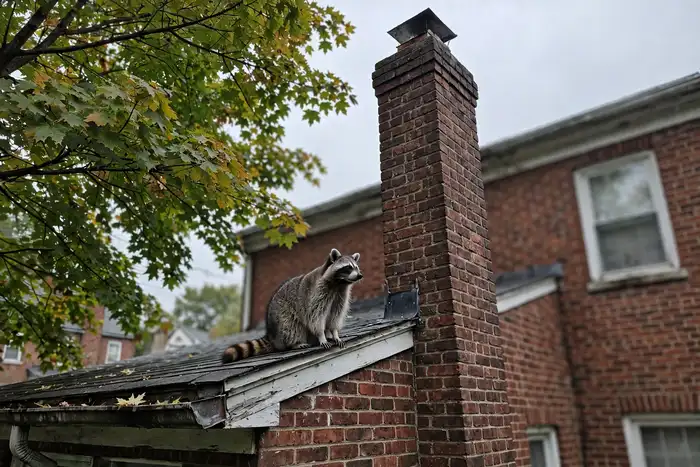
Uncapped chimneys on colonials and brick doubles are classic Cleveland raccoon nurseries, and lakefront food keeps them close. A rabies-vector species that Ohio law does not allow to be relocated — exclusion-first, kits accounted for, and the latrine cleaned out. See our full Cleveland raccoon removal guide →
🦇 Bats
Big brown bats fill the tall attics of older Cleveland houses — and hibernate in some of them all winter. Exclusion is legal only April 1–May 15 and August 1–October 15 without written ODNR permission, so timing the call matters. See our full Cleveland bat removal guide →
🦨 Skunks
The sheltered space under a front porch, often connected to the basement, is the usual Cleveland skunk den. A rabies vector that cannot be relocated under Ohio law, so the work is careful on-site handling plus screening the porch so the next one cannot move in. See our full Cleveland skunk removal guide →
🦫 Groundhogs
Groundhogs burrow under porches, sheds and foundation edges where Cleveland yards meet green space, then vanish into hibernation from late fall to late winter. Spring emergence is when fresh digging shows the burrow is occupied again. See our full Cleveland groundhog removal guide →
🐾 Opossums
Opossums den in garages, under porches and in basement window wells, and they wander in from the lakefront and creek corridors at night. Ohio law does not allow relocation, so removal is paired with closing the shelter they were using. See our full Cleveland opossum removal guide →
🐿️ Chipmunks
Chipmunks tunnel along foundations, front stoops and porch edges, undermining the soil right against older Cleveland houses. Small animals, but a busy colony moves a surprising amount of dirt. See our full Cleveland chipmunk removal guide →
🐀 Rats, mice & voles
Norway rats in older housing and near the lake, house mice pouring in at first frost, and voles carving trails under the snow that show up at melt. In Cleveland the rodent job is a foundation and basement job first. See our full Cleveland rodent removal guide →
🐍 Snakes
Almost always harmless — garter snakes, rat snakes and, near the water, northern watersnakes. The honest Cleveland snake call is identification and removal from a basement or garage, not fear. See our full Cleveland snake removal guide →
🪰 Dead animals
A smell building in one room, often in winter, usually means something died in a wall, the attic or down in the basement. Our crew locates it, removes it and cleans the area, then closes the opening it used. See our full Cleveland dead animal removal guide →
Animal-specific help in Cleveland
Deep, local guides for the problems we get called about most — with our wildlife crew behind every one.
How to get help in Cleveland
Tell us what you're hearing
Scratching in the attic, a snake by the porch, holes in the yard — call with your problem and your Cleveland address.
We connect you locally
Call us and tell us about the job — we will confirm the local crew for your county before any work starts.
They solve it — for good
Inspection, humane removal, full exclusion and cleanup — handled by our wildlife crew, following Ohio rules.
Common wildlife removal questions in Cleveland
Who do I call for wildlife removal in Cleveland?+
Why do animals keep getting into my Cleveland basement?+
When is the busiest season for wildlife in a Cleveland house?+
Can bats be removed from my Cleveland attic in summer or winter?+
Will you relocate a raccoon or skunk out to the country?+
How much does wildlife removal cost in Cleveland?+
Serving all of Cuyahoga County
Cleveland is one part of Cuyahoga County. See wildlife removal in Cuyahoga County, OH for the county-wide picture — the animals we get called about most, and the other towns we cover.
One call to your Cleveland wildlife crew
Whether it's squirrels in an older in-town attic or a raccoon in a new subdivision crawlspace, the fastest fix is our wildlife crew, who knows Cuyahoga County wildlife. Call us and tell us about the job — we will confirm the local crew for your county before any work starts.
- Local to Cuyahoga County. ODNR-compliant handling — call to ask about licensing and insurance.
- One company, one call. Call us and tell us about the job.
- Done right. Removal, exclusion and cleanup.