Dead Animal Removal in Chardon, OH
An odor that was nowhere in February blooming in one room as the snow finally retreats, with flies at the window? In Chardon, that sequence usually means an animal died inside the structure during the long winter — and the thaw is delivering the news. Call us and tell us about the job — we will confirm the local crew for your county before any work starts.
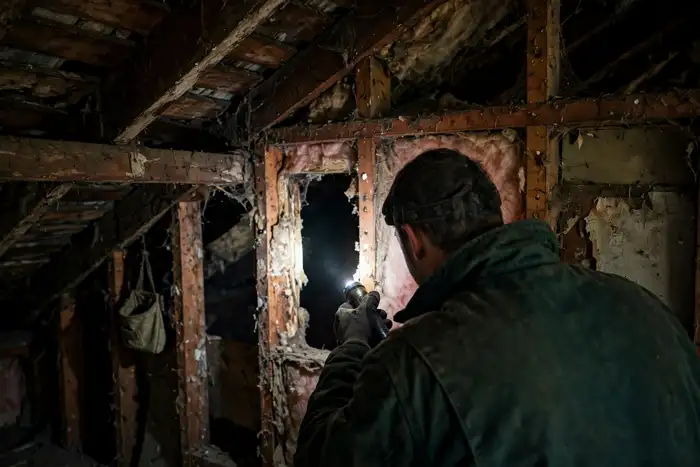
A dead animal in your Chardon walls, attic or porch den
Chardon owns Ohio's most distinctive dead-animal pattern: the thaw reveal. Animals den through the snowbelt winter in attics, chimney voids, wall cavities and porch dens, and the ones that die there are preserved by the cold — sometimes for months — with little odor to report. Then a warm spell or the spring melt arrives, decomposition resumes all at once, and a household gets a strong, sour smell in one part of the house with no recent noises to explain it.
The work is forensic and physical in equal parts: reconstruct from the odor pattern, fly activity and the house's entries where the animal lies; remove it and the fouled material around it with as little opening of walls as the location allows; treat the area; and close the route the animal used, so next winter's tenant list does not end the same way.
Where winter tenants die in a Chardon house
The catalogue follows the denning habits. Squirrels die in attics and wall runs. Mice and rats die in wall voids and under basement floors, frequently after eating poison. A raccoon can die in a chimney or a spacious attic. Skunks and opossums die in porch and basement dens, and ground-level animals occasionally die in crawlspaces. Matching the part of the house, the odor's timing and any noises heard back in the fall narrows the search to a likely species and a likely cavity before anyone opens anything.
Why the thaw announces what winter hid
Cold is a preservative. A January death in a wall can stay nearly silent through February, then surge during the first real thaw and surge again with each warm spell, because decomposition is resuming in installments. Households find this maddening and confusing — the smell comes and goes with the weather — but to a crew it is a signature: it dates the death, suggests the animal denned for winter rather than wandering in recently, and points the search at dens, not random wall space.
The poison thread running through wall deaths
Many in-wall carcasses trace back to rodent bait — set out by the household, a neighbor or a previous service. A poisoned mouse or rat retreats to its nest inside a wall, under a floor or deep in insulation, and dies precisely where it cannot be reached without a search. If any baiting happened on the property over the winter, say so when you call: it strongly suggests the species, and it starts the conversation about sealing and trapping that makes bait unnecessary.
Finding it without dismantling the house
Location work is comparative: odor intensity room by room and floor by floor, the windows where flies congregate, the known cavities and chases in an older village home, and where snow sat against the walls. From that evidence the search converges, the carcass and heavily contaminated material come out, and the area is cleaned and treated so the source — not a fragrance layered over it — is what ends the smell. Most jobs involve no cutting; where a modest opening is unavoidable it is kept small and placed deliberately.
A note on patching, before anyone cuts
If an opening in a wall or ceiling does prove necessary, know that most wildlife crews do not do plaster or drywall repair — and older Chardon homes often carry original plaster worth a careful patch. Ask before work begins what the job includes, so the repair afterward is a plan rather than a surprise in a finished room.
Sealing the den against next winter
The animal arrived alive, through a foundation gap, a broken vent, a porch opening or an ice-opened roofline joint. With the carcass removed, that route is found and closed in metal, and any porch den involved is screened below grade. In a town where every structure gets auditioned by winter tenants annually, removal without sealing is an appointment to repeat the experience.
Common dead animal questions in Chardon
A terrible smell started in my Chardon house at thaw — what is it?+
How long will the odor last if we just wait it out?+
We heard nothing all winter — how can something be dead in the walls?+
Could this be from the mouse bait we put out in fall?+
How much does dead animal removal cost in Chardon?+
Other Chardon problems that come with dead animals
Our wildlife crew handles these closely related problems — the ones that most often turn up with a dead animal issue.
Got a live animal problem in Chardon too?
The animal that died in your structure entered alive through an opening that is still there — sealing it is the difference between a finished job and a repeat next winter. See everything we handle locally on the Chardon wildlife removal hub, or jump to Ohio wildlife removal.
Serving all of Geauga County
Chardon is one part of Geauga County. See wildlife removal in Geauga County, OH for the county-wide picture — the animals we get called about most, and the other towns we cover.
One call to your Chardon dead animal crew
A carcass in a Chardon wall can perfume a house for weeks, fading and surging with every warm spell until the source is out. Call us and tell us about the job — we will confirm the local crew for your county before any work starts.
- Local to Geauga County. ODNR-compliant handling — call to ask about licensing and insurance.
- Find the source, take it out. Odor mapping and fly activity narrow the search; the carcass and fouled material are removed and the spot treated, rather than the smell being perfumed over.
- Done right. Removal, exclusion and cleanup.