Wildlife Removal in Chardon, OH
Chardon takes more lake-effect snow than anywhere else in Ohio, and its houses take the consequences — roofs loaded and ice-dammed winter after winter, older village homes with tall chimneys and deep attics, and maple woods standing right at the edges of the lots. Wildlife here plans around the snow, and so does good removal work. Call us and tell us about the job — we will confirm the local crew for your county before any work starts.
Why Chardon homes see the wildlife they do
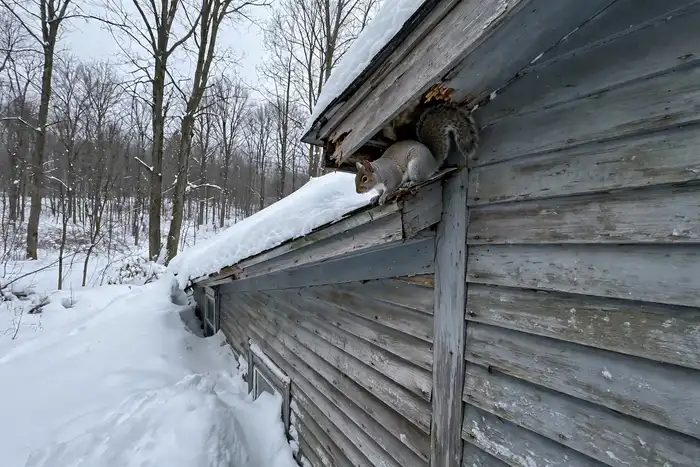
Start with the snow. Chardon sits at elevation in the center of Ohio's snowbelt, where lake-effect bands park over town and drop snow measured in feet while communities a short drive west report a dusting. Season totals here lead the state, and the weight and melt of that snow is a building force: it bends gutters, loads older roofs, dams meltwater behind ice at the eaves and works its way into soffits, flashing and vent joints a little further every winter.
The housing receiving all that weather is classic small-town Ohio — older village homes around the square, farmhouse-era houses on the streets behind it, and, at the edges, homes set into maple woods on lots where the tree line is the property line. Animals move between that woods and those houses as a daily commute. Squirrels den in attics overhanging maples, raccoons raise litters in chimneys, bats colonize the warm upper reaches, and groundhogs and skunks work the yards where lawn gives way to woods.
Our crew reads a Chardon property through its winter first: where snow sat deepest, where ice formed, which roof joints it opened, and what the woods offer on the other side of the wall. Removal follows Ohio rules, young are located before anything is sealed, and exclusion is built in metal rated for snow load country — because a repair that survives a mild winter and fails in a Chardon winter is not a repair.
Snow load and ice dams: how a Chardon roof gets opened
An ice dam is not just a winter nuisance; it is a pry bar. Snow melts on the warm upper roof, runs down to the cold eave, refreezes, and the growing ridge of ice forces water — and then ice itself — under shingles, into soffit joints and behind chimney flashing. Season after season, that cycle lifts corners, rusts vent screens and opens gaps at exactly the places squirrels, bats and mice later use. Chardon simply runs this cycle harder and longer than the rest of Ohio.
The animal season follows the damage season. Openings made by ice over winter get discovered by squirrels testing rooflines in fall, by bats slipping into attics in spring, and by mice at the first frost. Homeowners often blame a sudden fall infestation on bad luck; more often the house had been quietly opened since March. A spring roofline inspection, after the snow finally leaves, is therefore one of the most valuable habits a Chardon homeowner can adopt.
Exclusion materials have to match the climate. Metal flashing and mesh that can carry a snow load, shed ice and flex through freeze-thaw without splitting are the standard here. Light materials that might hold in a gentler county get peeled by ice or gnawed through in a single Geauga winter.
Village homes, tall chimneys and deep attics
Chardon's older houses were built for wood heat and big families: steep roofs, deep quiet attics, masonry chimneys — several of them now serving fireplaces that are lit rarely or not at all. To a raccoon in April, an unused flue is a nursery with a view. To a colony of big brown bats, a tall attic under a sun-warmed roof is a summer roost that stays warm late into the evening. To squirrels, the whole assembly — porch roofs, dormers, gable vents — is a staircase with rooms at the top.
These houses also hide problems well. A latrine can grow in a far attic corner, a bat colony can stain a gable for a season before droppings are noticed at ground level, and a squirrel's wiring work happens far from any room in daily use. That is why an attic inspection in a Chardon village home is a deliberate, whole-space check rather than a flashlight glance through the hatch.
The same age shows at ground level: fieldstone and block foundations with softened mortar, root cellars, crawlspaces and porches whose undersides have never been screened. Skunks and opossums read that level of the house as shelter, and the crew reads it the same way — from underneath up.
Maple woods at the lot line
Chardon is maple country — sugar maples in the yards, tapped woods on the edges of town, and deep forest lots a short walk from the square. That woods is not scenery to wildlife; it is home base. Flying squirrels glide in from it at night. The everyday commuters are gray squirrels, raccoons, opossums, skunks, chipmunks and deer mice, all treating the narrow lawn between woods and house as a corridor rather than a barrier.
Practical consequences follow. Bird feeders in a maple-shaded yard draw a crowd. A woodpile stacked against the house gives rodents and snakes covered travel right to the foundation. Fallen fruit, garden beds at the woods edge and brush piles all pay animals to linger near the walls. Trimming the commute — feeders out in the open, wood stored away from the house, a mowed strip at the tree line — does not empty the woods, but it changes which houses get inspected nightly.
Where lots run deep and wooded, ground-level shelter multiplies too: brush, stone piles, old outbuildings and sheds at the back of the lot. A Chardon inspection walks that back lot, because an animal problem at the house sometimes has its headquarters fifty yards behind it.
Ohio rules in snowbelt country: licenses, bat dates and the on-site rule
Anyone removing nuisance wildlife for hire in Ohio must hold the ODNR Commercial Nuisance Wild Animal Control Operator license established by Ohio Revised Code section 1531.40. Ask about that license and about insurance before a crew starts. The license carries the state rulebook with it, and in Geauga County three parts of that rulebook come up on nearly every job.
First, bats. Exclusion of a colony — five or more bats — is prohibited from May 16 through July 31, the maternity weeks when pups cannot fly, and from October 15 through March 31, when big brown bats may be hibernating inside the attic itself, unless written permission from the Chief of the Division of Wildlife comes first. Chardon's long cold season makes the hibernation window especially real here. Lawful exclusion runs April 1 to May 15 and August 1 to October 15, and smart scheduling treats those dates the way farmers treat planting dates.
Second, rabies. Raccoons, skunks, foxes and bats are the species Ohio names as its principal rabies carriers, which is one reason a strange-acting raccoon or a bat in a bedroom is a distance-and-a-phone-call situation. Third, the on-site rule: Ohio Administrative Code 1501:31-15-03(E)(3) does not permit a caught raccoon, skunk or opossum to be hauled away and set loose elsewhere — it stays on the property where it was caught or is humanely euthanized. Our wildlife crew therefore leads with exclusion, one-way doors and complete sealing, so animals leave a structure under their own power wherever that can be arranged, and handles the remainder as the rulebook directs.
Wildlife we remove in Chardon
From voles working under three feet of snow to bats hibernating in a village attic, these are the calls Chardon homeowners make through the long Geauga year.
🐿️ Squirrels
Maple-tree squirrels by day and flying squirrels gliding in from the woods by night — Chardon attics host both, entering through ice-lifted soffits and rusted gable vents. The fall move-in here starts early and the chewing reaches old wiring fast. See our full Chardon squirrel removal guide →
🦝 Raccoons
Village chimneys that no longer serve a fire are Chardon's raccoon nurseries each spring, and the surrounding woods keep the mothers well fed. Ohio bars carrying a raccoon off to release elsewhere, so exclusion, accounted kits and latrine cleanup make the job. See our full Chardon raccoon removal guide →
🦇 Bats
Big brown bats summer in warm Chardon attics and a share of them hibernate in the same houses through the snowbelt winter. State closure dates — maternity in early summer, hibernation from mid-October — decide when exclusion can legally run. See our full Chardon bat removal guide →
🦨 Skunks
Skunks den under porches, decks and sheds in town and along the wooded lot edges, sleeping through the deepest cold and emerging to mate in late winter. A rabies vector Ohio does not allow to be moved off a property — quiet exclusion and buried screening answer it. See our full Chardon skunk removal guide →
🦫 Groundhogs
Groundhogs burrow under porches, sheds and outbuildings where yards meet open or wooded ground, then hibernate longer here than almost anywhere in Ohio. Fresh spring dirt after the snow leaves means the system is awake. See our full Chardon groundhog removal guide →
🐾 Opossums
Opossums wander in from the woods at night and spend days under porches, in garages and in sheds at the back of deep lots. Ohio law keeps a caught opossum on its own property, so the lasting work is closing the shelter it selected. See our full Chardon opossum removal guide →
🐿️ Chipmunks
Chipmunks work the stone and block foundations of older village homes and the retaining edges of wooded lots, moving soil away from footings a cheekful at a time. Maple-seed and feeder spill at the wall keep the colony fed. See our full Chardon chipmunk removal guide →
🐀 Rats, mice & voles
House mice flooding in ahead of a long winter, Norway rats in older in-town housing, and voles spending months under Chardon's deep snowpack, carving trails and girdling shrubs that only show at melt. Three rodents, three plans. See our full Chardon rodent removal guide →
🐍 Snakes
Garter snakes in the garden, rat snakes in barns, garages and basements after mice, and milk snakes around stone foundations. Geauga County snakes are a near-uniformly harmless cast — the job is identification and, indoors, calm removal. See our full Chardon snake removal guide →
🪰 Dead animals
In snow country, animals that die in walls, attics and porch dens in January often announce themselves at the spring thaw, when odor and flies finally travel. Finding and removing the source ends a smell that air fresheners only decorate. See our full Chardon dead animal removal guide →
Animal-specific help in Chardon
Deep, local guides for the problems we get called about most — with our wildlife crew behind every one.
How to get help in Chardon
Tell us what you're hearing
Scratching in the attic, a snake by the porch, holes in the yard — call with your problem and your Chardon address.
We connect you locally
Call us and tell us about the job — we will confirm the local crew for your county before any work starts.
They solve it — for good
Inspection, humane removal, full exclusion and cleanup — handled by our wildlife crew, following Ohio rules.
Common wildlife removal questions in Chardon
Who do I call for wildlife removal in Chardon?+
How does all this snow actually lead to animals in my house?+
Can bats be excluded from my Chardon attic in winter?+
Will you take a trapped skunk or raccoon out to the woods and release it?+
My lot backs onto woods — is wildlife just unavoidable?+
How much does wildlife removal cost in Chardon?+
Serving all of Geauga County
Chardon is one part of Geauga County. See wildlife removal in Geauga County, OH for the county-wide picture — the animals we get called about most, and the other towns we cover.
One call to your Chardon wildlife crew
Whether it's squirrels in an older in-town attic or a raccoon in a new subdivision crawlspace, the fastest fix is our wildlife crew, who knows Geauga County wildlife. Call us and tell us about the job — we will confirm the local crew for your county before any work starts.
- Local to Geauga County. ODNR-compliant handling — call to ask about licensing and insurance.
- One company, one call. Call us and tell us about the job.
- Done right. Removal, exclusion and cleanup.