Bat Removal & Exclusion in Chardon, OH
Droppings collecting below a gable peak through summer, then silence all winter that may not mean the bats left? In Chardon — where winter is longest — big brown bats often spend the whole year in the same older house, and Ohio law fixes when they can be shown out. Call us and tell us about the job — we will confirm the local crew for your county before any work starts.
Bats in your Chardon home
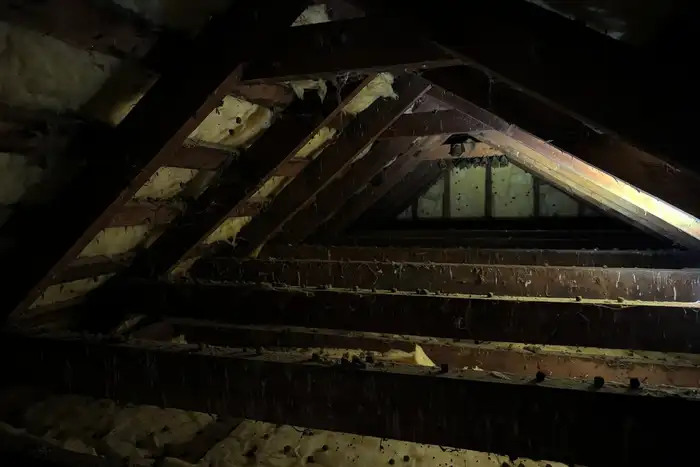
Chardon's bat is the big brown bat, and the town's older houses serve it in both halves of its year. In summer, a maternity colony wants a hot, high roost, and an attic under a dark village roof delivers heat a tree hollow cannot match. In winter, that same species wants the opposite — cold, stability and quiet — and finds it in the wall voids and attic corners of the very house it summered in. A Chardon colony is often not a visitor at all. It is a year-round tenant on a seasonal schedule.
Ohio law is built around exactly that schedule. Exclusion — letting bats leave through one-way valves and sealing them out — is the only lawful method, it must be done by a licensed operator when done for hire, and the state's closed seasons protect the two moments a colony cannot move: when pups cannot fly, and when adults are hibernating. Geauga County's long winter gives the second closure unusual weight here.
The closed seasons, and why winter is one of them
Ohio Administrative Code 1501:31-15-03(H)(5) prohibits bat exclusion from May 16 through July 31 when five or more bats are present — maternity season, when the young cannot fly — and from October 15 through March 31, the hibernation months. Either closure yields only to prior written permission from the Chief of the ODNR Division of Wildlife. The working windows are April 1 to May 15 and August 1 to October 15. In Chardon, where snow can still be falling in April, that spring window deserves planning the winter before, not improvisation once it opens.
Hibernating in the house they summered in
Outdoor silence in January tells you nothing about a Chardon attic. Big brown bats overwinter inside Ohio buildings routinely, tucked singly into quiet voids, metabolism slowed to a whisper. A homeowner who seals the gable vents in February, believing the colony migrated, can entomb the very bats the hibernation closure exists to protect. A winter bat job therefore begins with an inspection that looks for sleeping bats — carefully, and without disturbing them — before any talk of sealing dates.
Entries built by ice and age
A bat needs a slit, not a hole — roughly finger-width. Chardon's ice works those slits open at gable vents with rotted screens, at chimney flashing, behind corner boards and shutters and along porch-roof seams. Brown staining at a joint and droppings accumulating on the ground, a porch or snow beneath one spot mark which gaps are active. Droppings in fresh snow under a vent, noticed on a winter walk-around, are a genuinely useful Chardon clue that most climates never offer.
Guano over seasons, and a bat in the bedroom
A colony that summers in an attic for years leaves guano measured in buckets under the roost; dried droppings can carry the fungus associated with histoplasmosis, so cleanup is protective-equipment work. Bats are also the animal most often confirmed rabid in Ohio. An attic colony is not a household emergency — but a bat found in a room where someone slept is a health question: do not touch it, do not simply free it outside, close the room and ask your doctor or the Geauga County health authorities for guidance, since the bat may need testing.
How a lawful exclusion is staged
When a window opens, the choreography is exact. Every gap on the house is sealed except the colony's working entries; those receive one-way valves that let bats pour out at dusk and bar the return. The crew then verifies — by watch and by inspection — that the roost has emptied before the valves come off and the last entries are sealed for good. On a tall, many-gabled village house, expect multiple visits; this is a process measured in evenings, not hours.
What never works, in any season
Sealing the entry on sight is the classic error — with bats home, they die in the walls or blunder into the rooms. Mothballs, aerosol sprays and ultrasonic gadgets do not persuade a colony to leave and only add odor or false confidence. The legal sequence is also the effective one: inspect, wait for the window if the calendar demands it, exclude one-way, then seal — and schedule early, because every bat household in the snowbelt wants the same April and August weeks.
Common bat questions in Chardon
How are bats removed from a Chardon attic, legally?+
Why can nothing be done in the middle of a Chardon winter?+
A bat got into a bedroom overnight — what do we do?+
My attic went quiet in October — did the colony leave?+
How much does bat removal cost in Chardon?+
Other Chardon problems that come with bats
Our wildlife crew handles these closely related problems — the ones that most often turn up with a bat issue.
Got more than bats in Chardon?
The ice that works a Chardon roofline open for bats has usually made other openings too — squirrels and mice use the same map. See everything we handle locally on the Chardon wildlife removal hub, or jump to Ohio wildlife removal.
Serving all of Geauga County
Chardon is one part of Geauga County. See wildlife removal in Geauga County, OH for the county-wide picture — the animals we get called about most, and the other towns we cover.
One call to your Chardon bat crew
In snowbelt country, the costly bat mistakes happen in winter and midsummer — sealing in hibernating bats or flightless pups because the house went quiet or the colony got noticed late. Call us and tell us about the job — we will confirm the local crew for your county before any work starts.
- Local to Geauga County. ODNR-compliant handling — call to ask about licensing and insurance.
- Valves in the window, sealing after. One-way bat valves fitted only during April 1–May 15 or August 1–October 15, every other gap sealed first, and final closure once the roost is confirmed empty.
- Done right. Removal, exclusion and cleanup.