Raccoon Removal in Avon, OH
Heavy steps overhead at night, or a trash can tipped for the third morning running? Avon raccoons feed around ponds and active construction, then look for a dry attic or flue to den in. Call us and tell us about the job — we will confirm the local crew for your county before any work starts.
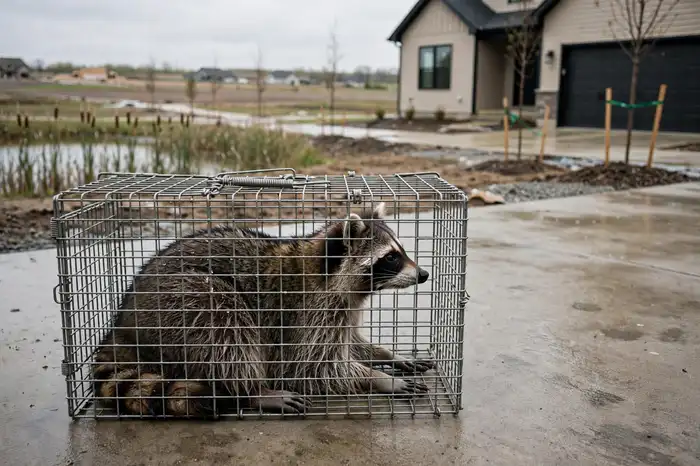
Raccoons in your Avon home
A growing city feeds raccoons unusually well. Avon offers them retention ponds to wash food at, drainage swales to travel, construction dumpsters during every new phase, and rows of curbside trash cans on collection night. What the subdivision does not naturally offer is a hollow tree — so when a female raccoon needs a den in spring, she grades the housing stock instead, and a soffit she can peel or a chimney without a cap will do.
The work is governed by two facts at once. Kits stay in the den for weeks, unable to leave on their own, and Ohio law does not permit a captured raccoon to be carried away and released somewhere else. A raccoon job in Avon is therefore planned around the family and the law together, not solved with a single trap set in the driveway.
Ohio law: a raccoon stays on the property or is not released at all
Under Ohio Administrative Code 1501:31-15-03(E)(3), a captured raccoon must be released on the same property or humanely euthanized. Taking one out to farmland and letting it go is unlawful, in part because raccoons are a leading rabies vector and moving them moves the disease. Our crew leads with exclusion — one-way doors and sealing that let a raccoon walk out of the structure on its own where that can work — and handles any animal that must be taken directly exactly as Ohio rules require. An offer to haul a raccoon away for release is an offer to break the rule.
Soffits, chimneys and the big-house roofline
On Avon homes the den is usually reached at a roof seam: a soffit corner a strong raccoon can pull down, the joint above a garage roof, or an uncapped chimney — many newer fireplaces are decorative and their flues never see a fire, which a raccoon reads as a quiet, warm shaft. Torn shingles at a roof return and muddy prints on siding are the outside signs. Whatever the entry, it is closed last, after the family is confirmed out; a cap or a panel fitted too early traps animals inside the house.
Finding the young before anything closes
Spring litters are the center of the job. Kits chirp and chatter from the den, but a quiet litter is easy to miss if nobody looks, and sealing a mother out from her young trades a raccoon problem for dead animals in the hardest corner of the attic to reach. Our crew inspects with lights and cameras, locates the litter, and builds the removal around accounting for every kit before a single opening is shut.
The latrine problem in a finished attic
Raccoons return to one spot to defecate, and in a large attic that deposit can grow before a homeowner ever goes up there. The waste can carry raccoon roundworm, whose eggs persist and matter most where children might later contact contaminated material. A complete job removes the fouled insulation in the affected area and sanitizes it. Crews sometimes present full-attic insulation replacement as automatic; often only the latrine area needs to come out, and you deserve a straight answer about which.
Sealing against an animal that pries
A raccoon that peeled a soffit once will test the repair with the same paws. Entries are closed with heavy-gauge metal: a proper chimney cap, reinforced vent covers, and flashing at roof returns and porch-roof seams. Wood patches and foam are not raccoon repairs. On Avon homes the crew also checks the long ridge vent and gable ends, because an animal this strong treats a second weak point as an invitation.
Food discipline in a building subdivision
Sealing holds best when the street stops feeding the pressure. Trash cans latched or kept in the garage until morning, pet food indoors, grills cleaned, and bird seed kept off the ground near the house all lower how often raccoons test the roofline. While construction continues nearby, dumpsters and pond edges keep a background population close — which is precisely why the metal work has to be complete rather than hopeful.
Common raccoon questions in Avon
There is a raccoon in my Avon attic — what should I do?+
Can you trap a raccoon and release it out in the country?+
Why did raccoons pick my newer house?+
I hear chattering in the attic — is that baby raccoons?+
How much does raccoon removal cost in Avon?+
Other Avon problems that come with raccoons
Our wildlife crew handles these closely related problems — the ones that most often turn up with a raccoon issue.
Got more than raccoons in Avon?
Raccoons are rarely the only thing using an attic or yard in Avon. See everything we handle locally on the Avon wildlife removal hub, or jump to Ohio wildlife removal.
Serving all of Lorain County
Avon is one part of Lorain County. See wildlife removal in Lorain County, OH for the county-wide picture — the animals we get called about most, and the other towns we cover.
One call to your Avon raccoon crew
The longer raccoons stay in the attic, the more they chew and the bigger the cleanup. Call us and tell us about the job — we will confirm the local crew for your county before any work starts.
- Local to Lorain County. ODNR-compliant handling — call to ask about licensing and insurance.
- Humane exclusion. One-way doors and steel sealing, not poison.
- Done right. Removal, exclusion and cleanup.