Bat Removal & Exclusion in Avon, OH
Droppings on the siding under a gable, or a faint staining at a roof seam? Avon bat colonies are usually big brown bats in the attic of a newer home — and in Ohio, the calendar decides when they can be put out. Call us and tell us about the job — we will confirm the local crew for your county before any work starts.
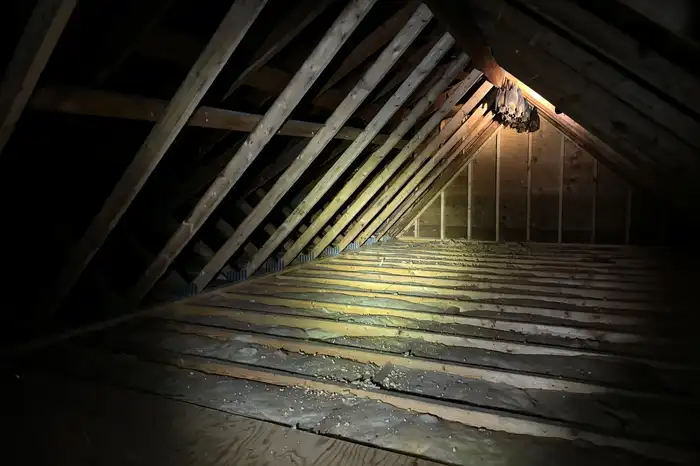
Bats in your Avon home
The bat in an Avon attic is, in the great majority of cases, the big brown bat. It does not need an old house. It needs a gap about the width of a finger at a flashing joint, a gable vent or a roof seam — and a large newer Avon roof, with its dormers, valleys and intersecting planes, offers more of those joints than a simple roof ever would. Homeowners usually find the colony by droppings beneath an entry or by a bat that turns up in a bedroom, not by seeing the roost itself.
Ohio regulates bat work more strictly than any other service on this page. Exclusion is the only legal way to remove a colony, only a licensed operator may do it for hire, and two closed seasons govern when it may happen at all. Getting the timing right is not a detail — it is the difference between a colony put out cleanly and one sealed in.
The closed seasons, and the two windows that work
Ohio Administrative Code 1501:31-15-03(H)(5) bars bat exclusion from May 16 through July 31 when five or more bats are present, because that is maternity season and the pups cannot yet fly — and from October 15 through March 31, because bats may be hibernating inside the structure. Either closed season can only be overridden with prior written permission from the Chief of the ODNR Division of Wildlife. That leaves April 1 to May 15 and August 1 to October 15 as the working windows. A call in June or January still matters: inspection, entry mapping and scheduling happen then, so the exclusion runs the moment the window opens.
Big brown bats can spend the winter in the attic too
Many homeowners assume the colony leaves in fall. Big brown bats often do not. They tolerate a cold, stable roost and commonly overwinter inside Ohio buildings, tucked singly or in small clusters into quiet attic corners. That is why a midwinter sealing, done on the assumption the attic is empty, can entomb animals that never left — and why the fall-to-spring closed season exists. A winter inspection looks for hibernating bats as carefully as for summer entries.
Where bats enter a newer Avon home
Follow the droppings. Guano collecting on siding, a deck or the ground beneath one spot on the roofline marks an active entry: a lifted flashing joint at a dormer, a gable vent with light screening, the seam where a lower roof meets a wall, or a gap behind trim that has shrunk since the house was built. On a complex roof there may be several active entries and more gaps that are merely possible — the crew's job is to tell them apart and treat both kinds.
Guano, rabies and the bedroom bat
Droppings under a roost used for years can be deep, and dried guano can carry the fungus linked to histoplasmosis, so cleanup is protective-equipment work. Bats are also Ohio's most frequently confirmed rabies species. That is why a bat found in a room where someone slept is handled as a health question: do not touch it, close the room, and ask your doctor or local health department for guidance. A colony that stays in the attic is not aggressive — the genuine risks are droppings and direct contact, not the bats going about their nights.
How a timed exclusion actually runs
Inside a legal window, the crew seals every gap on the house except the active entries, then fits those entries with one-way bat valves that let bats drop out at dusk to feed and block their return. Over the following nights the colony empties itself. Once checks confirm the attic is clear, the valves come off and the last openings are sealed for good. It is measured in visits and return checks, not a single afternoon.
What makes it worse
Caulking the entry the day you find it is the classic mistake. In summer it traps flightless pups; in winter it traps hibernating adults; in any season with bats still inside, it drives them into wall voids and living space. Mothballs, bright lights and ultrasonic gadgets do not empty a colony. The working sequence is inspect, wait for the window if the law requires it, exclude one-way, then seal.
Common bat questions in Avon
I have bats in my Avon attic — how do they get out?+
Why can the bats not be removed in July, or in the middle of winter?+
A bat got into my living space — what should I do?+
My house is new — how did bats get in at all?+
How much does bat removal cost in Avon?+
Other Avon problems that come with bats
Our wildlife crew handles these closely related problems — the ones that most often turn up with a bat issue.
Got more than bats in Avon?
On a large Avon roofline, the flashing gap a bat colony uses is seldom the only seam the seasons have opened. See everything we handle locally on the Avon wildlife removal hub, or jump to Ohio wildlife removal.
Serving all of Lorain County
Avon is one part of Lorain County. See wildlife removal in Lorain County, OH for the county-wide picture — the animals we get called about most, and the other towns we cover.
One call to your Avon bat crew
A bat colony does not chew its way in, but droppings build quietly under the roost year after year, and sealing at the wrong moment traps pups or sleeping bats inside the attic. Call us and tell us about the job — we will confirm the local crew for your county before any work starts.
- Local to Lorain County. ODNR-compliant handling — call to ask about licensing and insurance.
- Timed, one-way exclusion. Bat valves fitted in the April 1–May 15 or August 1–October 15 windows, then permanent sealing once the last bat is confirmed out.
- Done right. Removal, exclusion and cleanup.