Wildlife Removal in Avon, OH
Avon keeps building outward into fields and woods that wildlife was using long before the first foundation was poured. The houses are new, but the animals are not — they test every vent, soffit and pond edge in the subdivision, and a fresh roofline can have its first raccoon before the landscaping matures. Call us and tell us about the job — we will confirm the local crew for your county before any work starts.
Why Avon homes see the wildlife they do
Drive any newer Avon street and you can read the pattern from the curb. Behind one row of houses is a retention pond. Behind the next is a strip of woods the developer left standing. At the edge of the subdivision, a field that was farmed last year is staked for the next phase. Animals displaced by each new phase do not leave the area — they move sideways, into the finished streets, and they settle in the closest dry shelter they can find: an attic, a garage, the space under a deck.
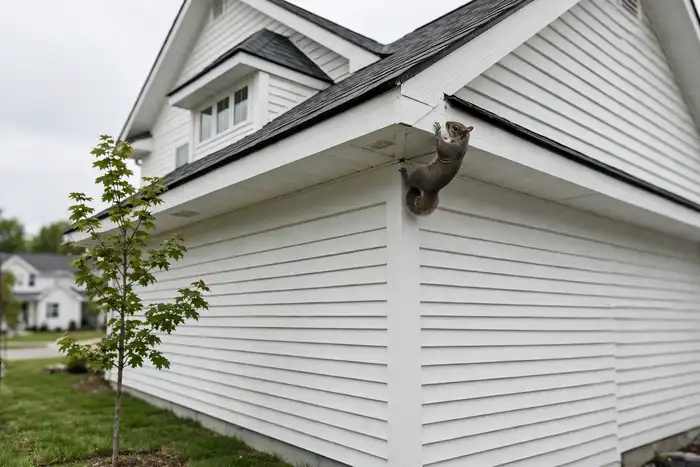
The houses themselves invite a closer look than most people expect from new construction. Avon homes tend to be large, with complex rooflines — multiple gables, dormers, intersecting roof planes and long soffit runs, plus finished basements and big attached garages. Every roof intersection is a seam, every decorative gable is a vent, and builders seal for weather, not for a determined squirrel. A gap left at a roof return on move-in day is still a gap five winters later, only wider after freeze and thaw have worked on it.
Our wildlife crew works Avon as a construction-edge problem as much as a house problem. We find where animals are entering the home, remove them the way Ohio law requires, seal the openings in metal, and look honestly at what the lot is offering — pond bank, woodline, bird feeders, an open garage — because in a growing subdivision the next animal is usually already nearby.
New streets, displaced animals: the construction edge
When a woodlot is cleared or a field is graded, the squirrels, raccoons, skunks and groundhogs that lived there scatter to the nearest cover. In Avon that cover is often the finished phase next door. Homeowners on the edge of an active build regularly report a first wildlife problem within a season or two of construction starting nearby — not because their house changed, but because the neighborhood around it did.
Construction also leaves invitations behind. Temporary dumpsters feed raccoons through a build. Unfinished drainage swales and silt ponds hold water that draws wildlife in. Lots that back onto a future phase sit against tall weeds and brush piles instead of a neighbor's maintained yard. None of that makes a house vulnerable by itself, but it raises the pressure on every vent and soffit on the street.
The answer is not to wait for the subdivision to finish growing. It is to seal the house properly now, while the pressure is highest, with materials that outlast the building boom around it.
A big new roofline has more ways in than a small old one
Homeowners assume new means tight. For weather, mostly yes. For wildlife, a large modern roof is a long list of test points: ridge vents that run the full length of the house, soffit panels that can flex at a corner, gable vents behind decorative louvers, and the valleys and joints where a garage roof, a porch roof and two dormers all meet the main wall. A raccoon needs one loose soffit panel. A bat needs a gap at one flashing joint.
Vinyl and composite materials change the repair, too. Squirrels chew through vent covers and gnaw at trim that looks solid from the ground. Freeze and thaw north of the lake work on every caulked seam, and lake-effect snow loading followed by a fast melt pushes water — and then ice — into joints that were tight in October.
Our crew inspects the whole roofline rather than the one spot under the noise. On an Avon house with four gable ends and three roof intersections, the active entry is rarely the only weak point, and sealing only the obvious one invites the animal to move ten feet and start again.
Retention ponds bring the wild neighborhood to the lot line
Nearly every newer Avon subdivision holds its stormwater in a shared retention pond, and those ponds are wildlife infrastructure whether anyone planned them that way or not. They hold water year-round, grow cattails and brush at the edges, and give raccoons, skunks, opossums, muskrats in some settings, snakes and frogs — and the animals that hunt frogs — a permanent base a few lots from your back door.
Pond-edge lots see the most of it: groundhogs burrowing in the bank and under nearby decks, skunks working the shoreline at night, snakes in the rocks and rip-rap. The pond itself is common property and not something a homeowner can change, which makes the house and the lot line the place to do the work — screening under decks, sealing the foundation line, and keeping pet food and trash from adding a second attraction on top of the water.
Further into the subdivision the pressure eases but does not vanish. Animals travel the drainage swales and the utility easements between streets the way they once traveled the fencerows, so even an interior lot can wake up to a skunk under the stoop.
How Ohio law shapes wildlife work in Avon
Wildlife removal for hire in Ohio requires an ODNR Commercial Nuisance Wild Animal Control Operator license under Ohio Revised Code section 1531.40, and the rules behind that license decide what a crew can and cannot do at your house. Bats follow the strictest calendar: exclusion is closed from May 16 through July 31 when five or more bats are present, because the pups cannot fly, and from October 15 through March 31, when big brown bats may be hibernating in the attic — in either window only with prior written ODNR permission. The working windows are April 1 to May 15 and August 1 to October 15.
Rabies is the other frame. Raccoons, skunks, foxes and bats are Ohio's main rabies vectors, and that is one reason Ohio Administrative Code 1501:31-15-03(E)(3) forbids moving several species off a property: a captured raccoon, skunk or opossum must be released on the same property or humanely euthanized, never carried away and let go elsewhere. Our crew leads with exclusion — one-way doors and sealing that let an animal leave a structure on its own where that can work — and handles the rest exactly the way Ohio rules require.
Wildlife we remove in Avon
From a squirrel in a brand-new attic to a groundhog in a pond bank, these are the calls Avon homeowners make most.
🐿️ Squirrels
Gray squirrels pushed out of cleared woodlots settle fast in Avon attics, and a complex new roofline gives them corners and vents to work on. Fall is the big entry season, and chewed wiring in a new attic is the urgent risk. See our full Avon squirrel removal guide →
🦝 Raccoons
Raccoons follow construction dumpsters, pond edges and unsecured trash through growing subdivisions, then den in attics and chimneys. A rabies-vector species that Ohio law does not allow to be moved off the property — exclusion first, young accounted for. See our full Avon raccoon removal guide →
🦇 Bats
Big brown bats find the flashing gaps on large, many-gabled Avon roofs within a few summers, and some hibernate in Ohio attics. Exclusion is legal only April 1–May 15 and August 1–October 15 without written ODNR permission. See our full Avon bat removal guide →
🦨 Skunks
Skunks den under the decks, stoops and patio slabs of pond-edge and woodline lots, and work the shoreline at night. A rabies vector that cannot be moved off the property under Ohio law, so the work is on-site exclusion plus buried screening. See our full Avon skunk removal guide →
🦫 Groundhogs
Groundhogs burrow in retention-pond banks, under decks and along the field edges at the back of new lots, then sleep through winter hibernation. Fresh dirt in spring means the system is active and growing again. See our full Avon groundhog removal guide →
🐾 Opossums
Opossums wander in from ponds, swales and remaining woods and bed down in garages, under decks and in window wells. Ohio law does not allow them to be carried off the property, so removal is paired with closing the shelter. See our full Avon opossum removal guide →
🐿️ Chipmunks
Chipmunks tunnel along new foundations, paver patios and retaining walls, moving soil away from edges that were backfilled only a few years ago. A busy colony does more undermining than its size suggests. See our full Avon chipmunk removal guide →
🐀 Rats, mice & voles
House mice pour into new Avon homes at first frost through utility gaps, voles trail pond-edge and open lawns under the snow, and Norway rats appear where construction food waste and older outbuildings give them cover. See our full Avon rodent removal guide →
🐍 Snakes
Almost always harmless — garter snakes in the yard, rat snakes in garages, northern watersnakes around pond rocks. The Avon snake call is calm identification and removal, not alarm. See our full Avon snake removal guide →
🪰 Dead animals
A smell building in one room of a newer house usually means something died in a wall void, the attic or under a deck. Our crew locates it, removes it, cleans the area and closes the opening it used. See our full Avon dead animal removal guide →
Animal-specific help in Avon
Deep, local guides for the problems we get called about most — with our wildlife crew behind every one.
How to get help in Avon
Tell us what you're hearing
Scratching in the attic, a snake by the porch, holes in the yard — call with your problem and your Avon address.
We connect you locally
Call us and tell us about the job — we will confirm the local crew for your county before any work starts.
They solve it — for good
Inspection, humane removal, full exclusion and cleanup — handled by our wildlife crew, following Ohio rules.
Common wildlife removal questions in Avon
Who do I call for wildlife removal in Avon?+
My Avon house is only a few years old — how are animals getting in?+
Can bats be removed from my Avon attic in summer or winter?+
Will you take a raccoon or skunk away and release it somewhere wild?+
Does living by a retention pond mean more wildlife at my house?+
How much does wildlife removal cost in Avon?+
Serving all of Lorain County
Avon is one part of Lorain County. See wildlife removal in Lorain County, OH for the county-wide picture — the animals we get called about most, and the other towns we cover.
One call to your Avon wildlife crew
Whether it's squirrels in an older in-town attic or a raccoon in a new subdivision crawlspace, the fastest fix is our wildlife crew, who knows Lorain County wildlife. Call us and tell us about the job — we will confirm the local crew for your county before any work starts.
- Local to Lorain County. ODNR-compliant handling — call to ask about licensing and insurance.
- One company, one call. Call us and tell us about the job.
- Done right. Removal, exclusion and cleanup.