Dead Animal Removal in Avon, OH
A sour note hanging over the laundry room or the finished basement of a house that is barely broken in? New construction hides cavities just as well as old — and its deep wells and sealed walls trap odor in surprising places. Call us and tell us about the job — we will confirm the local crew for your county before any work starts.
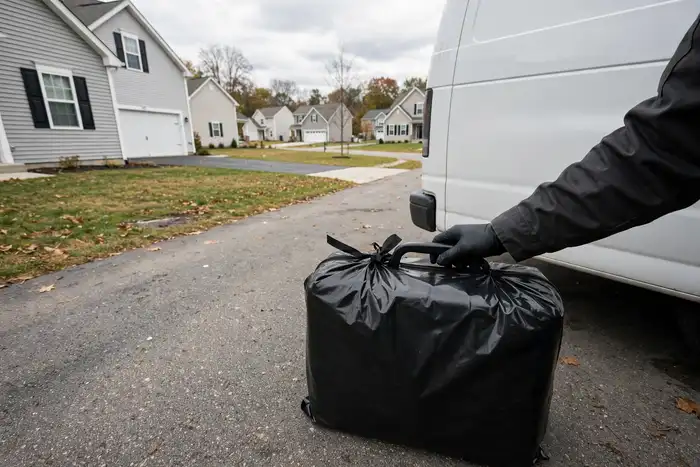
A dead animal hidden in a newer Avon house
Owners of newer houses often apologize when they call, as if the problem cannot be real yet. It can. A mouse that slipped in through an unfinished utility penetration during the build, a squirrel that explored an open soffit before the trim went on, a young opossum that fell into an egress well the week after closing — all of them can end up concealed inside a structure that looks, from every finished surface, completely sealed.
The search in a modern Avon home follows modern anatomy. Walls are deeper, chases carry plumbing and ductwork vertically between floors, and a forced-air system grabs odor from one cavity and delivers it to a bedroom two rooms away. Where the smell smells worst is a clue; where the air moves is often the better one.
Egress wells: the trap nobody thinks to check first
Start outside the basement window. Deep egress wells collect leaves, mulch and, occasionally, an animal that dropped in and could not scale the smooth sides — a juvenile opossum, a skunk, a rabbit from the lot next door, even a snake that later died there. Because the well sits directly against a basement window, odor enters at the lowest level and rises through the house, convincing everyone the source must be upstairs. A glance into every well, with a flashlight, is step one on an Avon call and solves a striking share of mysteries before any wall is touched.
Wall cavities built around pipes, wires and duct drops
Interior walls in new homes are busy places: supply lines, waste stacks, electrical runs and flexible duct drops all descend through the same framed bays. A mouse exploring from the attic or the garage can slip down a plumbing chase and become stuck between floors, behind tile or inside the boxed column that hides a stack in the kitchen. The clue pattern is specific — a fierce smell in one narrow vertical band of wall, flies clustering at an outlet or recessed light, a stain that appears on a ceiling below a bathroom. Crews use that vertical logic, bay by bay, instead of treating the whole room as suspect.
Under low decks and composite patios built close to grade
Many Avon decks sit inches off the soil on short posts, with composite boards and solid skirting that look finished but leave a crawl-height void beneath. Animals displaced from the next lot squeeze under to shelter, and not all of them leave. Access is the entire difficulty: boards may need lifting at one corner, or a small access panel cut into skirting where it will not show. Because these decks are new, owners understandably want the least invasive route discussed first — panel placement, board numbering and replacement are agreed before anyone picks up a tool.
Attics above garages and bonus rooms run hotter, smell faster
The attic triangle over a garage or a bonus room heats up earlier in spring than a main attic, so a winter loss up there announces itself weeks before the rest of the house would. Squirrels that entered at a garage roof return and mice overwintering in blown insulation are the usual finds in that space. Insulation depth is both a blessing and a chore: it muffles early odor, then holds contaminated material that must be scooped out in a radius around the spot, bagged and replaced so the smell does not linger in the fibres.
When the builder phase is part of the story
Ask when the house was finished and whether the street is still active. Open framing, garage doors left up during trades work and unsealed penetrations awaiting final fixtures all create a window — sometimes months long — when animals can enter cavities that later get closed behind drywall. A carcass sealed in during construction is uncommon, but crews in growing Avon hear the timeline often enough to ask. Knowing the phase history steers the search toward penetrations and chases that were open longest.
After extraction: deodorizing the void, not the living room
Sprays in the room accomplish little because the room is not the source. Once material is out, the cavity, well or deck void itself gets cleaned and treated with enzyme products that break down residue on framing and concrete, and any soaked insulation is replaced. The final step is practical prevention fitted to a new house: well covers, a sealed garage threshold, mesh behind louvered vents, and a check of the roof returns while a ladder is already up.
Common dead animal questions in Avon
The smell is worst in our laundry room — why would an animal be there?+
Could something really be inside walls that were just built?+
Flies appeared at a basement window but the room itself smells fine — is that related?+
Will you need to open our drywall, and who fixes it?+
How much does dead animal removal cost in Avon?+
Other Avon problems that come with dead animals
Our wildlife crew handles these closely related problems — the ones that most often turn up with a dead animal issue.
Got a live animal problem in Avon too?
Fresh subdivisions keep supplying newcomers — sealing the garage line, wells and roof returns now prevents the sequel while the neighborhood is still growing. See everything we handle locally on the Avon wildlife removal hub, or jump to Ohio wildlife removal.
Serving all of Lorain County
Avon is one part of Lorain County. See wildlife removal in Lorain County, OH for the county-wide picture — the animals we get called about most, and the other towns we cover.
One call to your Avon dead animal crew
New drywall and fresh paint make homeowners doubt themselves, but odor does not respect a move-in date. Once the source is out and the opening that admitted it is addressed, the house smells new again surprisingly fast. Call us and tell us about the job — we will confirm the local crew for your county before any work starts.
- Local to Lorain County. ODNR-compliant handling — call to ask about licensing and insurance.
- Trace airflow, open small, restore clean. Following duct runs and wall chases to the cavity, extracting through the smallest practical opening, then sanitizing and deodorizing the void itself.
- Done right. Removal, exclusion and cleanup.