Bat Removal in Roberta, GA
The big, tall-roofed older homes that give Roberta its character also give bats what they want: a high, warm, quiet roost behind a gable vent or under a lifted shingle, with fields and yard lights full of insects just outside.
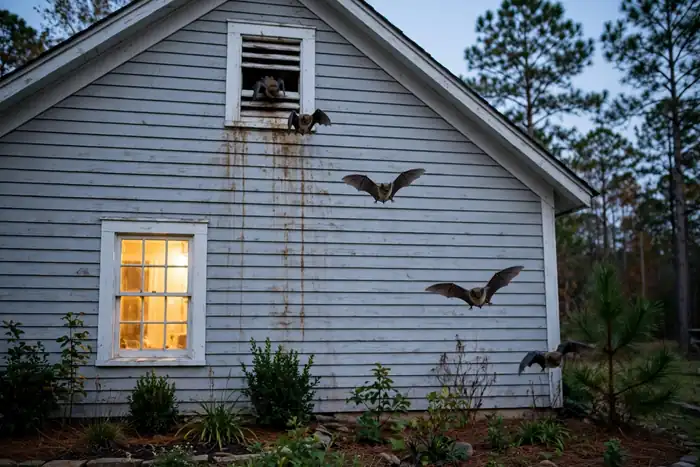
Why bats pick the tallest, oldest roofs in Roberta
Watch an older Roberta farmhouse at dusk in the warm months and you may see the roofline come alive. One bat slips from a gable vent, then another, then a loose stream of them heading for the fields and tree lines where insects gather over gardens and pasture. It is a striking sight, and it tells you something specific: the colony is not passing through. It is living in the house, probably in numbers, and it has been there long enough to learn the exits.
Most homeowners find the indoor evidence first. A scatter of small droppings on the attic floor below a vent. Dark staining around a louver. A faint, musty smell in the upstairs rooms on hot days, in a tall home where the attic bakes. Bats need only a narrow gap to enter, and older Roberta homes offer plenty: warped gable louvers, gaps where porch roofs meet walls, openings around chimneys, and ridge lines that have shifted over decades.
Gable vents and louvers on older Roberta farmhouses
The louvered gable vent is the most common bat doorway we find in Roberta. Slats weather and spread, screening behind them tears or was never fitted, and the space behind the vent opens straight into a warm attic peak. Bats cluster near that vent, which concentrates droppings below it. We inspect louvers from outside and inside, because a vent that looks intact from the yard can be wide open from the attic side.
The April to July rule that governs bat work in Georgia
Timing is not optional with bats. In Georgia, bat exclusion is restricted from April 1 through July 31, the maternity season, because flightless young are in the roost and sealing exits then would trap them inside while their mothers are shut out. If you call during that window, we survey, document the colony and plan the exclusion for when it can be done lawfully and humanely, and we will tell you that timeline plainly rather than promise work the calendar forbids.
What bat droppings in a Roberta attic mean for the household
Guano collects fast under an established roost, and it carries odor through ceiling gaps into upstairs rooms in a tall older home. We assess how much has built up, where it sits relative to vents and living space, and whether cleanup and sanitising should follow exclusion. Disturbing dry droppings without precautions is not a do-it-yourself job, so we explain what the attic needs before anyone starts sweeping it into the air.
Finding every exit a Roberta bat colony uses
Colonies rarely use one opening. There is a main exit the bats pour from at dusk, plus quieter gaps at a chimney joint, a ridge end or a porch-roof seam that a few bats use. Sealing only the obvious vent fails, because the colony shifts to the side gaps. Our survey includes a dusk watch where practical, a full ladder pass of the high rooflines, and an attic check for light lines showing where gaps connect to the outside.
How exclusion works on a tall Roberta home
Exclusion lets bats out and not back in. One-way devices are fitted at the primary exits and every secondary gap is sealed, so over several evenings the colony leaves to feed and finds its doors changed when it returns. After a confirmed quiet period — no dusk stream, no new droppings, no chatter in the walls — the devices come off and those final openings are sealed permanently. We will confirm the local crew for your county before any work starts.
Why bats should not simply be sealed into a Roberta wall
Sealing a roost shut with bats inside, or excluding during maternity season, creates a worse problem than the colony: trapped bats die in walls and attics, the odor is severe, and surviving bats push into living space through interior gaps looking for a way out. Patient, correctly timed exclusion avoids all of that, which is why we would rather schedule the work right than rush it wrong.
Common bat questions in Roberta
I see bats leaving the top of my older Roberta home every evening. How many could be inside?+
Can you remove the bats from my Roberta house in June?+
A bat got into my living room in Roberta. What should I do?+
Are the bats in my Roberta farmhouse eating insects from my garden and fields?+
How do bats get into a tall in-town Roberta home through such small gaps?+
Will the bats come back to my Roberta attic next year?+
Other Roberta problems that come with bats
Our wildlife crew handles these closely related problems — the ones that most often turn up with a bat issue.
Got more than bats in Roberta?
High rooflines that admit bats often admit squirrels at the eaves below them, especially on Roberta homes under tree canopy. If you hear daytime running as well as seeing bats at dusk, mention both when you call and we will check the attic for squirrel sign too. See everything we handle locally on the Roberta wildlife removal hub, or jump to Georgia wildlife removal.
Want the background before you call? Read our statewide guide: Bats in your attic: Georgia law, maternity season and what exclusion costs.
Serving all of Crawford County
Roberta is one part of Crawford County. See wildlife removal in Crawford County, GA for the county-wide picture — the animals we get called about most, and the other towns we cover.
One call to your Roberta bat crew
Bat work is won or lost on the survey, not the sealing day.
- Local to Crawford County. Georgia DNR-compliant handling — call to ask about licensing and insurance.
- Our method: find every gap the colony uses, then exclude at the lawful time. We watch the house at the right hour, mark primary exits and secondary gaps, fit one-way exclusion at the main openings in the proper season, and seal the rest so the colony leaves and cannot slip back in through a side gap.
- Done right. Removal, exclusion and cleanup.