Rodent Control in Roberta, GA
On a Roberta property, rodents rarely start in the kitchen. They start where feed and seed are stored — a shed, a barn corner, a coop — build numbers there, then follow the foundation and pipe runs into the walls of the house itself.
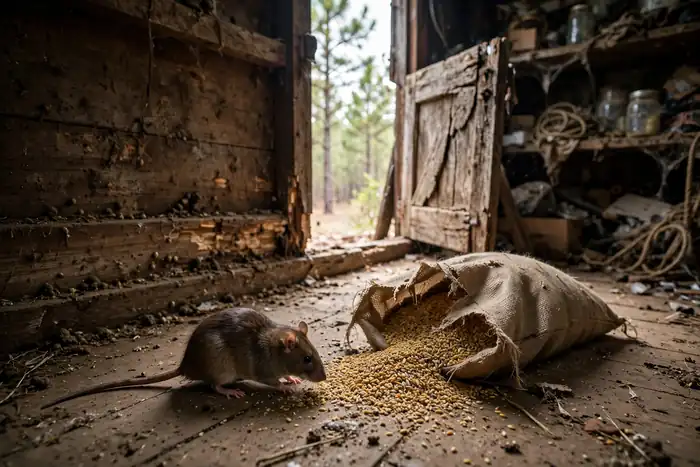
Why stored feed in Roberta outbuildings becomes a house problem
Every Roberta farm-town property has a building that smells like food to a rat. It might be a shed with sacks of chicken feed, a barn storing seed and pet food, or a garage corner with a torn bag and a quiet shelf above it. Rodents find that building first. They nest behind the sacks, breed in the walls of the outbuilding, and for a while the house seems untouched. Then the population outgrows the shed, the weather turns cold, or the feed runs out — and the house, warm and full of new smells, is the next building over.
The move shows up as night scratching in walls, droppings along a pantry baseboard, a chewed corner on a stored bag in the kitchen, or the faint stale smell of a nest in insulation. Mice slip through gaps around pipes that look impossibly small. Rats follow foundation lines and climb where vines, wires or stacked wood give them a route to the roof. By the time a Roberta homeowner hears them, there is usually an outbuilding chapter to the story that has been running for months.
Feed sacks and seed bins: the Roberta rodent starting point
An open or torn feed sack against an outbuilding wall is food, nesting cover and a landmark in one. Rodents feed at the base, nest behind it where nothing disturbs them, and raise litter after litter within a few steps of the supply. We start rodent visits in Roberta by opening the shed and barn doors and reading that scene: droppings along walls, gnawed sack corners, grease marks on the routes between nest and food.
How rats and mice travel from a Roberta shed to the house
Rodents dislike open ground, so they travel edges: along the outbuilding wall, down a fence line, across to the house foundation, then up and in through a pipe gap, a crawlspace opening or a spot where siding has pulled away. Stacked wood, equipment and tall weeds along that route act as covered bridges. Mapping the route on a Roberta lot tells us where control will work and which gaps into the house must be sealed.
Wall scratching and pantry sign inside a Roberta home
Inside the house, rodents nest in wall voids, attic insulation and the warm space behind appliances, and they travel the same internal runs nightly. Sign includes droppings along baseboards and in pantry corners, gnawed packaging, shredded material gathered for nests, and that light scratching that stops when you knock on the wall. We use the pattern of sign room by room to locate the runs rather than guessing where to set control.
Control that fits a Roberta property with animals and gardens
A working Roberta property may have pets, livestock, poultry and a garden to protect, so control has to be placed with care: secured stations and traps on rodent runs, out of reach of animals that should never encounter them, and located from the sign we found rather than scattered at random. We explain placements before we set anything, and we will confirm the local crew for your county before any work starts.
Sealing a Roberta house against the next wave of rodents
Control without sealing is a subscription. A mouse fits through a gap the width of a pencil, so we close pipe penetrations, foundation cracks, crawlspace openings and gaps at door sweeps with materials rodents cannot gnaw through easily, including metal mesh and solid backing behind soft spots. The outbuildings get attention too: door bottoms, chewed corners and the holes around stored-feed areas that started the whole cycle.
Storage habits that keep Roberta outbuildings rodent-poor
The long-term answer sits in how the shed is kept. Feed and seed go into hard, sealed containers raised off the floor. Spilled feed gets swept the day it spills, not the month. Old sacks, cardboard and clutter against walls come out, because that clutter is nesting cover. None of this changes how you farm or garden. It just stops the outbuilding from running a rodent nursery a short walk from your kitchen.
Common rodent questions in Roberta
Why do I have rats in my Roberta house when all the feed is out in the shed?+
How small a gap can a mouse use to get into my Roberta home?+
Is it safe to control rodents around my coop and animals in Roberta?+
I cleaned out my Roberta shed. Why are mice still in the walls?+
What are the dark smear marks along beams in my Roberta barn?+
Will sealing my house push rodents into the barn instead in Roberta?+
Other Roberta problems that come with rodents
Our wildlife crew handles these closely related problems — the ones that most often turn up with a rodent issue.
Got more than rodents in Roberta?
Where rodents thrive around a Roberta property, snakes follow, and raccoons raid the same feed stores. If your shed is drawing more than mice, tell us what else you are seeing and we can fold snake or raccoon work into the same plan. See everything we handle locally on the Roberta wildlife removal hub, or jump to Georgia wildlife removal.
Want the background before you call? Read our statewide guide: Roof rats in Georgia: why bait alone never ends it.
Serving all of Crawford County
Roberta is one part of Crawford County. See wildlife removal in Crawford County, GA for the county-wide picture — the animals we get called about most, and the other towns we cover.
One call to your Roberta rodent crew
Trapping alone cannot outrun a stocked pantry in the shed.
- Local to Crawford County. Georgia DNR-compliant handling — call to ask about licensing and insurance.
- Our method: control the animals, seal the house, fix the storage. We set control where rodents are actually travelling, close the foundation and pipe gaps that let them into walls and ceilings, and change how feed is stored in the outbuildings so the next generation finds the Roberta address a lot less rewarding.
- Done right. Removal, exclusion and cleanup.