Squirrel Removal in Roberta, GA
A Roberta roof under a pine canopy is a roof squirrels can reach without ever crossing the yard. They land from a limb, find a soft spot at the eave, and settle into insulation above the back rooms.
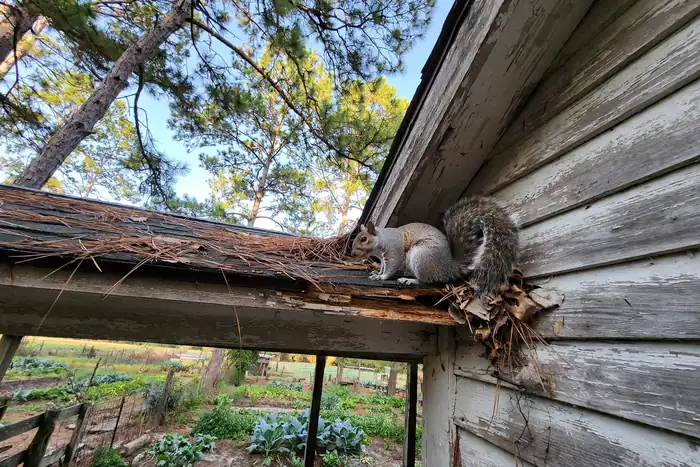
Why squirrel trouble in Roberta starts in the pine and oak canopy
Stand in a Roberta yard and look up. On lot after lot, mature pines and spreading oaks lean over the roof of an older home, and that overhang is the whole story for squirrels. A gray squirrel can leave a pine at the field edge, cross two crowns of branches, drop onto shingles and be at the eave in seconds. From the ground the house looks sealed. From the canopy, it has a front door.
Inside, the signs build slowly. Light running and rolling sounds in the morning. A nest of shredded insulation and leaves in one attic corner. Chewed trim at a gable vent. Because older Roberta homes often have layered rooflines — a porch roof meeting a main roof, an addition tied into the original wall — squirrels find the little ledges and seams those junctions create, and they chew the soft wood at exactly those spots.
How squirrels use overhanging limbs to reach Roberta rooftops
A squirrel does not need a tree touching the house. A limb within leaping distance is enough, and pines at the field edge grow tall and lean toward the light over a yard. We map every branch that overhangs or nearly overhangs the roof, note which eave sits under it, and match that to the entry chewing we find. That map tells us both how they are arriving and what trimming advice will slow the next arrival.
Eave seams and porch-roof junctions on older Roberta houses
The classic Roberta squirrel entry is not a big hole in the middle of a wall. It is a chewed corner where a porch roof dies into the main wall, a lifted shingle edge at an eave return, or a gable vent with slats spaced just wide enough to work on. Additions make more of these junctions. We probe those seams with a light and a ladder, looking for daylight from inside the attic and fresh pale wood where chewing is recent.
What a squirrel nest in a Roberta attic does over one season
Squirrels drag leaves, pine straw and shredded insulation into a compact nest, often above a back bedroom where the house is quiet. They flatten insulation so it stops insulating, foul the same corner repeatedly, and gnaw on whatever crosses the space, including wiring and stored boxes. Young born in the nest keep the activity going for weeks. The longer a nest stays, the more the attic takes on the smell of the woods the squirrels came from.
Getting squirrels out of a Roberta attic without sealing young inside
Timing matters. If young are present and not yet mobile, we plan removal around them rather than sealing a one-way door that strands them in the nest. Once the attic is confirmed clear — no running at dawn, no fresh chewing, no sound at the nest corner — we close the entries. We will confirm the local crew for your county before any work starts, and we explain the sequence before the first ladder goes up.
Sealing work that holds against Roberta squirrels
Squirrels chew through caulk, foam and thin flashing in short order, so we close entries with metal flashing, hardware cloth and solid replacement wood where trim has gone soft. Vent openings get screened from inside the attic where possible, so the screen cannot be pulled off from the roof. Every entry we found gets closed once removal is confirmed complete, because an open backup hole invites a new tenant within days.
Keeping squirrels off a Roberta roof after removal
The lasting fix is distance: limbs cut back so the roof is no longer a landing strip, feeders moved away from the house so seed stops drawing squirrels to the eaves, and attic vents kept screened. We also suggest a quick look at the roof edge each fall, when squirrels in Crawford County start hunting for a warm winter cavity and an older eave seam is the first thing they test.
Common squirrel questions in Roberta
The pines behind my Roberta house hang over the roof. Is that why squirrels keep getting in?+
I hear rolling sounds in my Roberta attic in the morning. What is that?+
Can squirrels really chew through the wood on my older Roberta home?+
What if there are baby squirrels in my Roberta attic?+
Do I need to cut my trees down to keep squirrels out in Roberta?+
Will squirrels use my shed or barn instead if the attic is sealed?+
Other Roberta problems that come with squirrels
Our wildlife crew handles these closely related problems — the ones that most often turn up with a squirrel issue.
Got more than squirrels in Roberta?
Squirrels in a Roberta attic often share the property with rodents in the outbuildings, because both follow stored feed and cover. If you are also seeing droppings in a shed or hearing wall scratching at night, ask us about rodent control while we are there. See everything we handle locally on the Roberta wildlife removal hub, or jump to Georgia wildlife removal.
Want the background before you call? Read our statewide guide: Squirrels in the attic: what it costs and why sealing too early backfires.
Serving all of Crawford County
Roberta is one part of Crawford County. See wildlife removal in Crawford County, GA for the county-wide picture — the animals we get called about most, and the other towns we cover.
One call to your Roberta squirrel crew
Once the squirrels are out, the work that matters is at the roof edge.
- Local to Crawford County. Georgia DNR-compliant handling — call to ask about licensing and insurance.
- Our method: remove, then seal the tree-side entries. We set removal up at the active openings, confirm the attic is clear, then close eaves, vents and gable gaps with sturdy material squirrels cannot chew through quickly, and we flag the limbs that give them a landing route.
- Done right. Removal, exclusion and cleanup.