Dead Animal Removal in Roberta, GA
The smell usually announces it before anything is seen: a heavy, sweet rot that builds over days in one part of a Roberta house, worst in the heat, with flies gathering at a porch screen or a wall outlet. Something crawled in — and did not crawl out.
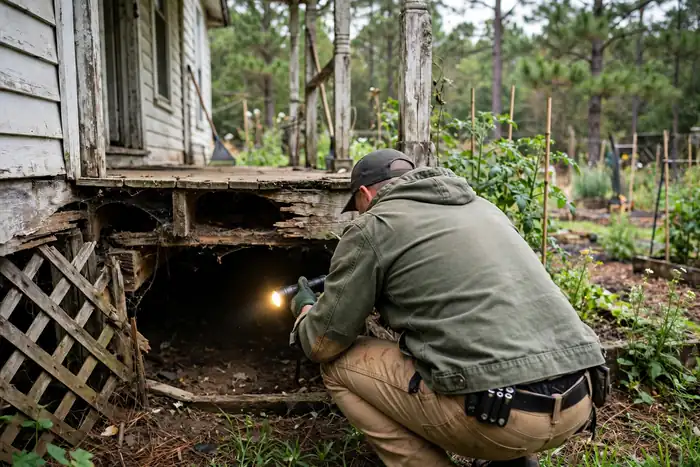
Why animals end up dead under Roberta porches and in Roberta walls
On a Roberta property, the spaces animals shelter in and the spaces they die in are the same spaces. The void under a wide front porch. The hollow beneath deck boards. The wall of an older home, entered from the crawlspace below or a gap at the porch roof above. An animal that is sick, injured, trapped by a shifted board, or simply old can end up in one of those voids, and the house finds out slowly: a faint off smell on Monday, an unmistakable one by Thursday, flies in a window that were not there before.
Guessing wrong about the location makes this job miserable, because a carcass two feet from where you open a wall might as well be across the county. We locate by pattern — which room, which wall, where the smell peaks at different times of day, where flies cluster, how the porch and crawlspace are framed — and in older Roberta homes that detective work is most of the skill. These houses have additions, enclosed porches and layered walls, and animals travel further inside them than homeowners expect.
The under-porch void: Roberta first place to check
More dead-animal calls in Roberta start under the porch than anywhere else. Opossums, raccoons, skunks and stray cats all den in porch voids, entering through a broken skirt board or a gap at the steps, and a void that shelters them in life can trap them at the end of it. The smell rises through floorboards and porch decking, strongest on warm afternoons. We access porch voids from outside where the structure allows, which usually means no interior demolition at all.
Dead animals inside the walls of older Roberta homes
A wall death usually begins higher up or lower down than the wall itself: a squirrel or rat enters at the roof or crawlspace, travels the void, and cannot get back. The odor localises to one stretch of wall, often low, and flies may appear at outlets and baseboards in that room. Locating the exact bay of the wall before opening anything is the whole game, and we use smell mapping and the framing pattern of the house to narrow it to the smallest possible area.
Deck hollows and crawlspace corners in Roberta yards
Low decks built close to grade create a dark hollow that animals enter from one loose edge and cannot always leave, especially if a board warps or a skirt settles after they go in. Crawlspaces have their own far corners, beyond the access door and behind ductwork, where an animal can die unnoticed until the odor comes up through the floor across several rooms. We search those low, awkward spaces systematically rather than assuming the first strong smell is the exact source.
How we locate a carcass in a Roberta home without tearing it apart
We start with questions: when the smell began, which room is worst, whether it changes with heat or wind, where flies have gathered, and whether any animal was heard in the walls or under the floor in the weeks before. Then we check the crawlspace, porch void and attic in that order of likelihood for your house. Most Roberta removals are completed through existing access or a small, planned opening. We will confirm the local crew for your county before any work starts, and we explain access options before we cut anything.
Removal, cleanup and calming the odor in a Roberta house
Once located, the carcass and any soiled nesting or insulation immediately around it are removed and bagged, and the spot is treated to knock down the odor and the bacteria that come with it. Some smell can linger in wood and drywall for a while after removal, fading as the materials dry, and we will be honest about that timeline. What removal does immediately is stop the source, so the house improves from that day instead of worsening.
Sealing the route so another Roberta animal does not die in the same wall
Every dead-animal job ends with the question of how it got there. A crawlspace door hanging open, a porch skirt gap, a vent with the screen gone — the animal that died used an entry, and the next animal coming out of the fields will find the same one. We identify that entry during the visit and close it as part of the work, turning a miserable week into genuine protection for the house.
Common dead animal questions in Roberta
How long will the dead-animal smell last in my Roberta home if I wait it out?+
The smell is worst in one bedroom of my Roberta house. Does that mean the animal is in that wall?+
Why are there suddenly so many flies around my Roberta porch?+
Can you remove a dead animal from under my Roberta house if the crawlspace is tight?+
Something died under my Roberta porch but the smell is fading. Should I still call?+
How do animals keep getting into the walls of my older Roberta home?+
Other Roberta problems that come with dead animals
Our wildlife crew handles these closely related problems — the ones that most often turn up with a dead animal issue.
Got more than dead animals in Roberta?
An animal that died in a Roberta wall often has living company — the same porch void or crawlspace usually shelters others. If you are hearing movement as well as smelling odor, tell us, and we will check the space for live animals and talk through removal while we are there. See everything we handle locally on the Roberta wildlife removal hub, or jump to Georgia wildlife removal.
Want the background before you call? Read our statewide guide: Dead animal in a wall or attic: how long the smell lasts.
Serving all of Crawford County
Roberta is one part of Crawford County. See wildlife removal in Crawford County, GA for the county-wide picture — the animals we get called about most, and the other towns we cover.
One call to your Roberta dead animal crew
Removal ends the smell. Sealing ends the repeat performance.
- Local to Crawford County. Georgia DNR-compliant handling — call to ask about licensing and insurance.
- Our method: locate precisely, remove cleanly, close the route in. We narrow the location using the odor pattern, access points and knowledge of how Roberta porches and older walls are built, remove the carcass with the least opening-up the structure allows, treat the spot, then seal the exterior entry that let the animal reach that void in the first place.
- Done right. Removal, exclusion and cleanup.