Squirrel Removal in Jackson, GA
In Jackson a squirrel rarely has to hurry. It can work the corner of a cabin roof on a Tuesday when nobody is there to hear it, take Wednesday to haul in leaves, and be raising young by the time the owners unlock the door on Friday.
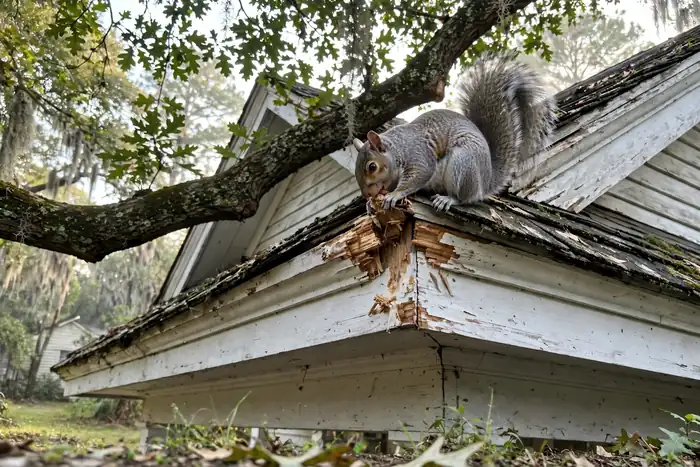
Squirrels in a Jackson attic that nobody listened to for five days
The classic Jackson squirrel call does not start with a sighting. It starts with a sound at first light on the first morning of a stay: a rolling, scrabbling run above the bedroom of a lake house that was silent when everyone arrived the night before. Squirrels keep early hours, and in a part-time home their whole first week can pass unheard. The owner is not meeting a new problem on that Friday dawn — they are meeting a finished one, complete with a nest built from insulation and leaves carried in one mouthful at a time.
In town the same animal arrives by a shorter road. Jackson lots inside the city still carry mature oaks and pines hard against the houses, and a squirrel that feeds in those crowns treats a roof as another branch platform. From a limb it can reach a vent, test the screen with its teeth, and drop onto shingles without ever touching the ground where a dog or a person might interrupt it. If your Jackson roof has a tree touching or nearly touching it, that contact point is where our crew starts looking, whatever room the noise seems to come from.
The Tuesday chew: how Jackson squirrels open a cabin nobody is home to defend
Squirrels open houses by persistence rather than force. A slightly soft fascia board at a gable corner gets tested, then widened a shaving at a time across several undisturbed mornings. In a full-time home that gnawing is usually heard and investigated within a day. In a Lake Jackson cabin it can run a full work week in peace, which is why part-time places so often present with a hole already large, edges already polished by passing bodies, and interior damage well past the first exploratory chew.
Insulation nests and stored lake gear in a Jackson attic left closed all week
Once inside, a squirrel turns the attic into a nursery and a pantry annex. Insulation gets tunnelled and packed into bowl nests, acorns from the lot oaks are cached in corners, and the soft things owners store overhead — life jackets, cushions, holiday boxes in a cabin loft — get shredded into lining. The longer the house sat between visits, the more of this rearrangement we find, and the more carefully the attic has to be checked after removal so cached food does not keep drawing attention from outside.
Woodland in-town Jackson lots where the canopy hands squirrels the roof
Ask where the squirrel entered an in-town Jackson home and the honest answer is often a specific tree. A water oak limb resting on the ridge, a pine crown hanging over a vent stack, or a fence run that meets the eave like a ramp all serve as delivery routes. We identify the route because closing the hole while leaving the limb in contact simply moves the chewing a few feet along the same eave to the next soft board the animal can reach from its familiar perch.
Wires, ducts, and the fire worry inside a Jackson cabin attic
A gnawing animal does not distinguish trim from wiring. Squirrels strip insulation off cables, chew duct runs, and pack dry leaves against warm fixtures, and in a house that stands empty those habits run for days with nobody smelling hot dust or hearing a fault. That risk is the practical reason we urge Jackson owners not to wait out a season hoping the noise stops — silence from an attic can mean a litter grown and gone, or it can mean the animals simply shifted to a bay above a quieter room.
Closing Jackson gables so the next empty week stays empty
Repairs here have to survive absence. We fit gnaw-resistant covers over vents, rebuild chewed corners with solid backing behind the trim, and seal the secondary gaps a squirrel would test next once its main door is gone. Then we talk through the lot: which limbs to bring back from the roofline, where firewood should move to, and how to spot fresh chew dust on a Friday arrival before it becomes a new opening. In Jackson, a ten-minute walk-around on each arrival is genuine prevention.
When a Jackson squirrel sound turns out to be something else in the roof
Not every dawn noise is a squirrel. Bats make faint rustling at dusk rather than a morning gallop, rats move at night with a lighter, steadier patter, and a raccoon sounds unmistakably heavier. Part-time owners hear only fragments of the pattern, so we ask about timing, weight, and direction of travel and verify in the attic itself. Getting the tenant right matters in Jackson because the repair that stops a squirrel will not hold a raccoon, and the approach for bats follows seasonal rules squirrels do not.
Common squirrel questions in Jackson
We only hear squirrels at our Jackson cabin on the first morning of a stay. Why?+
Can squirrels really chew into a Jackson house in just one week away?+
Our in-town Jackson roof has a big oak touching it. Is that the whole problem?+
Will squirrels leave our Jackson attic on their own when summer gets hot?+
What should we do the moment we hear scratching at our lake house?+
Do squirrels in a Jackson attic mean the cabin will smell?+
Other Jackson problems that come with squirrels
Our wildlife crew handles these closely related problems — the ones that most often turn up with a squirrel issue.
Got more than squirrels in Jackson?
While we are in a Jackson attic we also look for bat droppings in the gable peaks and rodent sign along the stored-gear walls, because a cabin quiet enough for squirrels is quiet enough for both — mention anything you have seen and we will fold it into the visit. See everything we handle locally on the Jackson wildlife removal hub, or jump to Georgia wildlife removal.
Want the background before you call? Read our statewide guide: Squirrels in the attic: what it costs and why sealing too early backfires.
Serving all of Butts County
Jackson is one part of Butts County. See wildlife removal in Butts County, GA for the county-wide picture — the animals we get called about most, and the other towns we cover.
One call to your Jackson squirrel crew
Getting squirrels out of a Jackson cabin is only half the work if the tree route stays open.
- Local to Butts County. Georgia DNR-compliant handling — call to ask about licensing and insurance.
- Our method follows the commute, not just the hole. We map which limb or fence line delivers squirrels to the roof, find every chewed opening that route connects to, move the animals out, and close the gaps with material a squirrel cannot gnaw back through in another empty week. Trimming guidance for the branches that bridge woodland to roofline is part of the same conversation.
- Done right. Removal, exclusion and cleanup.