Raccoon Removal in Jackson, GA
A raccoon in Jackson often eats at your place long before it sleeps there. Nights around dock bins and deck scraps teach it your address; the roof of a house that empties out on Sunday night is simply the quiet room above the restaurant.
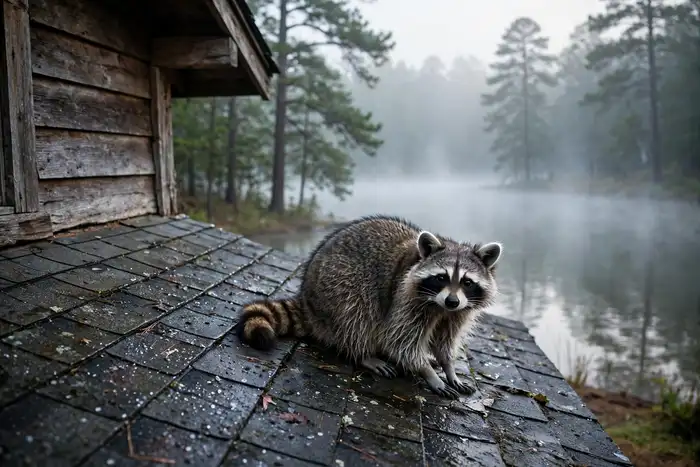
Raccoons that dined at a Jackson dock all month and then moved into the roof
On Lake Jackson a raccoon evening has a recognisable route. It comes out of the shoreline brush at dusk, checks the dock where fish were cleaned, works the bin that held the scraps, noses around the deck for what the grill dropped, and then — in a part-time house — climbs to a roof nobody will defend until Friday. The animal is not being bold. It is following a menu the property wrote for it, one weekend of leftovers at a time, and the roof den is usually the last stop the route acquires, not the first.
In town, Jackson raccoons run a quieter version of the same business through alleys, carports, and the big oaks behind older houses. Their hands are the headline: they peel back loose soffit panels, lift shingles at a roof return, and roll a poorly latched crawlspace door enough to slip through. Heavy thumping that moves slowly across a ceiling at night, rather than the light gallop of squirrels at dawn, is their signature — and when that sound settles over one room and stays, a mother may be raising kits in the insulation.
Fish-cleaning waste, dock bins, and the Jackson shoreline menu
Nothing on a lake lot advertises like fish waste left accessible overnight. Cleaning-table scraps, bait buckets, and bin bags that held a catch give off a scent trail that carries along the shore, and raccoons patrol that shore nightly. One rewarded visit becomes a route; a route that passes your dock becomes a route that inspects your deck, your carport, and eventually your roofline. Breaking the menu — latched metal bins, scraps removed the same evening, tables rinsed down — does not remove a denned raccoon, but it decides whether the next raccoon bothers to climb.
A mother raccoon denning above a Jackson cabin that empties every Sunday
Spring and early summer change the stakes. A female raccoon looks for a den that is dry, dark, and left alone for long stretches — a description a midweek-empty cabin attic fits better than almost any hollow tree. She will tear a generous opening, because she needs to come and go with kits inside, and she defends that space hard. If heavy sounds, churring noises, or a strong musky smell settle over one bedroom of a Jackson lake house, tell us before anyone goes into the attic; a cornered mother is the one raccoon encounter we work hardest to prevent for homeowners.
Hands on tired wood: soffits and roof returns on older Jackson homes
Raccoon entry points in town Jackson look pried, not chewed. Look for soffit panels sprung at a corner, fascia pulled outward, or a vent cover bent at one edge where fingers got purchase. These animals test a roofline the way a person tests a loose gate, returning to the joint that moved. Our repairs answer that strength directly: solid backing, screwed rather than stapled covers, and flashing renewed where it was lifted, because a patch a raccoon can flex is a patch it will reopen on a quiet night.
Georgia rules for raccoons: why a Jackson raccoon is removed, not relocated
Raccoons sit on Georgia's rabies-vector list, and state law treats them accordingly. Under O.C.G.A. 27-2-10, rabies-vector species — raccoon, skunk, bobcat, fox, and coyote — are removed, not relocated. That is not a preference of ours; it is how Georgia protects both people and the animals already living wherever a raccoon might otherwise be released. We explain this plainly on every Jackson raccoon call so nobody expects a countryside release that the law does not allow and disease control does not support.
Chimneys, decks, and crawlspaces: the other Jackson raccoon addresses
Not every raccoon chooses the attic. Uncapped chimneys on older Jackson homes collect nesting females who mistake the flue shelf for a hollow trunk. The void under a low deck offers a latrine and a den in one, announced by droppings concentrated in a corner and a smell that rises through the boards at midday. Raised lake cabins invite occupation underneath, where a raccoon can den against warm ductwork. Each space needs its own handling, and each leaves different evidence — which is why we ask where on the property the signs are, not just whether raccoons are present.
After a Jackson raccoon is out: droppings, insulation, and honest clean-up talk
Raccoon latrines are the part of the job nobody should improvise. Droppings concentrated in an attic carry health risks that call for careful removal rather than a homeowner with a dustpan, and insulation matted into a den bowl rarely recovers its condition. Once the animal is out and the entries are hardened, we will show you what was fouled, what can stay, and what should come out, in plain terms. On a part-time property that conversation matters more, because contaminated insulation left in a closed house seasons the whole building between visits.
Common raccoon questions in Jackson
Our dock bins get raided every weekend at Lake Jackson. Does that mean raccoons are in the house?+
We hear heavy thumping over one room of our Jackson home at night. Is it a raccoon?+
Can you just trap the raccoon at our Jackson lake house and release it in the woods nearby?+
There are raccoon droppings all along one side of our Jackson attic. Can we clean that ourselves?+
A raccoon got into our Jackson chimney. Should we light a fire to drive it out?+
Why did raccoons pick our older in-town house and not the newer one next door?+
Other Jackson problems that come with raccoons
Our wildlife crew handles these closely related problems — the ones that most often turn up with a raccoon issue.
Got more than raccoons in Jackson?
Raccoon traffic around a Jackson lake house usually overlaps with rodent activity in the storage areas below it, drawn by the same spilled feed and scraps — if you are finding droppings in the boathouse or carport too, say so and we will look at both levels in one visit. See everything we handle locally on the Jackson wildlife removal hub, or jump to Georgia wildlife removal.
Want the background before you call? Read our statewide guide: Raccoon in the attic: babies, rabies law and what happens next.
Serving all of Butts County
Jackson is one part of Butts County. See wildlife removal in Butts County, GA for the county-wide picture — the animals we get called about most, and the other towns we cover.
One call to your Jackson raccoon crew
A raccoon removed from a Jackson roof will be replaced if supper is still served at the dock.
- Local to Butts County. Georgia DNR-compliant handling — call to ask about licensing and insurance.
- Our method starts at the food and ends at the flashing. We trace how the animal is feeding on the property, remove the raccoon from the structure, and then harden the exact joints its hands exploited — soffit corners, roof returns, chimney flashing — with fastenings that resist prying. We finish with plain guidance on bins, grills, and cleaning tables so the shoreline routine that attracted it loses its reward.
- Done right. Removal, exclusion and cleanup.