Dead Animal Removal in Jackson, GA
The worst version of this call in Jackson has a particular script: the drive down, the key in the lock, the door of a house shut for ten days — and a smell that says something died inside the walls while nobody was there to hear it alive.
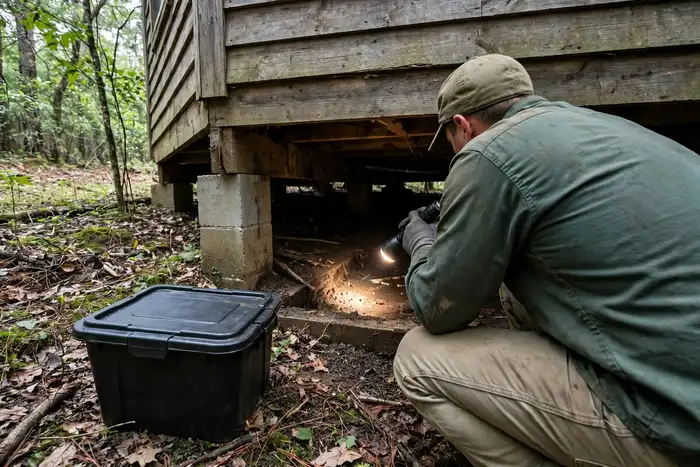
An animal that died in the walls of a Jackson house while it stood empty
Dead-animal calls in Jackson cluster around return days. A lake house or cabin sits closed through warm weather, its interior air still, and somewhere in a wall void, under a tub, or along a crawlspace duct an animal that got in — and could not get out — dies unheard. Decomposition in a sealed, sun-warmed house is fast and thorough, and the smell works its way through every crack into the living space. When the owners finally open the door, the odour does not read as a hint. It reads as the whole house, and it does not fade by airing the rooms for an afternoon.
Full-time Jackson homes get a different version: a smell that builds room by room over several days, strongest in one wall, worse when the air system runs, with flies appearing at a window for no obvious reason. That slower presentation helps localisation, because the household notices the day it starts and the room where it peaks. In both versions the principle is identical — the carcass is in a specific place, scent follows predictable paths through the structure, and random wall-cutting is the expensive way to learn what a systematic search reveals. Our crew works the pattern first and opens only what the pattern indicts.
The sealed Jackson lake house in warm weather: why the smell is so complete
A closed house is an incubator. With windows shut and no air moving except the occasional thermostat cycle, warmth builds through a Jackson summer day and odour saturates soft furnishings, insulation, and the dust in duct runs. That is why a carcass no larger than a squirrel can perfume an entire cabin by the second week. It also means the timeline owners give us — last visit date, first day of smell — carries real information about where in the process things stand and whether a live animal may still be trapped elsewhere in the structure, a possibility we always check on arrival-day calls.
Wall voids in older Jackson homes where animals fall and cannot climb out
The classic in-wall death starts at the top. An animal exploring from the attic or a chimney steps or falls into a wall cavity whose smooth inner faces give it nothing to climb, especially in the framed voids of older Jackson houses with additions built onto additions. It dies at the base of that wall, often directly behind a bedroom or bathroom, which is why the smell in such cases is fiercely localised to one stretch of one room. We locate that base by scent gradient and by the structure of the framing, then open the smallest practical access at the lowest point rather than demolishing the wall that smells.
Crawlspaces under Jackson cabins: ducts, insulation, and carcasses below the floor
Under a raised lake house the dead animal is usually found along the warm routes: beside ductwork, in fallen insulation, or in the far corner where a trapped creature followed the foundation wall. The smell rises through floor gaps and registers, which is why owners often swear it is in a room whose walls are actually innocent. Crawlspace work in Jackson means low headroom, damp soil, and methodical searching with lights along every run — unglamorous, but it is where a large share of supposed wall cases are truly solved, and solving it there spares the house any cutting at all.
Chimneys in Jackson houses that sit unused between cold snaps
An unused chimney is a vertical trap. Birds, squirrels, and raccoons enter an uncapped flue of a Jackson home that burns fires only on winter weekends, slide or fall below the damper, and die in a space that vents its smell straight into the living room every time the air warms. If the odour in your house centres on the fireplace and strengthens on sunny afternoons, the flue is our first inspection, before walls. Removal from a chimney is its own procedure, and a proper cap afterwards converts the houses most reliable animal entrance into a closed one permanently.
After the carcass: soiled insulation, flies, and getting a Jackson house back
Removing the animal is not the whole remedy, because fluids soak into whatever lies beneath it and that material goes on smelling after the carcass is gone. In a wall that may mean a section of insulation at the base; in an attic, a fouled patch under the roost or run. We remove what is saturated, treat the immediate surfaces, and will tell you plainly if a space needs airing time after we finish. Fly activity — often the second thing owners notice at a closed Jackson house — subsides once the source is out, and screening the vents the flies used to enter is part of closing the incident properly.
Preventing the sequel in a Jackson house that will stand empty again
Every dead-animal job ends with the same question: how did it get in, and will the next one manage it during the next absence? The answers in Jackson are usually a chimney without a cap, a crawlspace door that does not latch against a curious raccoon, or a vent screen torn just enough for a squirrel. Because these houses sit unobserved for stretches, we weight the closing repairs heavily — a sealed seasonal home should be boring to wildlife for months at a time. We will leave you with the short list of what we sealed and what to glance at on each arrival, so the house greets you with lake air next time instead.
Common dead animal questions in Jackson
We arrived at our Jackson lake house to a terrible smell that was not there two weeks ago. What likely happened?+
The smell in our Jackson home is worst in one bedroom wall. Does that pinpoint the animal?+
How long will the smell last in our Jackson house if we just wait it out?+
There are flies all over one window of our closed Jackson cabin. Is that connected to the smell?+
Can you tell whether the dead animal in our Jackson wall was a squirrel, a rat, or something else?+
Our Jackson home smells awful near the fireplace but nowhere else. Where should we look?+
Other Jackson problems that come with dead animals
Our wildlife crew handles these closely related problems — the ones that most often turn up with a dead animal issue.
Got more than dead animals in Jackson?
A death in the walls of a Jackson home is often the end of a live-animal story nobody heard — squirrels in the attic or rodents in the voids first. If there was scratching in earlier visits, or there is still live noise alongside the smell, tell us and we will plan the visit to handle both chapters at once. See everything we handle locally on the Jackson wildlife removal hub, or jump to Georgia wildlife removal.
Want the background before you call? Read our statewide guide: Dead animal in a wall or attic: how long the smell lasts.
Serving all of Butts County
Jackson is one part of Butts County. See wildlife removal in Butts County, GA for the county-wide picture — the animals we get called about most, and the other towns we cover.
One call to your Jackson dead animal crew
Finding the carcass is the centre of this work, but a Jackson house only smells right again when the entry that admitted the animal is closed too.
- Local to Butts County. Georgia DNR-compliant handling — call to ask about licensing and insurance.
- Our method is locate precisely, remove completely, and close the door it used. We narrow the void by scent mapping and inspection access before anything is opened, remove the animal and the insulation or material it fouled, treat the immediate area, and then identify and seal the entry — a chimney, a vent, a crawlspace gap — so the next animal exploring your roofline does not repeat the story during your next absence.
- Done right. Removal, exclusion and cleanup.