Rodent Control in Jackson, GA
A mouse does not need a Jackson house to be abandoned. It needs it to be predictable: feed in the same sack, crumbs in the same drawer, and long quiet stretches when nothing larger than a spider walks the kitchen.
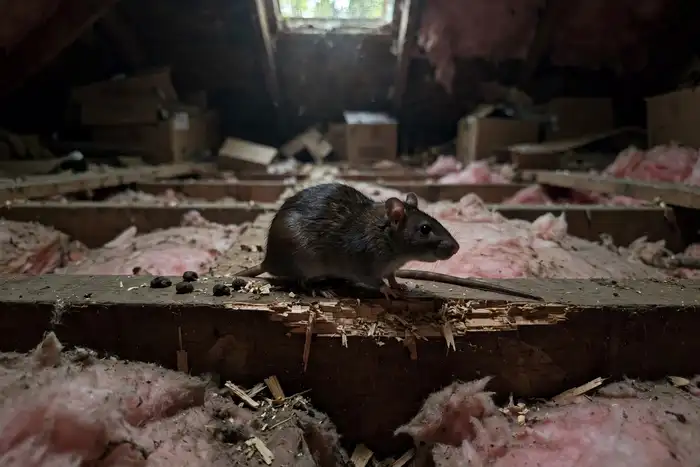
Rats and mice settled into a Jackson home during its quiet weeks
Rodents read a Jackson property by its leftovers. Rural homes keep feed for chickens, dogs, or deer in carports and outbuildings; lake cabins keep a pantry stocked for the next visit, snacks in a drawer, and a bag of charcoal or seed on the porch. To a mouse, a house visited twice a month is not empty — it is a stocked larder with occasional giants in it. Colonies here grow in the walls and insulation between visits, so the owners first evidence is often a drawer of droppings, a gnawed feed sack slumped in the corner, or the unmistakable stale smell of a nest in a closed room.
Full-time Jackson homes are not exempt; they just meet the problem earlier. A rat working the tree line behind an in-town house needs one gap at a pipe entry or a gnawed crawlspace vent to move its route indoors, and from there the wall voids become a heated highway between the kitchen and the attic. The difference is tempo: occupied homes hear the night traffic in the walls within days, while seasonal homes around the lake may host three generations before a human spends a night. Either way, the colony is never just the one animal someone glimpsed crossing the porch.
Stored feed in Jackson carports and outbuildings: the colony cafeteria
More Jackson rodent problems are catered than owners realise. A torn feed sack in an outbuilding feeds rats where they shelter; the same animals then explore the house wall ten feet away with full stomachs and established scent trails. Bird seed in a porch bin, dog food in a carport tub without a true lid, and deer corn stacked for the season all count. Part of our visit is a storage walk, because moving feed into sealed metal or heavy plastic bins often ends the outdoor half of an infestation before any trap is set.
The seasonal Jackson pantry: mice in a kitchen closed for a month
A cabin pantry is mouse architecture: shelf above shelf of boxed goods, a stove drawer full of crumbs and a warm motor below it, and nobody opening a door for weeks. Mice nest in the drawer insulation, run the shelf edges at night, and leave the rice-grain droppings owners find when they arrive with groceries. We treat seasonal kitchens as their own discipline — clearing and cleaning the runs, checking behind and under appliances, and advising owners to decant supplies into jars and tins, because cardboard and thin plastic are packaging a mouse opens professionally.
Rats along Jackson tree lines and the crawlspace vents they test nightly
Roof rats and Norway rats reach Jackson houses from the cover at the lots edge. A rat follows the same fence or brush line nightly, tests the crawlspace vent screens with its teeth, and exploits the one whose mesh has rusted or whose frame has shrunk from the foundation. Once under the house it has the run of every pipe opening into the walls. Sealing for rats is carpentry at small scale: hardware cloth set in frames, gaps at pipe entries closed with material teeth cannot work, and vent screens renewed before they fail the nightly test again.
Insulation highways in a quiet Jackson attic and what the traffic damages
Rodents do not just pass through insulation; they farm it. Runs get tunnelled into permanent paths, nests get lined with shredded material in the warmest bays, and urine soaks the same routes until an attic in a closed Jackson house develops a sharp, stale reek that drifts down through ceiling fixtures. Wiring along those runs gets gnawed, and stored cabin gear — cushions, linens, life vests in a loft — gets harvested for bedding. After removal we will show you which bays were lived in, because owners deciding on clean-up deserve to see the traffic map rather than guess.
Why Jackson rodent problems return when only the visible animals are caught
A trap line that takes five mice from a cabin with a dozen entry gaps is a harvest, not a cure. The colony replaces its losses from the surrounding woods and outbuildings as long as doors and dinner remain. That is why our Jackson rodent work is judged at the re-check: are droppings still appearing in the pantry, is the feed room quiet, has anything re-gnawed a sealed corner? Sealing first-class and food stored hard make the removal hold; skipping either turns a rural property into a standing reservation for the next litter born in the brush at the lot line.
Snap traps, stations, and placement a Jackson family can live with
Control methods have to fit how a Jackson house is actually used — children arriving Friday, dogs underfoot, feed animals in the yard. We place devices along the runs rodents already travel, inside wall-adjacent spaces and storage areas rather than in the middle of living rooms, and we explain every placement to the owner so nothing is a surprise to a bare foot at midnight. Where outdoor pressure from outbuildings and tree lines is heavy, we will talk honestly about an ongoing check rhythm for the property instead of pretending one visit rewires the woods.
Common rodent questions in Jackson
We find mouse droppings in our Lake Jackson cabin every time we arrive. Where are they living?+
Is one mouse in our Jackson house ever just one mouse?+
Our feed room in Jackson keeps getting raided even though the house is clean. Why?+
Can rodents really get through a gap as small as people say?+
We hear light scratching in the walls of our Jackson home at night. Is it rodents or something bigger?+
Will sealing our Jackson cabin keep rodents out while it sits empty this winter?+
Other Jackson problems that come with rodents
Our wildlife crew handles these closely related problems — the ones that most often turn up with a rodent issue.
Got more than rodents in Jackson?
Rodents under a Jackson lake house are also snake food delivered to the crawlspace door — if your rodent sign comes with shed skins or shoreline snake sightings near the steps, say so on the call and we will treat the two problems as the single system they are. See everything we handle locally on the Jackson wildlife removal hub, or jump to Georgia wildlife removal.
Want the background before you call? Read our statewide guide: Roof rats in Georgia: why bait alone never ends it.
Serving all of Butts County
Jackson is one part of Butts County. See wildlife removal in Butts County, GA for the county-wide picture — the animals we get called about most, and the other towns we cover.
One call to your Jackson rodent crew
Trapping rodents out of a Jackson cabin without closing their doors and their food supply is a subscription, not a solution.
- Local to Butts County. Georgia DNR-compliant handling — call to ask about licensing and insurance.
- Our method is remove, seal, and starve — in that order of work. We remove the animals present, seal the gaps they used at a tolerance most owners underestimate, and then go through the storage habits that fed them: sacked feed into lidded bins, pantry goods into hard containers, and the carport and outbuilding supplies rearranged so a returning scout finds a Jackson property that no longer caters.
- Done right. Removal, exclusion and cleanup.