Bat Removal in Jackson, GA
A closed-up house near the lake is perfect bat country: insects over the water at dusk, a warm ridge to roost under by day, and nobody inside for a week at a time to notice the first faint rustle in the gable.
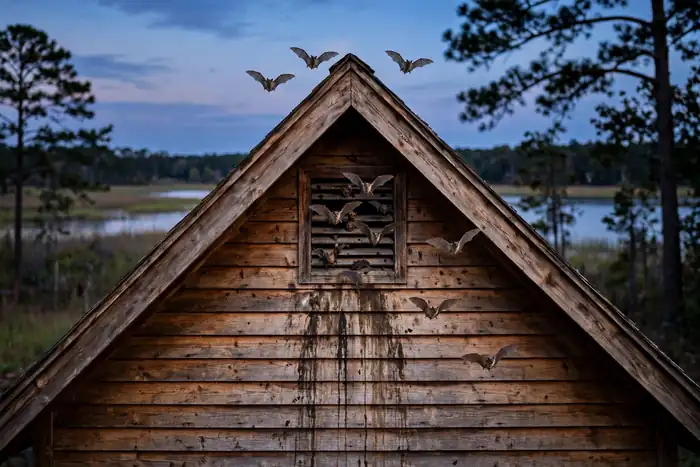
Bats roosting in a Jackson house that stays shut between weekend visits
Bats around Lake Jackson live well. The water breeds the evening insects they hunt, the shoreline woods give them commuting cover, and the roofs of cabins and older Jackson houses give them the hot, narrow daytime roosts they prefer — tucked under ridge caps, behind gable vents, and along the peaks where sun-warmed shingles meet. A bat needs a gap no wider than a thumb joint, which means a house can look perfectly sound from the driveway and still be hosting a colony along its highest seams.
What makes Jackson special for bats is the calendar of its houses. A colony in a full-time home usually gets noticed — a smell in a upstairs room, staining at a vent, a bat in the hall. A colony in a cabin opened six weekends a summer can grow for seasons behind walls nobody sleeps against in February. Owners often meet the problem fully grown: droppings streaking the siding under a vent, a sweet, musty odour in the closed-up rooms, and soft chittering at dusk that they first assume is coming from the trees.
Gable vents and ridge lines on Jackson cabins that warm up empty
An empty house still heats and cools every day, and its roof peak becomes a reliable warm roost while the rooms below stay shut. Bats favour the ridge and the tops of gable vents because heat gathers there and the slots behind louvres are exactly body-width. On Jackson cabins we inspect those high seams first, looking for the tell-tale rub marks and droppings caught on siding below, because a colony at the ridge can be large long before a single dropping appears inside the living space.
Older in-town Jackson rooflines where a bat gap hides in plain sight
In town the entry points are architectural leftovers: a chimney flashing gap from a re-roof years ago, a dormer cheek where trim shrank, a soffit joint at the top of a two-storey wall no ladder has reached in a decade. Bats do not need damage; they need a seam, and older Jackson houses are built from seams. Our inspection works seam by seam rather than hole by hole, because sealing the one gap with droppings under it while leaving its twin on the other dormer untouched simply moves the colony across the roof.
The April-to-July rule that governs every Jackson bat job
Timing is law-bound in Georgia. Bat exclusion is restricted during maternity season, from April 1 through July 31, when flightless pups are in the roost and sealing exits would trap them inside to die in the walls. During that window we assess, identify exits, and plan, but the exclusion itself waits until the young are flying. We would rather give a Jackson owner an honest date than a fast one — a botched in-season seal turns a roof problem into a dead-animal problem inside the building, and it breaks the rules we work under.
Droppings in a closed-up Jackson cabin: what guano tells and what it risks
Bat droppings accumulate where bats roost, and in a closed cabin they accumulate undisturbed — along wall tops, in the insulation under a ridge, and in little heaps below exterior exits. Guano is useful evidence: its location maps the roost precisely. It is also material to treat with respect, since dried droppings disturbed in a sealed, dusty attic are a genuine health concern. Leave it in place, keep the hatch shut, and let our crew judge the quantity and plan any clean-up with proper precautions rather than sweeping it up as a weekend chore.
One-way exits over Lake Jackson at dusk: how a colony actually leaves
A proper exclusion uses the bats own routine. They leave at dusk to hunt over the water and the fields, so one-way devices fitted at the proven exits let that departure happen while blocking the return at dawn. The colony does not vanish in a night; it relocates over several evenings to roosts in the surrounding woods, which around Jackson are plentiful. Once activity at the devices stops, the exits are sealed permanently and the secondary seams closed, so the next bat scouting your roofline finds no familiar door ajar.
A single bat in a Jackson bedroom at midnight is a different call
One bat circling a bedroom is usually a wanderer that came down a flue or through a door left open at dusk, not proof of a colony — but it should never be handled bare-handed, and nobody who slept in that room should shrug it off. Close the room off, keep people and pets out, open an exterior window or door if you can do so safely from the doorway, and call us for guidance. We will also check the roofline afterwards, because in an older Jackson house a lone indoor bat sometimes is the colony introducing itself.
Common bat questions in Jackson
Our Jackson cabin smells musty-sweet when we open it up. Could that be bats?+
Why can the bats in our Jackson attic not just be sealed out this month if it is summer?+
We found a bat hanging in our in-town Jackson home in daytime. What should we do?+
Will bats come back to our Lake Jackson house next year after exclusion?+
How did bats get into a Jackson house that looks completely solid?+
Are the bats at our Jackson place dangerous to leave until the exclusion date?+
Other Jackson problems that come with bats
Our wildlife crew handles these closely related problems — the ones that most often turn up with a bat issue.
Got more than bats in Jackson?
The same lifted ridge caps and tired gable vents that admit bats into a Jackson home are the openings squirrels widen next — if you have heard heavier daytime movement as well as dusk rustling, mention both and we will assess the roofline as one system. See everything we handle locally on the Jackson wildlife removal hub, or jump to Georgia wildlife removal.
Want the background before you call? Read our statewide guide: Bats in your attic: Georgia law, maternity season and what exclusion costs.
Serving all of Butts County
Jackson is one part of Butts County. See wildlife removal in Butts County, GA for the county-wide picture — the animals we get called about most, and the other towns we cover.
One call to your Jackson bat crew
Bats leave a Jackson roof through the gaps they already trust, so the work is about guiding, timing, and sealing in the right order.
- Local to Butts County. Georgia DNR-compliant handling — call to ask about licensing and insurance.
- Our method respects the season first, then the structure. We identify the active exits, fit one-way devices that let bats depart at dusk and not re-enter, and only seal the remaining gaps once the roost is empty, scheduling around the maternity restriction. On a part-time Jackson property we also set the check-back around your visits, so confirmation happens when someone can actually be there.
- Done right. Removal, exclusion and cleanup.