Snake Removal in Jackson, GA
In Jackson the snake question is usually a shoreline question. Rocks that hold the afternoon sun, brush where frogs gather at dusk, and a cool crawlspace under a raised cabin are three stops on the same short patrol.
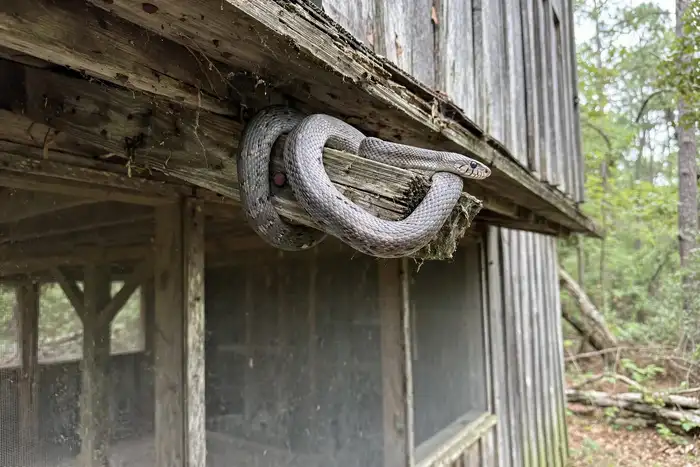
Snakes working the rocks and brush between Lake Jackson and your cabin steps
Jackson lots near the water give snakes everything in one short slope. The lake edge holds frogs and small fish, the brush line above it holds rodents and lizards, the riprap and dock rocks hold the days heat for an animal that runs on borrowed warmth, and the crawlspace of a raised cabin offers a cool, damp room for the hottest hours. A snake on a Jackson property is rarely lost. It is working that slope the way it has for years before the house mattered to it, and understanding the slope is what turns a removal into a lasting fix.
Away from the water the pattern repeats in miniature. Woodpiles stacked for the fireplace, brush heaped where a lot was cleared and never finished, stone edging along a shaded Jackson garden, and the cool gap under in-town porch steps all offer the same trio of cover, prey, and temperature choice. Most snakes using these spots want to be left alone in them, and most encounters happen because a person reaches or steps into one unannounced. Our calls in Butts County are as much about rearranging that meeting as they are about the snake itself.
Riprap, dock rocks, and retaining stones: Jackson's sun-warmed snake shelves
Rock along a shoreline is a snakes solar panel and fortress in one. It warms through the morning, offers body-shaped crevices to vanish into, and sits beside the water where prey concentrates. That is why the same flat stone by a Jackson dock can hold a snake three afternoons running. We search rock work slowly and from the side, with tools rather than hands, and we will tell you honestly if a particular pile is functioning as a den site — sometimes the lasting answer is re-stacking or relocating one small section of rock away from the swimming and walking area, not repeated removals.
Brush piles and woodpiles against Jackson cabins: cover stacked by the owner
Few Jackson properties mean to build snake housing, but a brush pile left from clearing a lot and a woodpile seasoned against the cabin wall are read by snakes as premium cover with hunting attached. Rodents nest in both, which makes them buffets as well as shelters. Moving firewood onto a rack away from the house, burning or chipping down old brush, and keeping a mown margin around steps and dock paths removes more snakes over a season than any number of individual captures — the animals simply stop finding the address interesting.
Crawlspaces under raised Lake Jackson houses where snakes cool off
A raised cabin on a damp, shaded lot keeps a crawlspace at exactly the temperature a snake wants in August, and if rodents are living off stored feed or cabin scraps under there, the hunting is indoor. Snakes enter at torn vent screens and gaps around pipes, and a shed skin along a foundation wall is often the first evidence an owner finds. We check the crawlspace as part of a shoreline call because evicting the snake while leaving its prey and its doorway intact just schedules the sequel.
Which Jackson snakes are venomous, and why identification comes first
Georgia has 47 native snake species, and only 7 of them are venomous. Around Jackson that means the large majority of encounters — racers along a fence, rat snakes in a woodpile or climbing after attic rodents, watersnakes along the shore — involve animals that are not venomous. Non-venomous snakes are protected in Georgia, so they are handled as carefully as the law expects and harm is never the default. Identification still comes before any approach, because the minority that are venomous, such as a copperhead in leaf litter or a timber rattlesnake on a rocky slope, demand distance and a different plan.
Watersnakes at the Jackson shoreline that are not cottonmouths
The snake most argued about on Lake Jackson docks is usually a harmless watersnake. Thick-bodied and quick to flatten its head when cornered, it looks the part of its venomous relative while spending its days on frogs and fish at the waters edge. We will never ask you to make that call yourself at armchair distance — from the dock, every shoreline snake earns the same respectful space. What we can do is identify it on site, remove it if it has taken up residence where people swim and fish, and show you the features that separate the two so dock life gets calmer.
A snake inside a Jackson home: the rodent trail it probably followed
An indoor snake in Jackson has usually followed dinner. Rat snakes in particular trace rodent scent through wall gaps and into attics, which is why a snake on a cabin rafter often signals mice in the same space. After locating and removing the snake, we trace its likely route — the pipe chase, the torn screen, the gap at the foundation — and check for the prey run that led it in. Owners understandably fixate on the snake; our crew fixes on the doorway and the dinner, because those are what would bring the next one.
Common snake questions in Jackson
We see a snake on the rocks by our Lake Jackson dock almost every sunny day. Is it living there?+
Is the snake in our Jackson woodpile dangerous?+
Can we keep snakes away from our Jackson cabin without harming them?+
A snake shed its skin in our Jackson crawlspace. Does that mean it is still there?+
Our dog found a snake in the yard of our in-town Jackson home. What happens now?+
Do snakes climb into Jackson attics, or is that a myth?+
Other Jackson problems that come with snakes
Our wildlife crew handles these closely related problems — the ones that most often turn up with a snake issue.
Got more than snakes in Jackson?
Snakes near a Jackson cabin are often following rodents into the crawlspace beneath it — if you are also hearing night movement under the floors or finding droppings in storage, tell us, because solving the rodent food supply usually ends the snake visits too. See everything we handle locally on the Jackson wildlife removal hub, or jump to Georgia wildlife removal.
Want the background before you call? Read our statewide guide: Georgia snakes: which are venomous, and what is legal.
Serving all of Butts County
Jackson is one part of Butts County. See wildlife removal in Butts County, GA for the county-wide picture — the animals we get called about most, and the other towns we cover.
One call to your Jackson snake crew
Removing one snake from a Jackson shoreline lot helps for a week; removing its reasons for staying helps for seasons.
- Local to Butts County. Georgia DNR-compliant handling — call to ask about licensing and insurance.
- Our method pairs the capture with a shoreline clean-up plan. We locate and handle the snake safely, then walk the property with you to rank what is holding snakes near the house: brush against the steps, a woodpile against the cabin wall, prey living in the crawlspace, or rocks piled where children walk. Tackle the top items on that list and the lot stops advertising itself to the next snake passing along the water.
- Done right. Removal, exclusion and cleanup.