Armadillo Removal in Sebastian, FL
This is the town’s signature call: a quarter acre of lawn worked over in one night, mulch out of every bed, and a fresh burrow under the shed ramp. If the damage map keeps growing, describe its extent — in Sebastian, the size of the lot is part of the plan.
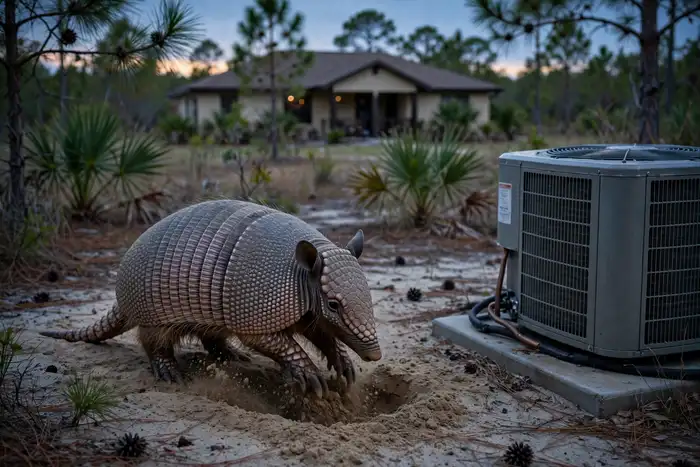
Armadillos in your Sebastian home
Sebastian was armadillo habitat before it was a city, and the nine-banded armadillo has declined to move out. What the town gives it is close to ideal: large irrigated lots over sandy soil, grove-edge streets where windbreaks and ditch banks hold burrows, scrub and preserve country to the west supplying new animals, and a river corridor stitching it all together. The animal works at night by smell, nearly blind and utterly methodical, excavating grubs and insects a few inches down — and a Sebastian lot gives it room to excavate at a scale a small yard never shows.
The plain fact first, because Sebastian callers ask weekly: an armadillo is nonnative in Florida and is never relocated or released — not to the preserve, not to a farm, not anywhere. Removal means professional trapping under Florida's rules for nonnative wildlife, explained honestly at the first conversation. Anyone who offers to catch your armadillo and let it go out in the country is offering something the rules do not contain, and the burrow under your shed will outlast the promise.
Reading damage at Sebastian scale
On a big Sebastian lot the evidence is a map, not a hole. Shallow conical pits scatter where individual grubs were taken; broader rooted patches mark the rich ground along irrigation lines and bed edges; mulch is pushed out in a fan. Fresh work is dark and damp at sunrise. Somewhere on that map sits the address that matters — a burrow mouth, roughly dinner-plate wide, at the base of the shed, under a ramp or slab edge, or in the fence-line scrub, with excavated sand below it. Trapping strategy starts at the burrow and the runs radiating from it, not at whichever lawn hole annoyed you most.
Burrows under the working parts of a Sebastian lot
Sebastian lots are working lots — sheds, boat trailers, ramps, workshops, pool equipment — and armadillos burrow under all of it, because a slab or a shed floor shades the sand and stabilises the tunnel roof. A burrow under a slab edge withdraws the support the concrete bears on, and sandy soil settles fast once it starts. Grove-edge properties add the commuter pattern: the burrow sits in the windbreak or ditch bank off the lot, and the animal commutes in nightly to feed. The survey therefore walks the boundaries as carefully as the buildings; a trap plan drawn only around the house misses the commuter entirely.
Trapping an animal that follows its nose
Armadillos are not caught with menus. A smell-led animal walking a habitual route is caught by placement and guidance: traps set squarely on the runs between burrow and feeding ground, with low guide boards or fencing that funnel a nose-down animal into the opening before it registers any obstacle. Across a large lot that means several sets, placed from the morning's fresh sign and adjusted as the pattern clarifies. It is methodical, unglamorous work, and it is why a trap dropped hopefully beside the worst hole — where the homeowner walks, not the armadillo — catches nothing but weather and the occasional sprinkler.
Females, identical quadruplets and the spring burrow
One Sebastian curiosity matters for timing: a female nine-banded armadillo gives birth to identical quadruplets, four young from a single egg, typically raised in the burrow through spring and summer. A burrow that holds one feeding adult in winter can hold a family by early summer, which changes the trap count and the patience required. It is another reason the inspection sizes the job from burrow and run evidence rather than from the one animal somebody glimpsed at the fence — and why 'just the one' quoted over the phone should be treated as a guess.
After the animal: burrow, lawn and the next prospector
An emptied Sebastian burrow advertises itself. Opossums inspect vacant burrows, and with preserve and grove country supplying armadillos continuously, a ready-made den under your shed will be re-let within weeks if it is left open. Once removal is confirmed complete, the burrow is collapsed and filled properly, and vulnerable slab and shed edges can be screened below grade. The lawn is usually kinder than it looks: rooted turf pressed back, watered and left to a growing season recovers across most of a lot, and we will point out the areas that genuinely need sod rather than let a landscaper sell you a whole new yard.
Grub treatment and gadgets, graded honestly
Treating a lawn for grubs removes one course from the armadillo's menu, and on some Sebastian properties it visibly thins the visits. It does not touch the worms and insects that make up the rest of the diet, it does nothing about a burrow already dug under the workshop, and on grove-edge lots the surrounding ground restocks the buffet nightly. Repellent granules, ultrasonic stakes and similar gadgets share that record: a smell-led animal with a den on the property tolerates a remarkable amount of discouragement. Trap the resident, close the burrow, then use lawn care as the supporting act it actually is.
Common armadillo questions in Sebastian
How many armadillos are working a lot this size?+
Why not just live-trap it and release it west of town?+
The burrow is under my shed. Can I collapse it myself?+
Is the damage seasonal in Sebastian?+
Should I keep my dog away from an armadillo?+
Other Sebastian problems that come with armadillos
Our wildlife crew handles these closely related problems — the ones that most often turn up with a armadillo issue.
Got more than armadillos in Sebastian?
Armadillos are rarely the only thing using an attic or yard in Sebastian. See everything we handle locally on the Sebastian wildlife removal hub, or jump to Florida wildlife removal.
Serving all of Indian River County
Sebastian is one part of Indian River County. See wildlife removal in Indian River County, FL for the county-wide picture — the animals we get called about most, and the other towns we cover.
One call to your Sebastian armadillo crew
The longer armadillos stay in the attic, the more they chew and the bigger the cleanup. Call us and tell us about the job — we will confirm the local crew for your county before any work starts.
- Local to Indian River County. FWC-compliant handling — call to ask about licensing and insurance.
- Humane exclusion. One-way doors and steel sealing, not poison.
- Done right. Removal, exclusion and cleanup.