Opossum Removal in Palm City, FL
The dog has found something under the pool deck that hisses, the cat food bowl empties itself nightly, and a pale shape ambles the canal bank like it pays taxes there. Mostly, it is harmless. Resident, though, is resident. Call us.
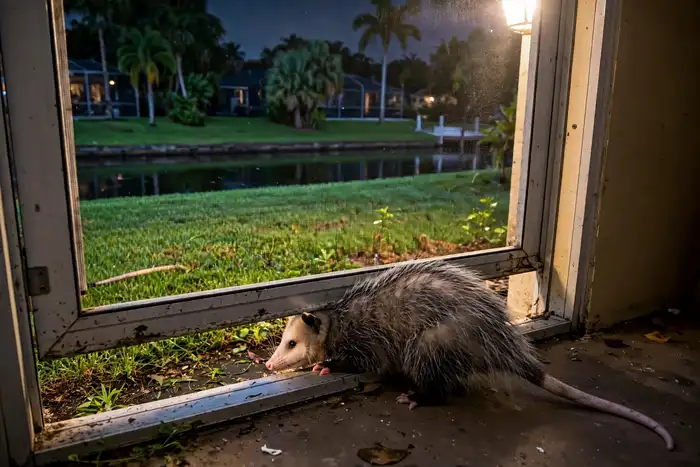
Opossums in your Palm City home
The Virginia opossum is the Treasure Coast's great drifter: a slow, solitary, mostly silent marsupial that works Palm City's canal banks, fence lines and pasture edges at night, eating insects, snails, fallen fruit and whatever pet food the neighborhood leaves out. It is not looking for your house. It is looking for a dry, dark, undisturbed place to sleep the day away — and Palm City offers those in abundance: the void under a pool deck, a garage's cluttered corner, a crawlspace with a failed vent, a hay shed on the western fringe with the door ajar since spring.
Because an opossum will take an offered shelter without damaging the building to get it, Palm City tenancies often run long before anyone objects — the animal is quiet, keeps late hours and cleans up insects as rent. The objections arrive in a cluster: the musky odor that grows with the tenancy, the dog that finally corners it, a litter of young appearing where one animal was assumed, or the opossum dying in its shelter, which in this climate converts an eccentric arrangement into an emergency within days.
Visitor or resident: the Palm City test
An opossum crossing your yard at midnight is traffic, not tenancy — they roam widely and rotate sleeping sites. Residence has a paper trail: droppings in one repeated corner, bedding of leaves and shredded material dragged to one spot, a gap under the pool deck worn smooth at a single point, and the same animal seen leaving the same shelter at the same dusk hour on successive evenings. If your sightings all involve one address — yours — the animal is not passing through.
Pool decks, garages and the tack room
Palm City's opossum lodgings map onto its lifestyles. Subdivision animals take pool-deck voids and garage corners, slipping in through a door left open to the evening or a gap at the deck skirt. Western-fringe animals take the outbuildings: barns, tack rooms and feed sheds, where the resident population is stable enough that the same shed can host a rotating cast across a season. Both patterns end the same way — removal plus a shelter physically closed, because an open void in Palm City does not stay vacant; it gets reviewed by the next drifter on the canal.
Counting the passengers
An opossum is rarely a single animal. Females carry young in the pouch through much of the year and then carry them riding on their backs, and a sheltered den may hold a mother with a full complement invisible to any casual look. Removal that misses the passengers, or a deck sealed with juveniles inside, manufactures next week's call. Our crew inspects the shelter completely — pouch, den and surroundings — before closure, and times family jobs so the whole household leaves the property together.
Short lives, warm walls
Wild opossums live fast and briefly — two or three years is a full life — and an aging animal that has denned inside a wall void or crawlspace may end that life there. Florida heat and humidity make the discovery rapid and unmistakable: an odor that builds over days and concentrates in the nearest room. Retrieval plus sealing the entry is the whole cure, and it is far cheaper scheduled as a removal this week than as an excavation after the fact.
Closing the shelter with a dig barrier
Opossums are not demolitionists, but they are persistent squeezers and shallow diggers, so Palm City closures fit the animal: hardware cloth trenched into the soil around the deck or shed, bent outward underground so digging meets metal at every attempt, vent screens replaced in metal, garage gaps sealed at the slab line. An evicted opossum accepts the verdict philosophically and resumes its route — the species holds no grudges and files no appeals — provided the building offers it no second door.
Starving the invitation, kindly
The other half of opossum management is the menu. Pet food belongs indoors after dark — in the barn as much as on the lanai — windfall fruit gets gathered, compost gets contained, and feed storage on the fringe properties gets lids that close. A Palm City yard with no night food and no open shelter is a yard opossums cross on their way somewhere more generous, which is the exact status a homeowner should want from them.
Common opossum questions in Palm City
Are opossums dangerous to have around the barn and the horses?+
It plays dead every time the dog finds it. Is it sick?+
Why does it keep coming back to my pool deck specifically?+
Can opossums get into the attic like raccoons do?+
How much does opossum removal cost in Palm City?+
Other Palm City problems that come with opossums
Our wildlife crew handles these closely related problems — the ones that most often turn up with a opossum issue.
Got more than opossums in Palm City?
Opossums are rarely the only thing using an attic or yard in Palm City. See everything we handle locally on the Palm City wildlife removal hub, or jump to Florida wildlife removal.
Serving all of Martin County
Palm City is one part of Martin County. See wildlife removal in Martin County, FL for the county-wide picture — the animals we get called about most, and the other towns we cover.
One call to your Palm City opossum crew
The longer opossums stay in the attic, the more they chew and the bigger the cleanup. Call us and tell us about the job — we will confirm the local crew for your county before any work starts.
- Local to Martin County. FWC-compliant handling — call to ask about licensing and insurance.
- Humane exclusion. One-way doors and steel sealing, not poison.
- Done right. Removal, exclusion and cleanup.