Wildlife Removal in Mentor, OH
Mentor sits between Lake Erie and the marshes, with ranch neighborhoods built under mature trees and a shoreline that never stops sending wildlife inland. When winter splits a roofline open, something moves into the attic by fall. Call us and tell us about the job — we will confirm the local crew for your county before any work starts.
Why Mentor homes see the wildlife they do
Mentor is a lakefront suburb first. The Lake Erie shoreline, the lagoons and the marsh habitat along the water give raccoons, skunks, mink-minded shoreline hunters and northern watersnakes a permanent base at the north edge of town. A few blocks inland, that wild edge meets street after street of 1960s and 1970s ranch homes — one-story houses, low rooflines, attached garages and big mature maples and oaks hanging right over the shingles. That meeting of marsh and subdivision is what shapes wildlife calls here.
Mentor also sits in the Snowbelt, and it takes some of the heaviest lake-effect snow of any city our crew covers in northeast Ohio. Snow load, ice at the eaves and constant freeze–thaw cycling pry at soffits, fascia, ridge vents and chimney flashing all winter. A gap that opens in February is invisible from the ground in spring, and by the fall push — when squirrels, raccoons and mice are all looking for winter shelter — it is an open door. Many Mentor attic jobs start with damage winter did months earlier.
Wherever your house sits, the work follows the same outline: our wildlife crew identifies the animal and how it is getting in, handles it the way Ohio rules require, closes the openings with metal wherever possible, and cleans up after it. In Ohio that legal part matters. Work for hire is done under an ODNR Commercial Nuisance Wild Animal Control Operator license (ORC §1531.40), and several common species cannot legally be taken away and released somewhere else. Honest work here is exclusion-first: get the animal out, keep it out, and handle the rest on site as the law allows.
What lake-effect winter does to a Mentor roofline
Lake-effect snow does not fall like ordinary snow. Bands off Lake Erie can bury Mentor while towns a short drive south get a dusting, and the weight sits on low ranch rooflines for weeks. Ice builds at the eaves, melts in a thaw, refreezes at night and works its way under shingles and into seams. Over one hard winter, that cycle can lift flashing around a chimney, split a soffit corner and loosen the screen behind a gable vent — three separate animal entries, none of them visible from the driveway.
That is why Mentor inspections start at the roofline even when the animal is heard in a wall or seen in the yard. A raccoon usually needs an opening winter already widened; a squirrel will chew a freeze-softened fascia board the rest of the way; a bat needs almost nothing at all. Sealing in spring, before the next fall push, is the cheapest wildlife work a Mentor homeowner buys.
Marsh, lagoons and the shoreline edge
The marsh and lagoon edges along the lake — the Mentor Lagoons area and the low, wet ground near the shore — are rich habitat. Frogs, fish, crayfish, eggs and carrion feed raccoons and skunks all season, and northern watersnakes hunt the shallows. Those animals do not stay at the water. At night they follow drainage swales, creek corridors and fence lines into the neighborhoods behind the shore, where decks, sheds and crawlspace openings offer dry dens close to the food.
Homes near the marsh edge tend to get repeat visits rather than a single animal passing through, which makes sealing and cleanup matter more than a one-time catch. A raccoon latrine in an attic near the marsh, or a skunk den under a deck two streets from the lagoons, is a location problem as much as an animal problem — the habitat keeps supplying replacements until the house itself is closed.
Ranch houses under mature trees
Mentor's post-war ranch subdivisions were built when lots were planted with shade trees that are now fully grown. A mature oak over a one-story roof is a squirrel highway that lands directly on the shingles, and ranch construction puts the attic low and close — sounds carry, and a squirrel family overhead is hard to ignore. Attached garages, breezeways and low porch roofs create seams where two rooflines meet, and those seams are classic entry points after decades of freeze and thaw.
The other ranch feature is the basement. Ohio houses sit over basements in a way southern houses often do not, and wildlife uses that: mice and chipmunks come in at the sill where the house meets the foundation, snakes follow them in, and a dead animal in a basement wall void is a common winter call. A complete Mentor inspection checks the foundation line and basement as carefully as the attic.
The Ohio calendar: fall push, winter dens, spring young
Ohio wildlife work runs on a calendar that year-round advice does not fit. Fall is the peak season — first frost pushes squirrels, raccoons and house mice into attics, and that is when most Mentor calls arrive. In winter, groundhogs are asleep underground, skunks den through the deepest cold, and big brown bats may be hibernating inside the attic itself, which is one reason bat exclusion is closed from October 15 through March 31 without written ODNR permission.
Spring reverses it: groundhogs and skunks emerge, raccoon litters arrive in attics and chimneys, and the bat maternity window — May 16 through July 31, when colonies of five or more cannot be excluded without written ODNR permission — approaches fast. The legal bat windows are April 1–May 15 and August 1–Oct 15. Knowing which season you are in tells our crew, and you, what can be done today and what should be scheduled.
Wildlife we remove in Mentor
From the lagoons to the ranch streets inland, our wildlife crew handles the full Lake County cast. These are the calls Mentor homeowners make most.
🐿️ Squirrels
The top attic call in Mentor's ranch neighborhoods. Mature oaks drop squirrels straight onto low rooflines, and freeze-thaw loosens the fascia they chew through. Gray squirrels by day; quiet night noise can mean flying squirrels. See our full Mentor squirrel removal guide →
🦝 Raccoons
Fed by the marsh and shoreline, raccoons den in attics and uncapped chimneys across town. They are an Ohio rabies vector and, under Ohio rules, cannot be taken away and released elsewhere — exclusion and on-site handling are the honest work.
🦇 Bats
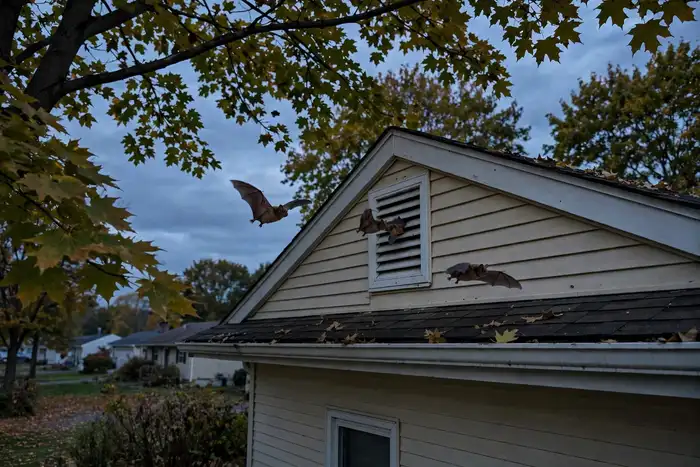
Big brown bats roost in attics and can hibernate there all winter. Exclusion is legal only in the April 1–May 15 and August 1–Oct 15 windows, apart from written ODNR permission — timing is the whole job.
🦨 Skunks
Marsh-edge skunks den under decks, porches and sheds, and spray season follows their February breeding. A rabies vector that Ohio law does not allow to be released off your property.
🦫 Groundhogs
Groundhogs burrow under slabs, decks and shed foundations, then vanish into hibernation from late fall to late winter. Spring emergence is when burrows and damage show up again.
🐾 Opossums
Opossums move into garages, under decks and occasionally into attics, often following pet food. Ohio rules require on-site handling rather than release somewhere else.
🐿️ Chipmunks
Chipmunks burrow along foundations, stoops and retaining edges, carrying soil out from under concrete. Small animal, real undermining when a colony works one wall for seasons.
🐀 Rodents
House mice pour in at first frost, Norway rats turn up near the shore and older drainage, and voles leave trails in the lawn that appear when Mentor's deep snow melts.
🐍 Snakes
Mostly harmless garter, rat and milk snakes inland — and northern watersnakes along the marsh and lagoons. The work is identification and calm removal, not fear.
🕊️ Dead animals
Winter is the peak: animals that denned in a wall or attic die out of sight, and the smell arrives with the thaw or the furnace running. We locate, remove and clean the area.
Animal-specific help in Mentor
Deep, local guides for the problems we get called about most — with our wildlife crew behind every one.
How to get help in Mentor
Tell us what you're hearing
Scratching in the attic, a snake by the porch, holes in the yard — call with your problem and your Mentor address.
We connect you locally
Call us and tell us about the job — we will confirm the local crew for your county before any work starts.
They solve it — for good
Inspection, humane removal, full exclusion and cleanup — handled by our wildlife crew, following Ohio rules.
Common wildlife removal questions in Mentor
Who do I call for wildlife removal in Mentor?+
Why does Mentor get so much wildlife in houses?+
Can a raccoon or skunk be trapped and released in the country?+
When can bats be excluded from a Mentor attic?+
I hear noises in the attic every fall. Why then?+
How much does wildlife removal cost in Mentor?+
Serving all of Lake County
Mentor is one part of Lake County. See wildlife removal in Lake County, OH for the county-wide picture — the animals we get called about most, and the other towns we cover.
One call to your Mentor wildlife crew
Whether it's squirrels in an older in-town attic or a raccoon in a new subdivision crawlspace, the fastest fix is our wildlife crew, who knows Lake County wildlife. Call us and tell us about the job — we will confirm the local crew for your county before any work starts.
- Local to Lake County. ODNR-compliant handling — call to ask about licensing and insurance.
- One company, one call. Call us and tell us about the job.
- Done right. Removal, exclusion and cleanup.