Bat Removal & Exclusion in Lorain, OH
Droppings streaking the siding under the eaves of a tall Lorain house, or bats pouring out of a gable at dusk over the lake streets? Ohio's bat calendar is strict — and in a city of high attics and hard winters, planning around it is everything. Call us and tell us about the job — we will confirm the local crew for your county before any work starts.
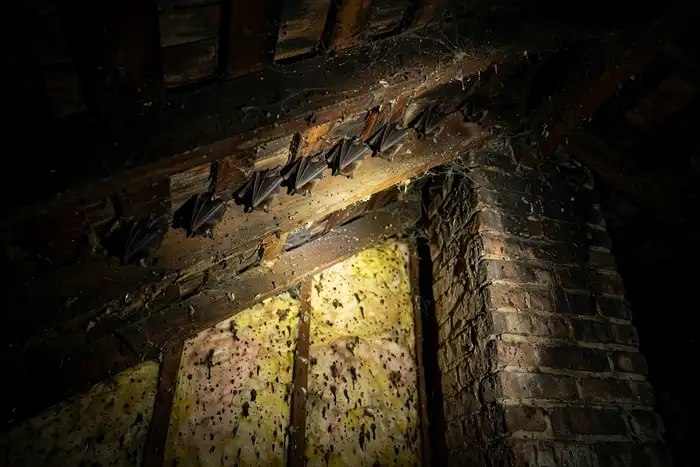
Bats in your Lorain home
Lorain's older houses are prime bat real estate. A big brown bat colony wants height, warmth and a finger-width entry, and a steel-era attic near the lake — where summer insect hunting over the water and the river is rich — provides all of it. Most colonies announce themselves quietly: guano speckling a porch or walk below the entry, staining under a gable, or the soft chittering of a maternity colony on a warm night.
Bats in Ohio come with the strictest rules in this trade. They are protected, exclusion is the only legal removal method, only a licensed operator may do it for hire, and the state forbids exclusion during the two periods when bats are most vulnerable — including winter, because big brown bats hibernate inside Lorain attics. A bat call here is answered with a calendar before it is answered with a ladder.
The Ohio windows, applied to a Lorain colony
Under OAC 1501:31-15-03(H)(5), exclusion is barred from May 16 to July 31 when five or more bats are present — the maternity season, when pups cannot fly — and from October 15 to March 31 for bats generally, because colonies are hibernating. Either window can be entered only with prior written permission from the ODNR Division of Wildlife. The lawful windows are April 1 to May 15 and August 1 to October 15. For a Lorain homeowner who discovers a colony in June, the correct sequence is inspection, entry mapping and a booked August exclusion — not a same-week sealing, which would be both unlawful and cruel to the pups inside.
Where bats enter a tall, older house
Height is no protection; bats fly, and Lorain's entries sit high: gable vents with failed screening, gaps under ridge and rake trim, separated chimney flashing, and the eaves of dormers. Lake weather accelerates all of it — rust takes vent screens, freeze-thaw opens flashing, and a bat needs only about three-eighths of an inch. A dusk watch, counting bats as they emerge, identifies the active doors and estimates colony size, which also determines whether the maternity blackout applies. The remaining roofline still has to be sealed gap by gap, or the colony re-enters two feet from the valve.
Guano in a big attic, and a bat indoors
Years of guano under a roost is the unglamorous half of a Lorain bat job. Dried droppings can harbor the fungus responsible for histoplasmosis, so disturbance and removal need proper respiratory protection, and the honest scope — spot removal versus larger cleanup — should be explained, not upsold. A bat loose in the living space is handled differently from an attic colony: bats are the most frequently confirmed rabies species in Ohio, so a bat in a bedroom, or any room where someone slept, means do not release it and do not touch it — close the door, call us, and ask your doctor or health department about exposure.
How the exclusion itself works
Within a legal window, the pro seals every secondary gap on the house and fits the active entries with one-way bat valves. The colony leaves at dusk to feed over the lake and river and cannot re-enter. After several nights of emergence watches confirm the attic is empty, the valves come off and those last entries are sealed permanently. The bats disperse to other roosts; a proper exclusion kills nothing and handles nothing. On tall Lorain houses the work is staged from ladders and lifts, and the sealing list is long — that thoroughness is what makes it a once-in-a-decade job rather than an annual one.
Living alongside a colony until the window opens
If your colony is found inside a blackout, there is still useful work to do: keep the attic hatch and any interior gaps sealed so bats stay out of living space, note emergence points at dusk, and avoid disturbing the roost. Do not caulk entries, hang deterrents or set off anything in the attic — none of it moves a colony, and sealing at the wrong moment is the one move that creates dead bats in walls. The inspection during the wait is what guarantees the exclusion, when its window opens, is complete in as few visits as possible.
Common bat questions in Lorain
I found bats in my Lorain attic in January — what happens now?+
What are the exact legal bat windows in Ohio?+
How big is a Lorain attic bat colony, usually?+
A bat was in my bedroom overnight — should I worry?+
How much does bat removal cost in Lorain?+
Other Lorain problems that come with bats
Our wildlife crew handles these closely related problems — the ones that most often turn up with a bat issue.
Got more than bats in Lorain?
Bats are rarely the only thing using an attic or yard in Lorain. See everything we handle locally on the Lorain wildlife removal hub, or jump to Ohio wildlife removal.
Serving all of Lorain County
Lorain is one part of Lorain County. See wildlife removal in Lorain County, OH for the county-wide picture — the animals we get called about most, and the other towns we cover.
One call to your Lorain bat crew
The longer bats stay in the attic, the more they chew and the bigger the cleanup. Call us and tell us about the job — we will confirm the local crew for your county before any work starts.
- Local to Lorain County. ODNR-compliant handling — call to ask about licensing and insurance.
- Humane exclusion. One-way doors and steel sealing, not poison.
- Done right. Removal, exclusion and cleanup.