Wildlife Removal in Lakewood, OH
Lakewood packs a lot of house into a little land — doubles and duplexes wall to wall, lakefront homes facing the wind, and porches close enough to hear the neighbors talk. Animals work the same tight spaces: shared walls, shared rooflines and the small gaps between one house and the next. Call us and tell us about the job — we will confirm the local crew for your county before any work starts.
Why Lakewood homes see the wildlife they do
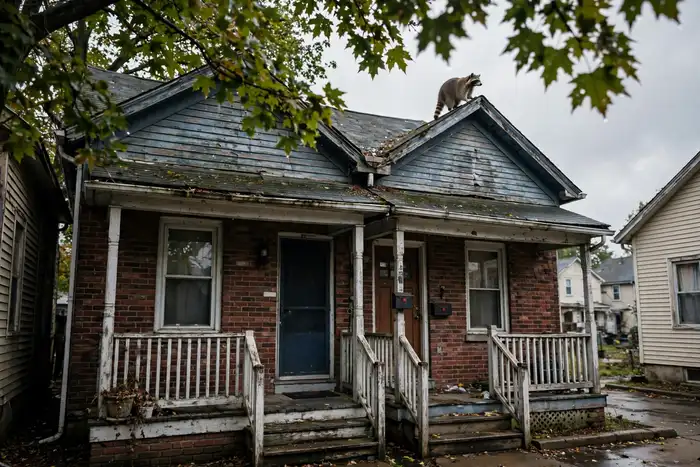
Density is the defining fact of a Lakewood wildlife call. The city was built close: older doubles, duplexes and single homes on narrow lots, many with a porch in front, a small yard behind and another house a few feet to either side. That closeness changes how animals move. A raccoon does not need your tree — it can cross three roofs from the mature street tree two doors down. A squirrel in a shared attic wall may be heard by both halves of a double at once.
The housing itself is old enough to offer openings everywhere. Brick and wood-sided homes have weathered a century of lake wind and freeze and thaw, and their rooflines, chimney flashing, porch roofs and foundation joints show it. Down at ground level, the small yards work in the animals' favor too: decks, porches and sheds sit close together, garbage and grills are never far from cover, and a skunk den under one porch is a problem the whole row of houses can smell.
Our crew works Lakewood houses with that closeness in mind: trace how an animal is traveling between roof, wall and porch, remove it the way Ohio law requires, seal the openings on your house so the route ends at your walls, and clean up what was left behind. In a neighborhood this tight, sealing only the hole you found is rarely the whole answer.
Shared walls, shared attics and the double-house problem
A Lakewood double is two homes under one weathered roof, and animals do not respect the property line down the middle. Squirrels entering at one half's soffit can nest above the other; noise in a shared wall can come from an opening on the neighbor's side; and a bat colony in a long attic may use gaps above both front doors. The first step on a double is therefore mapping the whole roofline, not just the half where the noise is loudest.
That does not mean your job depends on your neighbor. Our wildlife crew seals the openings that serve your home, fits one-way devices at the active entries, and tells you plainly which gaps sit on the shared structure so you can talk to the other household with facts in hand. Duplexes and converted homes add their own wrinkles — old openings between units, sealed-off chases and porches enclosed at different times — and each one is a route an animal may already know.
Renters and landlords run into the same split: the tenant hears the animal, the owner controls the roof. A clear inspection report on where entries are and what sealing they need helps that conversation happen before a litter is born in the attic.
Lake Erie wind, mature trees and a roofline under pressure
Lakewood faces the lake, and the lake leans on its houses. Wind off Lake Erie drives rain and snow into soffits, lifts tired shingles and works at flashing season after season, while lake-effect snow loads older roofs and melts back into the eaves. The gaps that result are small at first — exactly the size a bat needs, and a starting point a squirrel can widen in an afternoon.
The street trees complete the route in. Lakewood's mature canopy is beautiful and, from a squirrel's view, a highway system ending at the rooflines: limbs overhang roofs all over the city, and where a limb does not reach, a fence, a wire or the next house's porch roof bridges the gap. Trimming limbs back is worthwhile, but on lots this tight it is a supporting step, never the seal itself.
Fall is when it all meets. As cold arrives off the lake, squirrels, raccoons and mice test every wind-opened gap, and houses that were quiet all summer get attic noise in a single week.
Small yards where porches, decks and dens are close
Ground-level wildlife in Lakewood lives near people by necessity. Yards are small, so the sheltered void under a porch or deck is often a few steps from where the family eats outside, and the next house's yard is a few steps beyond that. Skunks den under porches, groundhogs dig at shed and garage edges, and opossums rotate through garages and under-deck spaces night by night.
Close quarters raise the stakes on ordinary things: a dog let out after dark meeting a skunk at the porch steps, children playing over a burrow-weakened patch of lawn, trash cans stored tight against the house where raccoons can work at the lids unseen. The fixes are close-quarters fixes too — buried screening at the porch, lids that latch, pet food inside, and sealing the gaps between porch, foundation and siding where several Lakewood additions meet the original house.
Because lots touch, one open den can serve animals that visit several yards. Closing yours properly is the part you control, and it is the part that ends your problem even when the neighborhood stays lively.
Ohio rules that shape the work: bats, rabies and relocation
Wildlife removal for hire in Ohio requires an ODNR Commercial Nuisance Wild Animal Control Operator license under Ohio Revised Code section 1531.40, and Lakewood work follows the same state rules as anywhere in Ohio. Bats run on a strict calendar: exclusion is barred from May 16 through July 31 when five or more bats are present, because the pups cannot yet fly, and from October 15 through March 31, when big brown bats may be hibernating in the attic itself — either window only with prior written ODNR permission. The open windows are April 1 to May 15 and August 1 to October 15.
Rabies is the second rule-maker. Raccoons, skunks, foxes and bats are Ohio's main rabies vectors, and this part of the state sits in the oral rabies vaccine baiting effort aimed at raccoon-variant rabies. Under Ohio Administrative Code 1501:31-15-03(E)(3), a captured raccoon, skunk or opossum cannot be moved off the property: the lawful outcomes are release on the same property or humane euthanasia. Our crew leads with exclusion — one-way doors and sealing that let animals leave a structure on their own where that is possible — and handles the rest exactly as Ohio rules require.
Wildlife we remove in Lakewood
From a squirrel in a shared attic wall to a skunk under a porch steps from the sidewalk, these are the calls Lakewood homeowners make most.
🐿️ Squirrels
Street trees overhanging tight roofs make Lakewood squirrel country. Grays work wind-lifted soffits on doubles and lakefront homes each fall, and a shared attic means one entry can trouble two households. Chewed wiring in an old attic is the reason to move quickly. See our full Lakewood squirrel removal guide →
🦝 Raccoons
Raccoons cross Lakewood roof to roof and den in uncapped chimneys and big attics, with alleys and tight trash storage feeding them below. A rabies-vector species Ohio law does not allow to be moved off the property — exclusion first, kits accounted for. See our full Lakewood raccoon removal guide →
🦇 Bats
Big brown bats slip through wind-worked gaps at gable vents and flashing on older Lakewood homes, and some stay to hibernate. Exclusion is legal only April 1–May 15 and August 1–October 15 without written ODNR permission. See our full Lakewood bat removal guide →
🦨 Skunks
The void under a Lakewood front porch is prime skunk shelter, close to sidewalks, dogs and the next yard over. A rabies vector that cannot be moved off the property under Ohio law, handled with calm exclusion and buried porch screening. See our full Lakewood skunk removal guide →
🦫 Groundhogs
Groundhogs dig at garage, shed and porch edges in Lakewood's small yards, where a burrow takes up a real share of the lawn and can undermine a walk or slab. They sleep through winter and resume digging at spring emergence. See our full Lakewood groundhog removal guide →
🐾 Opossums
Opossums patrol the alleys and lakefront edges at night and bed down in garages, under decks and in porch voids. Ohio law does not allow them to be moved off the property, so removal is paired with closing the shelter they chose. See our full Lakewood opossum removal guide →
🐿️ Chipmunks
Chipmunks tunnel along foundations, stoops and porch steps where Lakewood houses sit close to the sidewalk. A busy colony moves soil away from old footings and channels water against the wall. See our full Lakewood chipmunk removal guide →
🐀 Rats, mice & voles
Norway rats work the alleys and older foundations, house mice pour into doubles at first frost, and voles trail small lawns under the snow. In Lakewood the rodent job starts at the foundation and the shared wall. See our full Lakewood rodent removal guide →
🐍 Snakes
Almost always harmless — garter snakes in small gardens, rat snakes following mice into basements, and northern watersnakes near the shore. The Lakewood snake call is identification and calm removal, not alarm. See our full Lakewood snake removal guide →
🪰 Dead animals
A smell rising in one unit of a double, often after winter, usually means something died in a shared wall, the attic or a porch void. Our crew locates it, removes it, cleans the area and closes the opening it used. See our full Lakewood dead animal removal guide →
Animal-specific help in Lakewood
Deep, local guides for the problems we get called about most — with our wildlife crew behind every one.
How to get help in Lakewood
Tell us what you're hearing
Scratching in the attic, a snake by the porch, holes in the yard — call with your problem and your Lakewood address.
We connect you locally
Call us and tell us about the job — we will confirm the local crew for your county before any work starts.
They solve it — for good
Inspection, humane removal, full exclusion and cleanup — handled by our wildlife crew, following Ohio rules.
Common wildlife removal questions in Lakewood
Who do I call for wildlife removal in Lakewood?+
I live in a double — why do I hear animals that seem to be on my neighbor's side?+
When do Lakewood animals move into houses for the season?+
Can bats be removed from my Lakewood attic in summer or winter?+
Will you take a raccoon or skunk to a park and let it go?+
How much does wildlife removal cost in Lakewood?+
Serving all of Cuyahoga County
Lakewood is one part of Cuyahoga County. See wildlife removal in Cuyahoga County, OH for the county-wide picture — the animals we get called about most, and the other towns we cover.
One call to your Lakewood wildlife crew
Whether it's squirrels in an older in-town attic or a raccoon in a new subdivision crawlspace, the fastest fix is our wildlife crew, who knows Cuyahoga County wildlife. Call us and tell us about the job — we will confirm the local crew for your county before any work starts.
- Local to Cuyahoga County. ODNR-compliant handling — call to ask about licensing and insurance.
- One company, one call. Call us and tell us about the job.
- Done right. Removal, exclusion and cleanup.