Squirrel Removal in Lakewood, OH
Running overhead in a house where the next roof is only feet away? Lakewood squirrels travel tree to porch roof to soffit, and a shared attic doubles the audience for every step. Call us and tell us about the job — we will confirm the local crew for your county before any work starts.
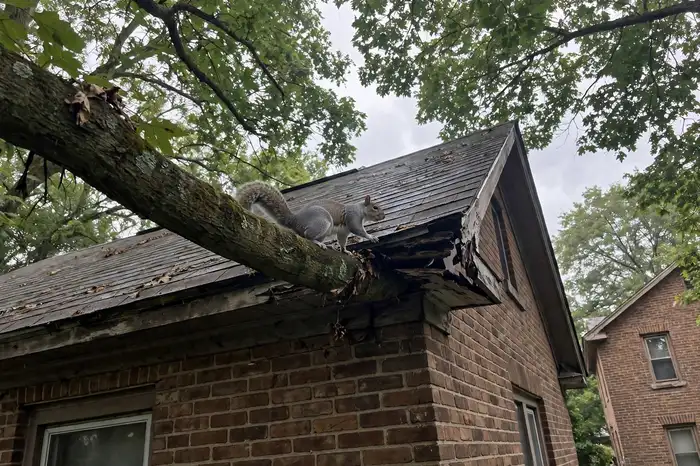
Squirrels in your Lakewood home
Lakewood's canopy is the start of most squirrel stories here. Mature street trees shade nearly every block, their crowns meeting over the pavement and reaching over roofs that sit close together. A gray squirrel can cross a whole street above ground and step onto a porch roof without ever touching the lawn — which is why a Lakewood house does not need its own overhanging limb to have a squirrel problem.
At the roof, wind and age have done the preparatory work. Soffits lifted at the corners, fascia softened behind old gutters, gable vents with tired screening: a squirrel tests each one, and on a double it may find its opening above the neighbor's half and its nesting corner above yours. Inside, it shreds insulation for a nest and chews — wood, ductwork and wiring included.
The tree-to-roof commute on a tight street
Cutting back your own tree helps less in Lakewood than in a spread-out suburb, because the next tree, the utility lines and the adjoining porch roofs keep the route open. Our crew treats access as a supporting issue and sealing as the fix: a squirrel that can reach the roof but cannot find an opening is a squirrel that moves on. Limbs trimmed six to ten feet back still reduce the easiest jumps and are worth doing alongside the metal work.
Daytime grays and the quieter night shift
Noise in the morning and again toward evening usually means gray squirrels, which are active by day and vocal about it. Softer, faster sounds after dark often mean flying squirrels, which live in groups and slip through gaps a gray could never use. The distinction changes the sealing standard: a flying squirrel job is not finished until the small openings — the vent corner, the trim gap — are closed as carefully as the obvious hole.
Doubles, duplexes and the shared attic
On a double, squirrels may be entering on one side and nesting on the other, traveling the length of a common attic. Excluding them still works — one-way doors at the active entries, confirmation the full attic is clear — but the inspection has to cover the building's whole roofline, including the porch roofs and the junction where an enclosed porch meets the main wall. Our crew will point out any openings on the other half plainly, so the sealing conversation between households is based on what was actually found.
Litters in late winter and late summer
Squirrels raise young twice a year, and an attic litter changes the sequence. Sealing an entry while flightless young are inside leaves a mother chewing a new way in — frequently through a spot worse than the first — and young that cannot survive on their own. Checking the nest area before anything closes is a standard part of the job, and where young are present the plan waits for or works around them humanely.
Exclusion, then metal that lake wind cannot lift
The working method is a one-way door at the active entry, time for the squirrels to leave and be confirmed out, then permanent closing of every opening with metal — flashing, steel mesh and hardware cloth secured to sound wood. Repairs on a lakefront-facing roofline need fastening that respects the wind: a patch that lifts in the first November gale is not a repair. Foam and thin wood are not used as final materials.
Feeders, porches and everyday pressure
Bird feeders hung from a porch concentrate squirrels at the wall all day, and seed stored in a garage or enclosed porch gives them a reason to test those doors too. Moving feeders into the yard and storing seed in sealed metal containers will not empty a wooded street of squirrels, but it lowers the daily pressure on the house while the sealing does the real work.
Common squirrel questions in Lakewood
My neighbor's tree is the problem — can my house still be squirrel-proofed?+
I hear noise in the wall between the two halves of our double — what is it?+
The scratching only happens at night — are those squirrels too?+
Can I seal the soffit hole myself this weekend?+
How much does squirrel removal cost in Lakewood?+
Other Lakewood problems that come with squirrels
Our wildlife crew handles these closely related problems — the ones that most often turn up with a squirrel issue.
Got more than squirrels in Lakewood?
Squirrels are rarely the only thing using an attic or yard in Lakewood. See everything we handle locally on the Lakewood wildlife removal hub, or jump to Ohio wildlife removal.
Serving all of Cuyahoga County
Lakewood is one part of Cuyahoga County. See wildlife removal in Cuyahoga County, OH for the county-wide picture — the animals we get called about most, and the other towns we cover.
One call to your Lakewood squirrel crew
The longer squirrels stay in the attic, the more they chew and the bigger the cleanup. Call us and tell us about the job — we will confirm the local crew for your county before any work starts.
- Local to Cuyahoga County. ODNR-compliant handling — call to ask about licensing and insurance.
- Humane exclusion. One-way doors and steel sealing, not poison.
- Done right. Removal, exclusion and cleanup.