Dead Animal Removal in Lakewood, OH
Your side smells fine in the morning and unbearable by dinner, while the household through the wall notices it too? That shifting pattern is typical in a Lakewood double, where one hidden animal can reach two addresses through the same framing. Call us and tell us about the job — we will confirm the local crew for your county before any work starts.
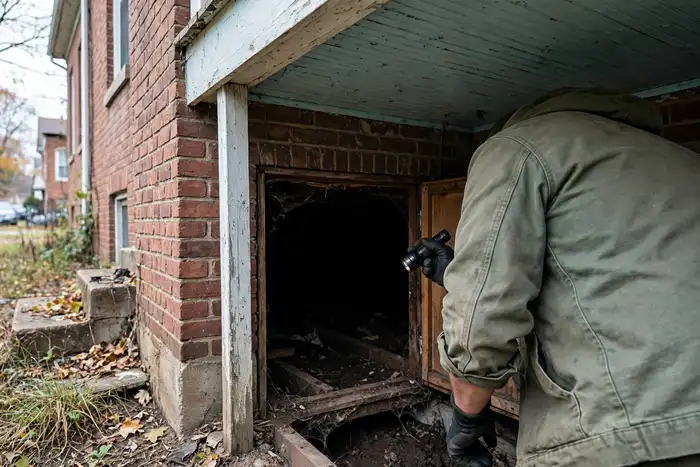
One hidden carcass, two Lakewood households affected
Start with the lease line that odor ignores. Lakewood's doubles and duplexes were framed as one building — one long attic, joist bays that run unit to unit, a plumbing stack and chimney chase serving both homes — so a single animal dying inside that shared skeleton can be smelled in two kitchens, at different strengths, at different hours of the day. Neither household is imagining it, and the stronger side is not automatically the side holding the source.
The smallness of these houses amplifies everything else. Rooms sit close together, front porches have been enclosed into living space over the original voids, and a sleeping room may sit directly above the pocket where an animal sheltered. Add lake wind pressing on one face of the building and furnace air pulling through the chases, and a smell can appear, vanish and return in a pattern that makes no sense until the building is read as a whole.
Why the smell crosses into the other unit
Warm air inside a house is always on the move, rising through wall cavities, leaking around pipes where they pass between floors, and drawing replacement air in at the foundation. In a double, that circulation does not stop at the dividing wall — it borrows gaps around the stack, the joist pockets and the old chimney chase that both units share. An animal that died beside any of those routes perfumes the airflow for the whole building. That is why our crew asks both households the same questions — strongest room, strongest hour, when it began — and treats the two sets of answers as one diagram rather than two competing complaints.
Porch voids: the hiding place nobody enters
Ask Lakewood crews where they look second and many will say under the front porch. The void beneath a raised porch is sheltered, dark and, on a tight lot, steps from food — an obvious winter den for a skunk or an opossum, and a place no homeowner ever opens. When an animal dies in there, the first evidence is often outside the house: an odor hanging at the steps that neighbors catch on the sidewalk, flies clustering at porch windows, a smell that floods in only when the front door opens. Enclosed porches complicate the picture further, because flooring and paneling laid over the old void seal the evidence in while letting the odor up through every seam.
Window wells and foundation pockets nobody checks
Deep basement window wells collect more than leaves. Small animals fall or climb in after shelter, cannot scale the smooth sides, and die hidden under debris directly outside a basement window — inches from the living space, yet invisible from indoors. The smell then enters through the window frame itself, which baffles a search aimed at walls and ceilings. Wells, disused coal openings, and the hollow pockets behind basement paneling are therefore early stops on a Lakewood search, before anyone discusses opening a finished wall upstairs.
Renters, owners and the access conversation
Doubles split this job in a practical way: the tenant lives with the smell, the owner controls the attic hatch and the porch, and the neighboring unit may hold the comparison evidence that pinpoints the source. A short written summary from the inspection — where the animal most likely lies, what access is needed, what will be disturbed — lets an owner approve work quickly and lets both households plan around the same visit. Please do not start opening walls or porch flooring yourselves before that visit; well-meant demolition usually destroys the odor pattern the crew is reading and makes the search longer, not shorter.
Rodent bait, mentioned plainly and briefly
If pellets or blocks were put down for mice in a garage, a basement or by a previous service, say so on the call and say where. A mouse that feeds and then retreats to its usual sleeping pocket — between floors, behind a shared wall, down in insulation — can die in exactly the spot no one can reach by hand. Knowing a product was placed last month reorders the search toward those pockets and toward one species. Going forward, trapping paired with sealing the shared entry points avoids building the next odor problem into the walls.
Pinpointing the source without tearing the house apart
The search leans on pattern, not demolition. Odor compared at outlets, registers and closet doors; fly activity watched at light fittings and windows; a small inspection camera slipped through an existing gap where the framing allows it. Plaster in these older homes is worth preserving, and most sources are reached through an attic, a porch void, a basement pocket or one discreet, deliberately placed opening. Once located, the remains and the material immediately around them come out, the pocket is cleaned and treated, and the entry that admitted the animal alive is identified for sealing — otherwise the same void simply takes its next tenant.
Common dead animal questions in Lakewood
Both halves of our double smell it — does that mean there are two dead animals?+
The odor is worst on our enclosed porch — what dies under there?+
I rent — what should I tell my landlord before you come?+
Something may have fallen into our window well — can you check there first?+
How much does dead animal removal cost in Lakewood?+
Other Lakewood problems that come with dead animals
Our wildlife crew handles these closely related problems — the ones that most often turn up with a dead animal issue.
Still hearing live movement overhead?
Whatever died here walked in alive through a route that remains open along the roofline, porch or foundation — finding and closing that route is how the building stays clear. See everything we handle locally on the Lakewood wildlife removal hub, or jump to Ohio wildlife removal.
Serving all of Cuyahoga County
Lakewood is one part of Cuyahoga County. See wildlife removal in Cuyahoga County, OH for the county-wide picture — the animals we get called about most, and the other towns we cover.
One call to your Lakewood dead animal crew
A carcass left in a porch void does not stay a one-porch problem on lots this narrow — air moves, flies gather, and the neighboring household is soon involved. Call us and tell us about the job — we will confirm the local crew for your county before any work starts.
- Local to Cuyahoga County. ODNR-compliant handling — call to ask about licensing and insurance.
- Compare, pinpoint, clear. Readings taken room by room and unit by unit, the remains and soiled material taken out, and the pocket cleaned so the smell has nothing left to feed on.
- Done right. Removal, exclusion and cleanup.