Armadillo Removal in Monticello, GA
Call us when a lawn that was smooth at supper is pocked with holes by morning, or when digging appears along the edge of a Jasper County pasture or beneath a porch. Armadillos work Monticello country lots at night, and the pattern of holes tells us where to start.
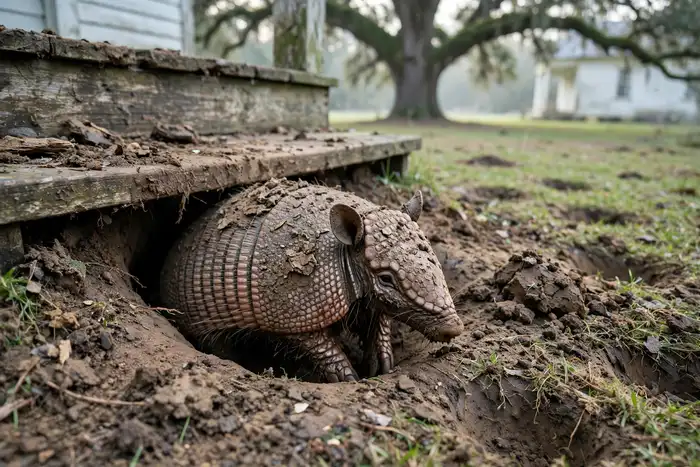
Soft Country Soil and Grub-Rich Pasture Edges Draw Armadillos Into Monticello Lawns
An armadillo announces itself in Monticello by the evidence, rarely by appearance. The animal feeds after dark, pushing its snout into soft soil and tearing small, conical holes as it hunts grubs, beetle larvae, and earthworms. On a pasture-edge lawn in Jasper County, where the mown grass meets ground that stays a little wilder and a little damper, that feeding can turn a tidy yard into a pocked field in a handful of nights, with each mornings damage a few feet from the last.
The lots most affected sit at that town-to-country step Monticello is known for: houses whose back fences open onto pasture, country homes with large, lightly managed lawns, and properties where a woodland edge or a low, wet corner gives an armadillo a daytime burrow within walking distance of the grass it feeds in. Understanding that geography is the heart of the job, because trapping a feeding area without finding the burrow usually means meeting the same animal again next week.
Reading Overnight Holes Across a Monticello Pasture-Edge Lawn
Armadillo holes have a signature: shallow, a few inches across, scattered in a wandering pattern that follows grub concentrations rather than any line a person would draw. The digging clusters where soil stays soft, along the pasture fence where moisture lingers, in the shaded strip beneath a big yard tree, and in the low corner of the lot that drains last after rain.
We walk that pattern with you in daylight and mark where it starts and stops. The map usually points back toward the burrow or the cover the animal travels from, and that direction decides where removal effort belongs, instead of scattering attention across every hole in the grass.
Burrows at the Woodland Edge and Under Monticello Outbuildings
By day an armadillo rests in a burrow, and around Jasper County properties those burrows sit at the base of a brushy woodland edge, beneath a fallen log, under the skirt of an outbuilding, or in the soft bank of a drainage. The entrance is wider than the lawn holes and often shows a fan of excavated dirt and tracks in soft ground after rain.
A burrow under a structure deserves prompt attention. Digging beneath a porch pier, an outbuilding slab, or the edge of a foundation removes the soil those supports count on. We check under structures on the lot during the inspection and flag any undermining plainly, because that repair conversation is different from the lawn conversation.
Why Monticello's Town-to-Country Lots Suit Armadillos So Well
Armadillos want three things within a short nightly walk: soft digging ground, insect food, and cover to retreat to. A Monticello country lot supplies all three in one parcel. The pasture edge and woodland border provide cover, the lawn provides irrigated or rain-softened soil full of larvae, and the quiet after dark provides hours of undisturbed feeding that a busier suburban street would never allow.
That is also why in-town lawns near the square are hit less often, and why the worst damage we see is on the larger lots where town loosens into countryside. If your property matches that description, one armadillo this season usually means the habitat will suit another, which makes the burrow search and any cover changes near the lawn worth doing thoroughly the first time.
Removing the Digging Armadillo From a Jasper County Property
Armadillos are creatures of route and habit, traveling the same path from burrow to feeding ground night after night. That predictability is what removal is built on. Our crew uses the tracks, the burrow location, and the freshest digging to position our effort on the animal's actual route, rather than guessing at the middle of the lawn.
We are straightforward about timing: an armadillo that has just discovered a lawn may take a few nights of patterned effort to remove, and fresh digging during that period does not mean the plan is failing. What matters is that the digging is being read each visit, and the approach is adjusted to the route the animal is showing us.
Lawns, Flower Beds, and Porch Piers After Monticello Armadillo Damage
The visible repair list after an armadillo visit goes beyond the holes. Flower beds along a porch get rooted through, mulch is scattered, small plantings are upended, and the soil under a shallow pier or a stepping path can be loosened. We point out the structural spots during our walk so cosmetic filling does not hide a place where support soil has been removed.
For the lawn itself, most Monticello yards recover well once the digging stops: holes can be filled and tamped, and the turf knits back during the growing season. We will give you an honest read on whether your grass needs reseeding in patches or simply time, based on how many nights the animal worked it.
Making a Monticello Country Lawn Less Inviting to the Next Armadillo
No lawn in Jasper County can be made armadillo-proof, but the odds can be shifted. Reducing the grub load in the turf through ordinary lawn care lowers the reward for digging. Keeping brush and ground cover trimmed back from the lawns edge shortens the covered approach. Promptly addressing a new burrow at the woodland edge keeps a visitor from becoming a tenant.
We leave you with the specific spots on your own lot to watch: the damp corner, the fence stretch, the outbuilding skirt. A homeowner in the Monticello countryside who checks those places monthly will spot the next armadillo in its first week, when a call is a small job rather than a season of holes.
Common armadillo questions in Monticello
How do we know the digging in our Monticello lawn is an armadillo and not something else?+
Our lot backs onto pasture outside Monticello. Will armadillos keep coming from there?+
An armadillo is digging under our outbuilding in Jasper County. Is that urgent?+
Can we just fill the holes and hope the armadillo moves on from our Monticello yard?+
When are armadillos most active around Monticello properties?+
Will treating our lawn for grubs alone solve our armadillo problem?+
Other Monticello problems that come with armadillos
Our wildlife crew handles these closely related problems — the ones that most often turn up with a armadillo issue.
Got more than armadillos in Monticello?
Digging on a country lot is not always armadillo work. If our inspection turns up torn feed storage or loft sign instead, our raccoon page covers the other usual Jasper County night visitor, and we will tell you plainly which animal your evidence supports. See everything we handle locally on the Monticello wildlife removal hub, or jump to Georgia wildlife removal.
Want the background before you call? Read our statewide guide: Armadillos tearing up your Georgia lawn.
Serving all of Jasper County
Monticello is one part of Jasper County. See wildlife removal in Jasper County, GA for the county-wide picture — the animals we get called about most, and the other towns we cover.
One call to your Monticello armadillo crew
Our armadillo work pairs removal with a look at the ground that attracted it.
- Local to Jasper County. Georgia DNR-compliant handling — call to ask about licensing and insurance.
- We target the burrow and the feeding route together. Our crew finds where the animal dens, whether that is a burrow at the woodland edge or a cavity under an outbuilding, and plans removal around its nightly path, and we will confirm the local crew for your county before any work starts.
- Done right. Removal, exclusion and cleanup.