Dead Animal Removal in Hampton, GA
A sweet, rotten smell that gets stronger every day, flies at one window, and you can't find where it's coming from? Something has died in the wall, the attic or under the floor. Call us and tell us about the job — we will confirm the local crew for your county before any work starts.
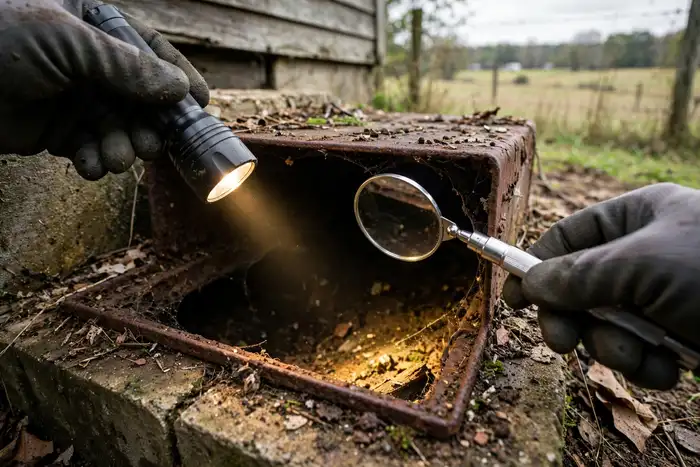
A dead animal in your Hampton walls or crawlspace
Many older Hampton homes sit over crawlspaces, and that's where a lot of these calls start. An opossum, rat or squirrel gets in under the floor or into a wall and dies where nobody can see it. For the first day or so you notice nothing. Then a sweet, rotten smell builds in one room, flies gather at the nearest window, and air fresheners don't help.
There's no secret method for finding a dead animal. Pros use their sense of smell and watch where the flies are, and they know where animals tend to die in a house. Before you call, ask yourself what happened recently. Did someone put out rat bait? Did someone patch a hole in the roof while an animal was still inside? The dead animal usually points to a live-animal problem that hasn't been fixed yet.
Rat bait is the usual cause
The most common cause is rodent poison. A poisoned rat doesn't die in the open. It goes back to its nest inside a wall, in the attic insulation or under the floor, and dies there. On a Hampton property next to fields full of rodents, that can happen again and again. Sealing the house and trapping is the way to deal with rodents without creating more dead-animal calls.
How long the smell lasts
If nothing is done, a dead-animal smell lasts about 14 days from start to finish. It is usually worst in the middle of that stretch. Heat speeds up decay, so a carcass in a summer attic or a sunny wall smells stronger and sooner, and the air system can carry the smell into other rooms. Waiting it out is possible, but most people don't want two weeks of that smell, and the flies don't leave until the carcass is gone.
Finding it: smell, flies and experience
The pro walks the house to find where the smell is strongest, checks where flies are gathering, and looks first in the places animals usually die. Those include wall cavities around kitchen and bathroom plumbing, deep in the attic insulation near the edges of the roof, and the corners of the crawlspace near foundation vents. Pinpointing the spot first means fewer holes in your walls.
Getting it out, and the drywall question
Pros go through the crawlspace, the attic or an existing opening whenever they can, and cut into drywall only if there is no other way. If they do have to cut, ask about the repair up front. Most wildlife companies don't do drywall repair, so find out whether patching is included or whether you'll need a handyman. After the carcass is out, the pro removes soiled insulation and other material around it and treats the area to break down the smell.
Wall, attic, crawlspace or outbuilding
Each location means different work. A crawlspace job usually means crawling in on a tarp to reach the carcass. An attic job means digging through insulation. A wall cavity is the hardest, because the pro has to narrow it down to one spot between two studs. On Hampton lots with sheds and old outbuildings, the smell sometimes turns out to be coming from out there instead of the house.
Find the way in
An animal that died inside your house got in somewhere, and that opening is usually still there. It might be a crawlspace vent with no screen, a gap at a gable vent, or a hole where a roofline meets an addition. A good pro finds the opening and can seal it while they're there. If it isn't sealed, the next rat or squirrel will use the same route.
Common dead animal questions in Hampton
There's a dead-animal smell in my wall in Hampton — what do I do?+
How long until a dead-animal smell goes away on its own?+
I put out rat poison and now something smells — what happened?+
Why are there suddenly flies in one room?+
Will you have to cut into my wall to remove it?+
How much does dead animal removal cost in Hampton?+
Other Hampton problems that come with dead animals
Our wildlife crew handles these closely related problems — the ones that most often turn up with a dead animal issue.
Got a live animal problem in Hampton too?
Something that died inside your house got in through an opening, and that opening is probably still there. See everything we handle locally on the Hampton wildlife removal hub, or jump to Georgia wildlife removal.
Want the background before you call? Read our statewide guide: Dead animal in a wall or attic: how long the smell lasts.
Serving all of Henry County
Hampton is one part of Henry County. See wildlife removal in Henry County, GA for the county-wide picture — the animals we get called about most, and the other towns we cover.
One call to your Hampton dead animal crew
If nothing is done, a dead-animal smell takes about two weeks to fade. You can have the carcass found and removed long before that. Call us and tell us about the job — we will confirm the local crew for your county before any work starts.
- Local to Henry County. Georgia DNR-compliant handling — call to ask about licensing and insurance.
- Find it, remove it, clean it. Locating the carcass by smell and flies, taking it out through the smallest opening, and treating the area.
- Done right. Removal, exclusion and cleanup.