Bat Removal in Sebastian, FL
At dusk they pour from one corner of the roof toward the river, and at dawn the droppings under that corner have grown again. Sebastian bats are a calendar problem before they are a ladder problem — let us date the job properly.
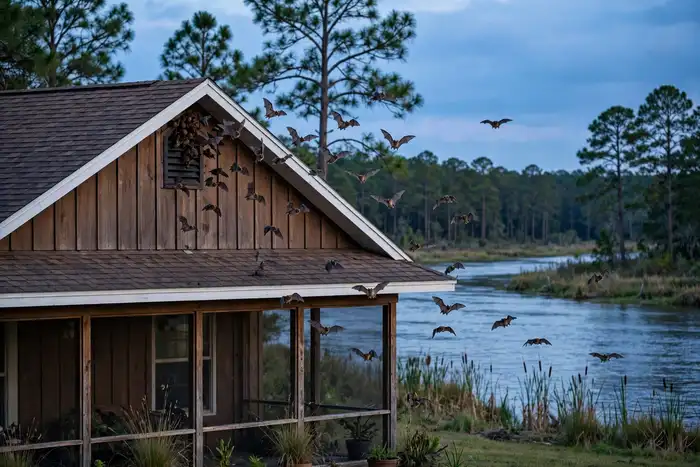
Bats in your Sebastian home
Stand on a Sebastian dock at dusk and watch the sky over the river: the first evening bats flicker low over the water, and higher up the Brazilian free-tailed bats stream toward the feeding grounds. Both species spend their days in the town's structures — in the gable peak of a riverfront home, behind the fascia of a ranch near the US-1 corridor, in the seams of a boat shed or the ridge of a manufactured home's roof. They are quiet tenants, and most Sebastian colonies are discovered by their droppings or by a single bat indoors, not by noise.
Florida draws a hard line around this work. Exclusion — fitting the one-way devices that let a colony leave — is lawful only from August 15 to April 15. The closed season, mid-April to mid-August, is maternity season, when the roost holds young that cannot fly, and in those months we inspect, identify and prepare, but we do not exclude, and we will explain why any operator willing to do so should not be hired. Bats are never harmed in this work; the colony leaves on its own wings and the building is sealed behind it.
Where Sebastian bats roost, from river houses to sheds
The roost map here is more varied than in tile-roof country. Sebastian's housing offers gable vents with perished screens, fascia gaps on low ranch eaves that a bat can reach from a fence line, open ridge ends, and — a local speciality — outbuilding roosts: sheds, carports and boat shelters whose corrugated seams and unlined roofs suit a small colony perfectly. A bat job that seals the house and ignores the shed has relocated the colony twenty feet. Our survey covers every structure on the lot at the dusk watch, counting exits building by building.
The hurricane complication, Sebastian edition
The exclusion window opens on August 15, deep inside hurricane season, and Sebastian — river on one side, inlet-driven surge and wind on the other — feels storms fully. A colony booked for late August may meet a September storm that shifts its entries before devices are fitted. We manage it by completing the survey early in summer, sealing every gap that can lawfully be sealed while the bats use their known main exit, and re-watching the roost after any significant weather before devices go on. The first calm, legal stretch of autumn gets the job done with the preparation already banked.
How a one-way exclusion empties a roost
The device is fitted over the exit the colony actually uses, identified at dusk, not the most convenient gap. Bats slip out through it to feed over the river and the lagoon, return at dawn, and find the door no longer opens inward. Night by night the roost empties as bats take up alternative quarters — hollow trees, bridges, bat houses along the river. With all secondary gaps on every structure already sealed, there is no side door back in. After exit counts confirm the roost is empty, we remove the device and seal its opening, and the droppings cleanup described below completes the job.
Guano in the gable, and the bedroom bat
A colony over a bedroom leaves two legacies: droppings accumulated in the gable or attic, which we remove with protection against breathing the dry dust, treating the surfaces involved — and the occasional individual bat that appears indoors, usually a juvenile that took a wrong turn at a vent. For the indoor bat: close it alone in one room, keep children and pets away, do not handle it, and call us. If anyone slept in that room or may have touched the bat, contact a doctor or the county health department as well — rabies caution with bats is always the right instinct.
Spring is for sealing empty roofs
The cheapest Sebastian bat job is the one done before a colony exists. A March to May roofline and outbuilding check — vents rescreened, fascia gaps closed, ridge ends capped, shed seams sealed — removes the vacancies a summer colony would otherwise fill, and it is finished before maternity season complicates any work. Riverfront associations and owners who found droppings last autumn should treat spring as the appointment, not the first hot night when a bat comes through the vent.
Common bat questions in Sebastian
We found bats in June. What can actually happen before August 15?+
Are Sebastian’s river bats good for anything, or pure nuisance?+
How big is a typical colony here?+
Can the bats be sealed in while they are out feeding one night?+
Does the inspection for bats cost anything?+
Other Sebastian problems that come with bats
Our wildlife crew handles these closely related problems — the ones that most often turn up with a bat issue.
Got more than bats in Sebastian?
Bats are rarely the only thing using an attic or yard in Sebastian. See everything we handle locally on the Sebastian wildlife removal hub, or jump to Florida wildlife removal.
Serving all of Indian River County
Sebastian is one part of Indian River County. See wildlife removal in Indian River County, FL for the county-wide picture — the animals we get called about most, and the other towns we cover.
One call to your Sebastian bat crew
The longer bats stay in the attic, the more they chew and the bigger the cleanup. Call us and tell us about the job — we will confirm the local crew for your county before any work starts.
- Local to Indian River County. FWC-compliant handling — call to ask about licensing and insurance.
- Humane exclusion. One-way doors and steel sealing, not poison.
- Done right. Removal, exclusion and cleanup.