Iguana Removal in Fort Pierce, FL
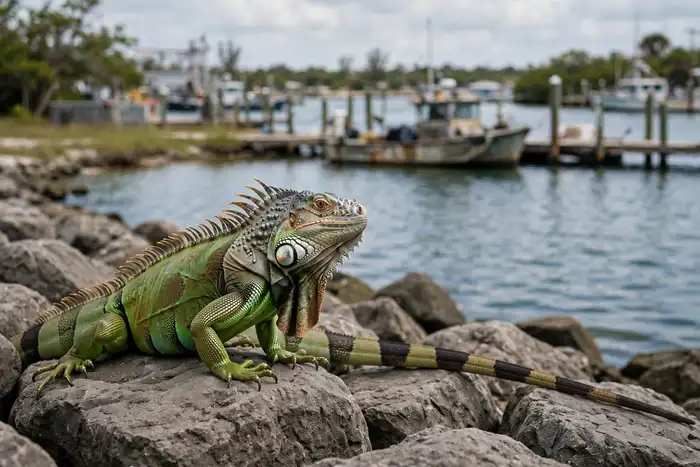
A big green lizard has taken up sunbathing on the seawall, and the neighbors have opinions. Reports like yours are arriving more often from the lagoon and inlet neighborhoods each year. Tell us where it basks and whether it is alone — both facts shape the visit.
Iguanas in your Fort Pierce home
Accuracy matters with this animal, so here is the supported version: green iguanas are increasingly reported in Fort Pierce — on seawalls and docks along the lagoon, around the inlet, and in the canal banks and waterside landscaping behind them — but they are not the established, breeding-in-numbers presence here that they are in the counties well to the south. This coast sits near the cold edge of what a tropical lizard can endure, and a sharp winter still does control work no crew can schedule.
The legal position is clearer than the biological one. The green iguana is a prohibited species in Florida, and FWC encourages removing it from private property year-round with the landowner's permission — while prohibiting the release or relocation of any captured iguana anywhere in the state. Our iguana work follows that frame exactly, and we describe the outcome plainly before starting, because some homeowners expect a relocation that Florida law simply does not offer.
Where Fort Pierce sightings concentrate
The map is a waterfront map: lagoon seawalls and the riprap below them, dock edges and boat lifts, the banks of the canals feeding the river, and the warm, south-facing walls of waterside houses. The inlet neighborhoods add rock and current-swept edges the animals use as basking shelves. Nearly every report describes the same furniture — open sun, close water, and vegetation within a short dash — because that is the combination the species selects. A sheltered canal corner can carry an iguana through a winter that an exposed ocean-side wall cannot.
Burrows in banks and seawall backfill
Iguanas dig, and on a waterfront lot the digging has an address: into canal banks and into the soil behind seawalls, where a burrow system removes backfill the wall quietly depends on. Add the lesser counts — ornamental plantings eaten to the stem, hibiscus being a documented favorite, and droppings deposited on the docks and decks where the animals bask — and the case for early removal builds itself. A single new burrow mouth at a seawall is a small job; a bank honeycombed over two seasons is an excavation problem wearing a lizard costume.
Cold mornings: the stunned iguana
Below roughly fifty degrees, an iguana's muscles stop answering — the animals go torpid, lose their grip in trees, and are found stiff on lawns, docks and sidewalks after a cold night, reviving as the sun warms them. Fort Pierce's coldest mornings produce the city's easiest collections and its most misunderstandings. A torpid iguana is alive: do not pick it up by hand, do not bring it indoors to recover, and keep dogs away — revival can be sudden. Call while it is still cold, and the animal can be collected safely at a fraction of July's effort.
How removal proceeds, and why release is not an option
Work on your lot proceeds with your permission, using capture and trapping methods fitted to open waterfront ground — basking sites, burrow mouths and travel lines along the wall. Every captured iguana is then handled inside the state's no-release rule for prohibited species: none is transported to a canal across town, none is let go at the river. The rule exists because released animals are precisely how new territories get colonized, and Fort Pierce — where the population is still thin — is exactly the place where honoring it matters most.
Common iguana questions in Fort Pierce
Are iguanas established in Fort Pierce now?+
One is lying motionless under my tree after a cold night. Is it dead?+
Could you catch it and release it somewhere uninhabited?+
There is a burrow in my canal bank. Should that worry me?+
What does iguana removal cost in Fort Pierce?+
Got more than iguanas in Fort Pierce?
Iguanas are rarely the only thing using an attic or yard in Fort Pierce. See everything we handle locally on the Fort Pierce wildlife removal hub, or jump to Florida wildlife removal.
Serving all of St. Lucie County
Fort Pierce is one part of St. Lucie County. See wildlife removal in St. Lucie County, FL for the county-wide picture — the animals we get called about most, and the other towns we cover.
One call to your Fort Pierce iguana crew
The longer iguanas stay in the attic, the more they chew and the bigger the cleanup. Call us and tell us about the job — we will confirm the local crew for your county before any work starts.
- Local to St. Lucie County. FWC-compliant handling — call to ask about licensing and insurance.
- Humane exclusion. One-way doors and steel sealing, not poison.
- Done right. Removal, exclusion and cleanup.