Groundhog Removal in Lorain, OH
In Lorain a groundhog does not just dig in your yard — it digs in the softest soil the city has: shoreline banks, the Black River's edges, and the sheltered ground under porches and garage slabs. That soil is also holding things up. Call us and tell us about the job — we will confirm the local crew for your county before any work starts.
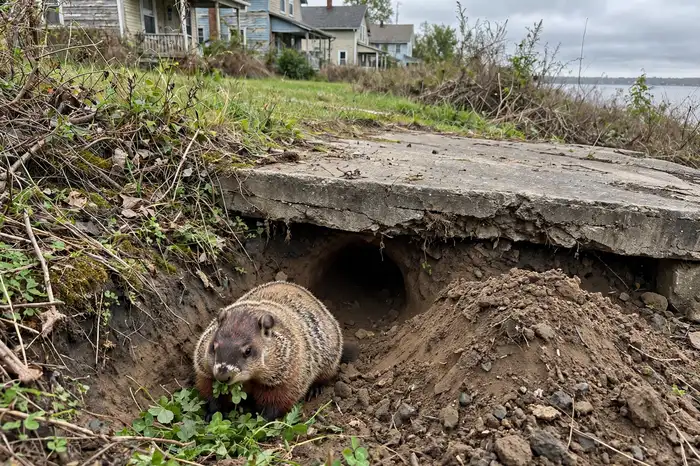
Groundhogs in your Lorain home
The groundhog, or woodchuck, is an excavator with preferences, and Lorain indulges all of them. It wants soil that digs easily, cover nearby and something solid overhead. The lake shoreline and riverbanks give it soft, workable ground with brush at the top of the bank; the city's porches, sheds and garage slabs give it the overhead cover. A mature burrow is a system — multiple entrances, turning chambers, a nest and a toilet area — moving a surprising volume of earth over a single season.
In a yard, that is a gardening problem. In a bank or under a slab, it is structural: soil that was supporting a lawn edge, a seawall approach or a concrete pad ends up in a mound at the burrow mouth. Lorain groundhog work therefore starts with where the system runs, not just where the animal feeds.
Bank burrows: when the digging undermines the shore
A burrow in a shoreline or riverbank works against gravity and water at once. Entrances above the waterline tunnel back into the bank, rain and wave action wash loosened soil out of the system, and the bank face can slump or a lawn edge can drop without warning. Near a seawall, patio or dock approach, an active system is a repair bill growing underground. A pro maps entrances on both the bank face and the top of the bank — groundhogs keep a discreet plunge entrance with no dirt mound, often hidden in brush — because treating only the obvious hole leaves the system occupied.
A true hibernator's year
Groundhogs vanish completely in a Lorain winter. From roughly late October to February they hibernate in the burrow, heart rate and temperature dropped, living on summer fat. They emerge for mating in late winter, and pups are born in spring, coming above ground weeks later and dispersing in summer to dig burrows of their own. Fall is the fattening season, when garden and bank damage peaks. Each phase changes the job: spring systems hold pups, fall is the time to screen a cleared system before hibernation, and a silent January burrow is an occupied one, asleep.
Under porches, slabs and foundations
The inland version of the bank burrow is the porch burrow. Lorain's wide porches sit over exactly the dry, sheltered soil a groundhog chooses, and an entrance at the porch edge can run chambers beneath the steps and toward the foundation. Garage slabs and shed bases get the same treatment, with settlement cracks as the receipt. Burrows against foundations also give rainwater a path downward. Finding every entrance — main hole with its dirt fan, plunge hole without one — and confirming whether the system is active this season comes before any removal or filling is discussed. Ohio's nuisance rules give woodchucks their own subsection, OAC 1501:31-15-03(H)(6), covering how burrow work and trapping are done.
Removal, then a barrier a digger respects
Removal is scheduled around activity and pups, and the system is verified empty before it is closed. Then the structure or bank edge is defended with buried hardware cloth, trenched down and bent outward, so the next groundhog digging in meets metal facing it. Loose fill in an entrance is an invitation — a resident reopens it overnight, and a vacant but open system attracts skunks and opossums. On bank properties, a pro will also tell you honestly where screening is practical and where bank stabilization is a landscaper's or contractor's job beyond wildlife work.
Gardens at the top of the bank
Lorain groundhogs feed boldly in daylight and climb low fences better than their build suggests. A garden between a bank den and open lawn will be cropped in a pattern — beans and peas first, melon and squash as they ripen. Fencing helps only when it is tall enough, tight at the bottom and the resident has been removed; a groundhog with a burrow inside the fence line owns the garden. Remove the animal, screen the den structure, then fence — in that order the garden finally gets a season.
Common groundhog questions in Lorain
A groundhog is burrowing in my Lorain shoreline bank — is that urgent?+
How is a groundhog under my porch removed?+
The burrow has been quiet since fall — did it move out?+
Can a groundhog burrow hurt my garage slab or foundation?+
How much does groundhog removal cost in Lorain?+
Other Lorain problems that come with groundhogs
Our wildlife crew handles these closely related problems — the ones that most often turn up with a groundhog issue.
Got more than groundhogs in Lorain?
Groundhogs are rarely the only thing using an attic or yard in Lorain. See everything we handle locally on the Lorain wildlife removal hub, or jump to Ohio wildlife removal.
Serving all of Lorain County
Lorain is one part of Lorain County. See wildlife removal in Lorain County, OH for the county-wide picture — the animals we get called about most, and the other towns we cover.
One call to your Lorain groundhog crew
The longer groundhogs stay in the attic, the more they chew and the bigger the cleanup. Call us and tell us about the job — we will confirm the local crew for your county before any work starts.
- Local to Lorain County. ODNR-compliant handling — call to ask about licensing and insurance.
- Humane exclusion. One-way doors and steel sealing, not poison.
- Done right. Removal, exclusion and cleanup.