Groundhog Removal in Brunswick, OH
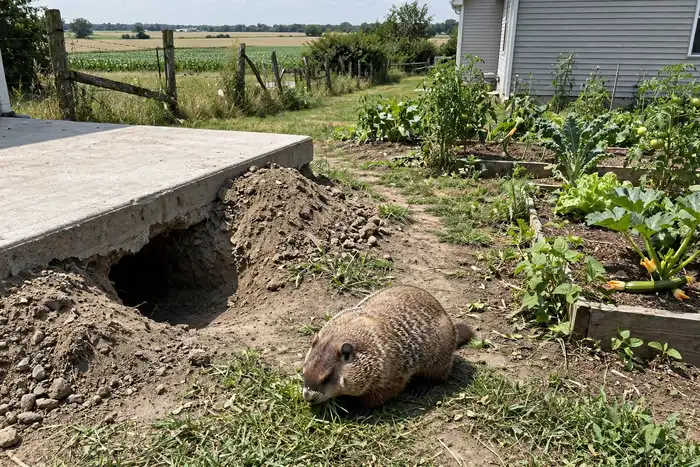
Fresh soil mounded beside the shed, a hole vanishing under the patio slab, and a groundhog sitting upright in a yard that was a field not long ago? In Brunswick, the groundhog is rarely an invader — it is the previous tenant. Call us and tell us about the job — we will confirm the local crew for your county before any work starts.
Groundhogs in your Brunswick home
More than any other animal, the groundhog explains Brunswick. Woodchucks burrowed the edges of Medina County farm fields for generations — along the fencerows, ditch banks and barn foundations — and a housing development does not erase that map. The burrow under your new deck, patio slab or shed is often dug from the same ground the animal or its colony used when it was field, now with a structure over it that keeps the soil dry and the digging safe from predators.
The stakes are structural. A groundhog burrow is a system — multiple entrances, tunnels and chambers — and every bucket of soil on the entrance mound came from under something. Left for seasons, burrows undermine slabs, settle patios, tilt deck posts and open den space that skunks and opossums adopt next. Ohio's nuisance rules give woodchucks their own subsection, OAC 1501:31-15-03(H)(6), with trap-placement requirements: this is established, regulated work in this state, and Brunswick is prime territory for it.
Previous tenants: groundhogs on former farmland
A groundhog colony works an edge for years. When fields are graded for a Brunswick subdivision, the surviving animals shift the shortest possible distance — from the fencerow to the nearest new edge: a drainage swale, a retention-pond bank, the back fence line, and the dry ground under decks and outbuildings. That is why one street can have several groundhog addresses while a mature suburb across town has none. Your burrow is not random; it is the field's old edge, redrawn.
Hibernation: why the problem "disappears" every fall
Groundhogs are true hibernators. They feed heavily into autumn, seal themselves in, and sleep from about late October to late winter. Homeowners understandably conclude the animal left — and then it emerges in spring, hungry, and digs the burrow bigger, often raising young in it by late spring. Winter is the right time to assess and plan, and to close systems our crew has confirmed are empty; the active-season work of trapping happens spring through fall, under Ohio's woodchuck trap-placement rules.
What the burrow does under new concrete
New slabs and patios are, if anything, more vulnerable than old ones: the soil beneath them was recently graded and has not finished settling, and a burrow system accelerates voids exactly where support is needed. The sequence is familiar — a fine crack in the patio, a section tilting, a deck post dropping, a shed floor going uneven. The soil piled at each entrance is the material that used to hold those structures up. Filling the visible hole accomplishes nothing; the tunnels remain, and a groundhog — this one or the next — reopens them in days.
Gardens planted in groundhog country
The first vegetable garden in a new Brunswick subdivision is often planted in what a groundhog considers its feeding ground, and the results are one-sided: greens clipped, beans stripped, a worn path from burrow to garden. Fences help only if they are buried and flared, which garden fences rarely are, and repellents do not hold a hungry woodchuck in June. Removal of the burrowing animal plus closure of its system — not a taller fence — is what lets a garden on former farmland succeed.
How removal and closure are done
Our crew maps every entrance first — main holes with mounds, and the discreet plunge holes groundhogs dig as escape routes — because closing a system with animals or young inside is both cruel and futile. Trapping is set at the burrow under Ohio's woodchuck-specific rules. When the system is confirmed empty, entrances are collapsed and closed, and edges under slabs and decks can be protected with buried screening so the next groundhog emerging from a nearby bank finds finished work instead of an invitation.
Common groundhog questions in Brunswick
Why is there a groundhog under my new Brunswick deck?+
The groundhog vanished in November. Is the problem over?+
Can a groundhog really damage my patio or slab?+
Can I fill the holes or fence it out myself?+
How much does groundhog removal cost in Brunswick?+
Other Brunswick problems that come with groundhogs
Our wildlife crew handles these closely related problems — the ones that most often turn up with a groundhog issue.
Got more than groundhogs in Brunswick?
Groundhogs are rarely the only thing using an attic or yard in Brunswick. See everything we handle locally on the Brunswick wildlife removal hub, or jump to Ohio wildlife removal.
Serving all of Medina County
Brunswick is one part of Medina County. See wildlife removal in Medina County, OH for the county-wide picture — the animals we get called about most, and the other towns we cover.
One call to your Brunswick groundhog crew
The longer groundhogs stay in the attic, the more they chew and the bigger the cleanup. Call us and tell us about the job — we will confirm the local crew for your county before any work starts.
- Local to Medina County. ODNR-compliant handling — call to ask about licensing and insurance.
- Humane exclusion. One-way doors and steel sealing, not poison.
- Done right. Removal, exclusion and cleanup.