Chipmunk Removal in Brunswick, OH
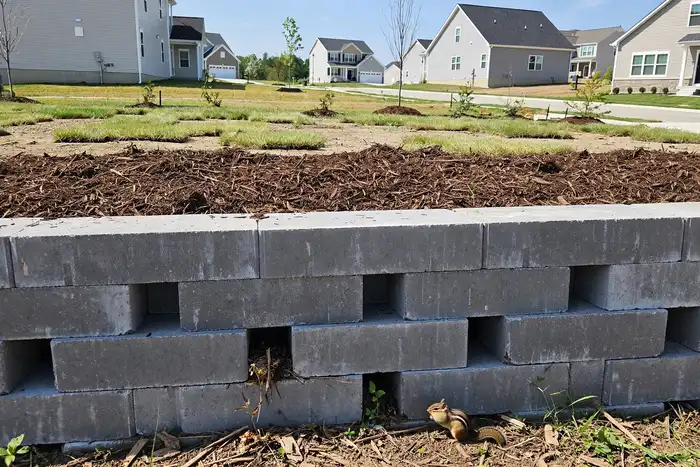
Chipmunks popping out of the new retaining wall, vanishing into the foundation bed, and reappearing by the front stoop? Brunswick's leveled lots and stacked-block walls are ready-made chipmunk housing — and the colony is tunneling it from inside. Call us and tell us about the job — we will confirm the local crew for your county before any work starts.
Chipmunks in your Brunswick home
Brunswick builds chipmunk habitat as a by-product of building houses. Sloping farm lots get leveled with segmental retaining walls — stacked blocks with voids and gravel bedding behind them — and houses sit in fresh foundation backfill that stays loose and easy to dig for years. A chipmunk reads that landscape instantly: cover, drainage and soft digging, in a new yard where the remaining field edges keep supplying animals.
The tidy little entrance hole, with no dirt mound, understates what is underground: a burrow system with chambers and multiple exits, run along a foundation, under a stoop, or through the heart of a retaining wall. Soil and bedding carried out grain by grain lets walls bulge and settle and stoops tilt. Ohio's nuisance rules treat chipmunks as a release-or-euthanize species — they are not on the no-relocation list — but the practical problem is the colony and its tunnels, not the legal category: removal plus closure, or the wall rehomes a new family next season.
The retaining wall colony
This is Brunswick's signature chipmunk job. A stacked-block retaining wall is, to a chipmunk, a ready apartment block: gaps between blocks for entrances, a gravel drainage layer for tunneling, and a soil bed above for chambers. Animals enter at the base or through a face gap, and their digging migrates the wall's own bedding material out through the joints. Seasons of it leave blocks shifting, sections leaning and soil piping out after heavy rain. Our crew maps which stretches of wall are occupied — chipmunks pop in and out at favorite points — before removal, because sealing an occupied wall section entombs animals and guarantees new exits blown through the face.
Fresh backfill at the foundation
Soil placed against a new foundation is never as compact as undisturbed ground, and chipmunks know it. Burrows run along the wall below the mulch line, entrances hidden by the shrubs builders plant against the house. In Brunswick's winters, those tunnels carry meltwater straight to the foundation, and freeze-thaw works in the loosened soil. A colony ignored for a few seasons can tunnel a full side of a house. Catching it early — the year the holes appear — is a much smaller job than rebuilding a burrowed foundation bed and a settled stoop.
Feeders, fresh seed and new lawns
New subdivisions are seeded, fed and watered like nurseries, and chipmunks cash in: spilled birdseed at foundation feeders, grass seed in fresh lawns, bulbs in new beds. A colony raises young in spring and often again in summer, so numbers climb fast where food is constant. Moving feeders away from walls and beds will not empty an established burrow, but it stops concentrating every chipmunk in the neighborhood at your foundation while removal proceeds.
How colony removal works
Our crew identifies all the active entrances — at the wall, along the foundation, under the stoop — and sets traps at the burrow mouths on the animals' own paths, checked daily. A colony is several animals, sometimes more than a dozen, so removal is confirmed by days of no activity at every entrance, not by the first catches. Only then are entrances collapsed and closed. The sequence matters: trap first, close second is the order that works; reversed, it fails and often kills animals inside the wall.
Closing wall and foundation ground
After removal, the vulnerable construction gets attention: gaps in the retaining-wall face and cap are closed, the worst tunneling is backfilled and compacted, and foundation beds and stoop perimeters can be protected with buried screening that makes re-digging difficult. On a new Brunswick lot this is best done once, thoroughly, while the animals are out — re-colonization comes from the field edges, and a closed, screened edge is what it meets.
Common chipmunk questions in Brunswick
Why are chipmunks living in my new retaining wall?+
Can chipmunk tunneling really damage a wall or stoop?+
Can I block the holes in the wall myself?+
There are so many this year. Is that normal?+
How much does chipmunk removal cost in Brunswick?+
Other Brunswick problems that come with chipmunks
Our wildlife crew handles these closely related problems — the ones that most often turn up with a chipmunk issue.
Got more than chipmunks in Brunswick?
Chipmunks are rarely the only thing using an attic or yard in Brunswick. See everything we handle locally on the Brunswick wildlife removal hub, or jump to Ohio wildlife removal.
Serving all of Medina County
Brunswick is one part of Medina County. See wildlife removal in Medina County, OH for the county-wide picture — the animals we get called about most, and the other towns we cover.
One call to your Brunswick chipmunk crew
The longer chipmunks stay in the attic, the more they chew and the bigger the cleanup. Call us and tell us about the job — we will confirm the local crew for your county before any work starts.
- Local to Medina County. ODNR-compliant handling — call to ask about licensing and insurance.
- Humane exclusion. One-way doors and steel sealing, not poison.
- Done right. Removal, exclusion and cleanup.