Armadillo Removal in Roberta, GA
You water the beds in the evening and they look fine. By morning a Roberta garden can look ploughed — shallow holes everywhere, mulch scattered, roots exposed — the calling card of an armadillo that fed there all night.
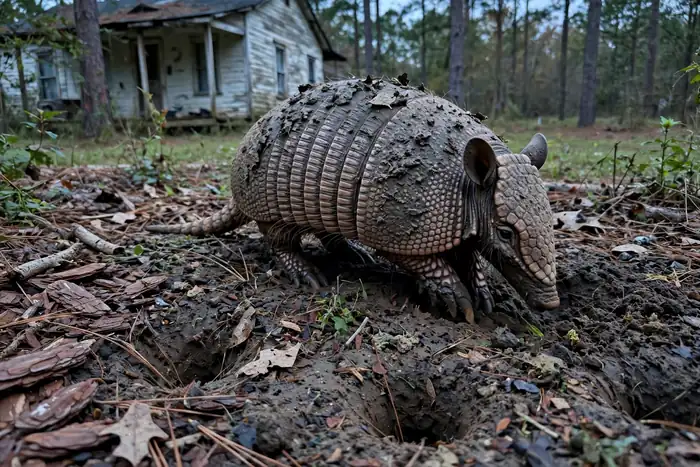
Why Roberta garden beds and soft soil draw armadillos in
Armadillo damage in Roberta has a particular cruelty to it: it happens to the ground you tend most. The garden beds you just planted. The flower border along the porch. The soft, watered soil around new shrubs. An armadillo hunts by smell, pushing its nose into loose earth for grubs and worms, and a well-kept Roberta bed — moist, mulched, full of life — is simply the richest hunting ground on the lot, richer than the hard field soil it crossed to get there.
The animal itself is rarely seen doing it. Armadillos work the night shift, arriving from a burrow in the field edge, under a shed, or beneath a porch, and leaving before the house wakes. What the homeowner gets is the evidence: dozens of shallow holes, uprooted seedlings, mulch kicked across paths, and sometimes a burrow entrance appearing under the deck or at the foundation. One night is a nuisance. A week of it can undo a season of garden work.
Reading overnight digging in a Roberta garden
Armadillo feeding holes are shallow, narrow and numerous, dug where the soil is softest: freshly watered beds, mulched borders, new plantings and lawn patches over rich earth. The pattern is scattered rather than focused, because the animal is sampling for grubs as it goes. We walk the damage with you in Roberta and separate feeding sign from burrowing, because the two point to different fixes — and from raccoon damage, which tears at plants and produce rather than the soil itself.
Soft Roberta soil, watering and the grub buffet
Watering does more than keep plants alive. It softens the ground so an armadillo can dig fast, and it concentrates the worms and grubs the animal is hunting near the surface. Beds watered in the evening are at their softest exactly when armadillos start moving. We talk through timing — morning watering lets the surface firm up before dark — along with grub pressure in the lawn, because a yard full of grubs will keep drawing armadillos no matter how many are removed.
Burrows under Roberta porches, decks and sheds
Feeding in the yard is half the story. Armadillos also dig burrows, and on a Roberta property the favourite spots are under porches, decks, sheds and the edges of foundations, where the soil is dry and undisturbed and the entrance stays hidden. A burrow under a structure can undermine soil against the foundation and gives the animal a home base inside your yard instead of out at the field edge. We check under structures on every armadillo visit.
Setting removal on armadillo runs at the Roberta lot edge
Armadillos are creatures of habit, entering the yard at the same low spot in the fence, the same gap at the field edge, the same path alongside the shed, night after night. Removal set on those runs outperforms anything placed randomly in open lawn. We find the runs from tracks, worn paths and the distribution of holes, set control there, and check burrow activity so we know whether we are dealing with one animal or a family group. We will confirm the local crew for your county before any work starts.
Protecting Roberta beds while removal is under way
While removal runs, small defences protect the work you have already done: temporary low barriers around the most valuable beds, mulch kept a little thinner in the worst-hit borders, and seedlings given a head start in pots before transplanting where that suits your garden. These are stopgaps, not the cure, but they keep a planting alive through the nights it takes to clear the animal working it.
Keeping armadillos from reworking a Roberta yard
After removal, the yard has to stop smelling like a buffet. Morning watering, attention to grub-heavy lawn patches, closing burrow entrances under structures once they are confirmed empty, and keeping the lot edge clear so runs are visible all reduce repeat visits. A new armadillo may still cross from the fields now and then — that is Crawford County — but it should find a yard that is harder to dig and quicker to notice.
Common armadillo questions in Roberta
What is digging up my Roberta garden every night?+
Why does the digging get worse after I water my Roberta beds?+
There is a big hole under my Roberta porch. Is that an armadillo burrow?+
Can I just fill in the holes and wait for the armadillo to leave my Roberta yard?+
Do armadillos in Roberta carry disease I should worry about?+
Will fencing my Roberta garden keep armadillos out?+
Other Roberta problems that come with armadillos
Our wildlife crew handles these closely related problems — the ones that most often turn up with a armadillo issue.
Got more than armadillos in Roberta?
Digging in a Roberta yard sometimes has more than one author. If you are also losing produce, seeing fruit stripped or finding the shed raided, a raccoon may be working the same garden, and we can assess both animals on one visit. See everything we handle locally on the Roberta wildlife removal hub, or jump to Georgia wildlife removal.
Want the background before you call? Read our statewide guide: Armadillos tearing up your Georgia lawn.
Serving all of Crawford County
Roberta is one part of Crawford County. See wildlife removal in Crawford County, GA for the county-wide picture — the animals we get called about most, and the other towns we cover.
One call to your Roberta armadillo crew
An armadillo is a route animal. Catch the route and you catch the problem.
- Local to Crawford County. Georgia DNR-compliant handling — call to ask about licensing and insurance.
- Our method: set control on the runs, close the burrows, dull the buffet. We map where the armadillo enters the yard from the field or woods, set removal along those runs and at active burrows, then work through the watering, grub and cover conditions in your Roberta beds that made the yard worth digging every night.
- Done right. Removal, exclusion and cleanup.