Bird Removal in Sebastian, FL
Ducks on the community dock, pigeons lined along a US-1 storefront, starlings boiling out of a vent at dusk. Sebastian bird calls divide into pond problems and building problems — tell us which one, and which bird if you know it.
Birds in your Sebastian home
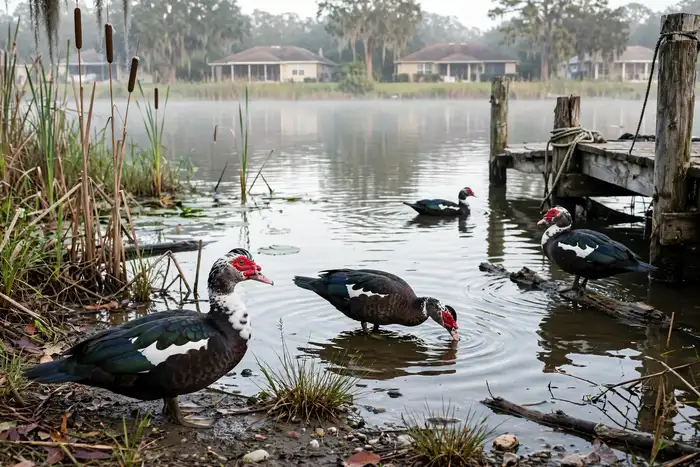
Start with the bird Sebastian argues about at association meetings: the Muscovy duck. The ponds, canals and slow ditches of the town's communities — manufactured-home parks, subdivisions, the waterways behind the US-1 corridor — collect Muscovies the way they collect rain, and a fed flock grows fast, fouls docks and pool decks, nests in the landscaping and defends it in breeding season. The legal framing belongs at the top of this page: FWC does not remove Muscovy ducks. Under the federal control order covering this nonnative species, they are handled by landowners or by the trappers landowners hire — and they are never released elsewhere, so no relocation is offered or implied.
The building half of the file belongs to pigeons and starlings. Pigeons work the flat roofs, signs and ledges of the US-1 commercial corridor and the sheltered seams of homes; starlings take the vents — dryer, bathroom, range hood — of homes and shops alike, announcing a tenancy with nesting grass at the louvre and a dawn racket in the duct. Those are exclusion problems with physical answers: netting, spikes and caps, fitted once and working quietly for years.
Muscovy ducks: the community pond, handled lawfully
A Muscovy job in Sebastian is usually an association job, because the pond is common ground and so is the problem. Our part is the trapping and removal itself, carried out as the landowner's hired hand under the federal control order. The association's part decides whether we are ever needed again: a no-feeding rule with actual enforcement, since a fed flock replaces itself in a season, and egg management within the rules during breeding season to slow the arithmetic. We will lay that out at the first meeting, because removing ducks from a pond that stays catered is a subscription, not a solution, and we would rather sell the solution.
Pigeons on the corridor and the roofline
Sebastian's pigeons concentrate where ledges, shade and food coincide — the sign bands and flat roof edges of US-1 businesses, carport beams, and the protected gap under rooftop solar panels on homes, where droppings build unseen until staining and odor testify. The durable response is to retire the sites physically: netting across voids, spikes and ledge treatments where birds loaf, and skirting that closes the panel gap to a nesting flock. Plastic owls and tape educate a pigeon flock for about a week; barriers educate it for the life of the fitting, which is why our quotes are for hardware, not theatre.
Starlings in the vents of homes and shops
A starling vent job follows a set order. First, confirm the tenancy and whether the spring nest holds young. Then clear the nesting material from the vent run as far as it can properly be reached — a packed duct is a lint-and-grass fire load as well as a bird problem — and fit a proper vent cap or cage that excludes birds while the vent still does its job. Starlings are nonnative and unprotected, so the work is lawful and direct. Every exterior vent on the building is checked in the same visit, because a pair refused at the dryer vent will try the bathroom vent before the week is out.
One line for the protected majority
Most other Sebastian birds — the herons and egrets stalking the ponds, ospreys over the river, the sandhill cranes walking the lots like they own them — are protected under the Migratory Bird Treaty Act, and for them our service is identification and advice only: active nests are left until they empty, deterrence is timed outside nesting season, and an injured protected bird belongs with a licensed rehabilitator, whose contact we can supply. Doing the lawful birds properly starts with knowing which birds those are.
Common bird questions in Sebastian
Can FWC be called to take the ducks off our community pond?+
Could the ducks be caught and put in the river instead?+
Pigeons roost on our shopfront sign every night. What stops them?+
There are baby birds in my bathroom vent. Can the cap go on today?+
A bird is loose inside our store on the corridor. Can you get it out?+
Got more than birds in Sebastian?
Birds are rarely the only thing using an attic or yard in Sebastian. See everything we handle locally on the Sebastian wildlife removal hub, or jump to Florida wildlife removal.
Serving all of Indian River County
Sebastian is one part of Indian River County. See wildlife removal in Indian River County, FL for the county-wide picture — the animals we get called about most, and the other towns we cover.
One call to your Sebastian bird crew
The longer birds stay in the attic, the more they chew and the bigger the cleanup. Call us and tell us about the job — we will confirm the local crew for your county before any work starts.
- Local to Indian River County. FWC-compliant handling — call to ask about licensing and insurance.
- Humane exclusion. One-way doors and steel sealing, not poison.
- Done right. Removal, exclusion and cleanup.