Iguana Removal in Palm City, FL
They sun on your seawall cap in a row like they own the canal — and underground, their burrows are quietly removing the bank the wall stands on. Palm City iguana work is bank work. Call us for a burrow count before the wall starts to lean.
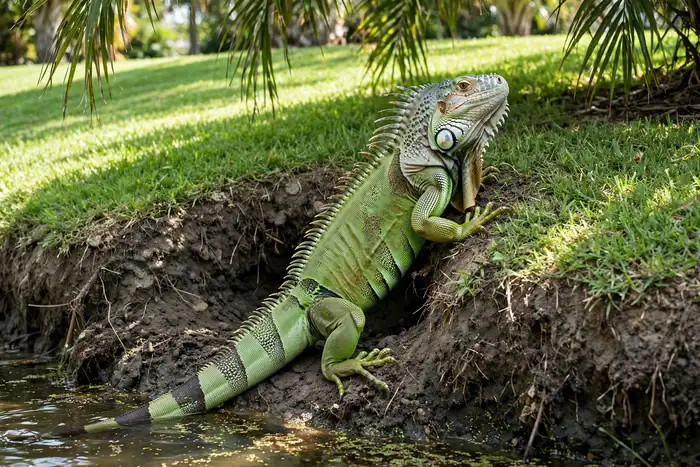
Iguanas in your Palm City home
Palm City's canals were dug as drainage and sold as waterfront, and the green iguana has taken both descriptions seriously. Martin County is where this species is established on the Treasure Coast — a breeding, self-sustaining population, not a scatter of escaped pets — and Palm City's miles of sunny canal banks, seawalls and rock edges, backed by irrigated lawns and ornamental plantings, are close to the exact habitat the population expands into first. If your lot ends in a seawall, iguanas have already inspected it.
The green iguana is listed as a Prohibited species in Florida, and the state's guidance is the most direct in all of wildlife work: FWC encourages removal, and iguanas may be taken on private property year-round with the landowner's permission. The disposition rule admits no exceptions — a captured iguana can never be relocated or released. Palm City iguana service therefore means two things done in order: the animals removed, and the burrow systems in your bank collapsed and closed before the next iguana family reads them as available housing.
Under the cap: how a canal bank gets hollowed
An iguana burrow starts as a sloping tunnel at the waterline or behind the seawall cap and develops into a chambered system — sleeping burrows for the resident group, deeper nesting chambers where females lay large clutches in late winter and spring. Along a worked Palm City bank the mouths multiply season by season, each one removing soil from behind the wall and opening a channel for rain and canal water to wash more out through joints and weep holes. The visible symptoms arrive late and expensively: a cap that has dropped a fraction, panels beginning to lean, a strip of lawn along the wall that feels hollow underfoot. Counting burrow mouths is the honest early diagnostic, and it costs a walk with a flashlight.
Life on the surface: decks, docks and plantings
Above ground the colony's economy is droppings and appetite. Resident iguanas foul the seawall cap, the dock and any pool deck within their circuit daily, and they graze — hibiscus and bougainvillea stripped to stems, garden vegetables and fruit taken methodically, young plantings uprooted in the digging. They are not aggressive animals, but a large male cornered on a dock by an enthusiastic dog defends itself with teeth, claws and a whipping tail, and the droppings ground into a pool deck's texture are a sanitation problem, not a housekeeping preference.
Cold snaps, and why Palm City holds the line
Iguanas run on borrowed tropical warmth: below roughly 50°F they go torpid, lose their grip in the trees and can be found stunned on the ground after a hard night — a Treasure Coast winter spectacle that also thins the population for free. It thins less here than farther north, which is the whole geography of the species in one fact: Martin County's milder coastal nights let the established population persist and breed, while colder counties up the coast hold only scattered individuals. Palm City's iguanas are therefore not a wave passing through. They are a resident population at the climate's edge, and removal-plus-closure, not waiting for weather, is the management answer.
Removal on a Palm City canal lot
The work starts with a bank survey: burrow mouths counted and flagged, basking sites and the routes between water, burrow and feeding plantings mapped, the colony sized honestly. Removal proceeds at those sites by trained handlers — active animals taken by hand and noose pole, burrow systems worked in sequence — under the landowner's permission Florida's framework requires. Disposition is lawful and final, explained plainly before the first visit: no iguana removed from a Palm City bank is ever released to colonize another one, in this county or any other.
Hardening the bank behind them
An emptied burrow system on a sunny canal is an advertisement to every juvenile iguana dispersing along the water, so closure is half the service: burrows collapsed and filled with compacted material, cap and joint gaps flagged for the seawall repair they may need, and the bank profile regraded or armored where digging has been heaviest. Planting choices finish the job — iguanas graze a known list of Palm City ornamentals down to the stems and pointedly ignore others, and shifting a bank's planting toward the ignored list removes the food half of the habitat equation. A closed, hardened, unappetizing bank is the least attractive address on the canal, which is the entire objective.
Mistakes that grow colonies
Feeding is the first — a hand-fed colony is trained, territorial about the handout spot, and swollen beyond what the bank would naturally carry. The second is the amateur grab: a large male's bite and claws are a real injury risk, and a failed attempt teaches the colony to scatter at a human silhouette, making professional removal slower for everyone. The third is the too-good offer: any company promising to release your iguanas 'somewhere wild' is promising a prohibited act in Florida — and has told you how the rest of the job will go.
Common iguana questions in Palm City
Are Palm City iguanas really a breeding population, or just pets that got loose?+
Why can't you release them at a preserve or out in the western county?+
Cold weather is coming. Won't the freeze just solve this?+
How fast does burrow damage become a seawall problem?+
How much does iguana removal cost in Palm City?+
Got more than iguanas in Palm City?
Iguanas are rarely the only thing using an attic or yard in Palm City. See everything we handle locally on the Palm City wildlife removal hub, or jump to Florida wildlife removal.
Serving all of Martin County
Palm City is one part of Martin County. See wildlife removal in Martin County, FL for the county-wide picture — the animals we get called about most, and the other towns we cover.
One call to your Palm City iguana crew
The longer iguanas stay in the attic, the more they chew and the bigger the cleanup. Call us and tell us about the job — we will confirm the local crew for your county before any work starts.
- Local to Martin County. FWC-compliant handling — call to ask about licensing and insurance.
- Humane exclusion. One-way doors and steel sealing, not poison.
- Done right. Removal, exclusion and cleanup.