Bird Removal in Palm City, FL
The pond bank is grazed to mud, ducklings trail across every driveway, and the HOA board has run out of polite letters. Palm City's Muscovy problem has exactly one lawful owner — the community itself. Call us and we will lay out how it actually gets solved.
Birds in your Palm City home
Palm City's bird work is dominated by a single, unmistakable tenant: the Muscovy duck, a heavy, red-faced, nearly silent duck that has colonized the retention ponds and canal banks of the community's HOA subdivisions. Fed by residents, safe from predators, and breeding in the plantings at the waterline, a Palm City pond flock compounds quietly until droppings coat the sidewalks and pool decks, males fight through nesting season, and the bank grass is grazed down to the mud it stands in.
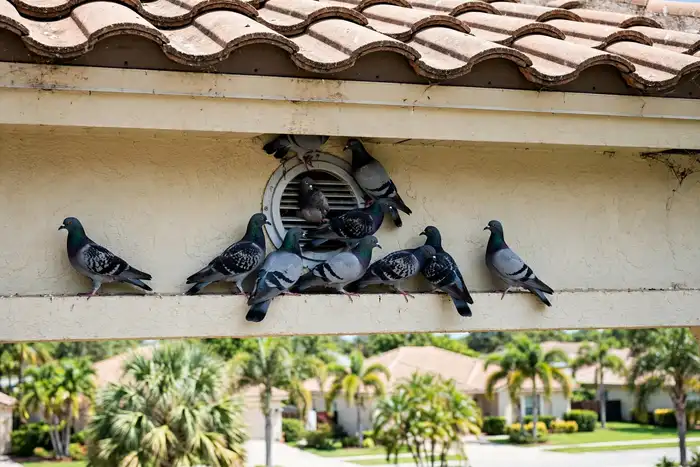
The second tier of calls is architectural — pigeons roosting on rooflines and under solar and tile edges, starlings packing vents and soffit gaps. Both are excludable problems with mechanical answers. Everything else with feathers in Palm City — the herons stalking the canal, the sandhill cranes crossing the western pastures, the osprey over the South Fork — is protected under the Migratory Bird Treaty Act, and the professional service for protected birds is identification and timing, never removal.
Muscovies are the landowner's job — FWC will not be coming
This is the fact Palm City HOAs most need to hear plainly: no agency removes Muscovy ducks from community land. FWC does not do it, the county does not do it, and animal control does not do it. Under the federal control order that governs this introduced species in Florida, Muscovies on private or community property are the landowner's responsibility, handled directly or by a hired trapper working lawfully and humanely. And one promise must never be made or believed: ducks taken under the control order are not relocated — they are not released at a park, a farm or another waterway to found the next community's problem. Our Palm City programs are built for boards and pond-front owners on exactly those terms: assessment of the flock and the site, lawful removal, and the habitat changes that decide whether the work holds.
The feeding question decides the sequel
Every durable Palm City Muscovy program starts with an uncomfortable agenda item: somebody in the community is feeding them. Bread and cracked corn at one beloved bank can sustain a flock through any removal, and lush fertilized grass at the waterline is a buffet even without a single handout. Communities that pair removal with an enforced feeding ban, egg-and-nest coordination where the rules allow the association to act, and bank planting choices ducks graze less eagerly, stay solved. Communities that skip the conversation re-meet the flock within a couple of breeding seasons — usually at the same bank, founded by ducks from the next pond over.
Pigeons and starlings: the excludable second tier
Pigeons on Palm City rooflines are a geometry problem: they need a flat, sheltered ledge, and netting, spike systems and screened cavities remove the geometry. Under-tile and solar-edge roosts get closed with mesh fitted to the roof system, and droppings — a genuine sanitation material — are cleaned as part of the job. Starlings are the vent story: dryer, bath and range vents and open soffit gaps packed with nesting grass by the armful. Birds confirmed out, then proper caps and screens fitted, ends both the noise and the lint-and-grass fire risk a packed dryer vent represents.
The protected birds are neighbors, not calls
One sentence of law covers the rest of Palm City's birdlife: under the Migratory Bird Treaty Act, nearly all native birds — and their active nests — are protected, and they may not be removed, moved or disturbed. Sandhill cranes striding a western pasture, a heron working your canal bank, swallows raising young under the lanai: the correct service is identification, deterrence that respects the protection, and timing any work for when nests are naturally empty. If a call turns out to involve a protected species, that is the answer we will give you, and it is the right one.
Common bird questions in Palm City
Our HOA has forty Muscovies on three ponds. Where do we even start?+
Can the ducks be caught and released at a park outside the community?+
A crane is nesting near our western lot line and we need the fence repaired. What are our options?+
Starlings keep defeating the vent cover I bought. Why?+
How much does bird work cost in Palm City?+
Got more than birds in Palm City?
Birds are rarely the only thing using an attic or yard in Palm City. See everything we handle locally on the Palm City wildlife removal hub, or jump to Florida wildlife removal.
Serving all of Martin County
Palm City is one part of Martin County. See wildlife removal in Martin County, FL for the county-wide picture — the animals we get called about most, and the other towns we cover.
One call to your Palm City bird crew
The longer birds stay in the attic, the more they chew and the bigger the cleanup. Call us and tell us about the job — we will confirm the local crew for your county before any work starts.
- Local to Martin County. FWC-compliant handling — call to ask about licensing and insurance.
- Humane exclusion. One-way doors and steel sealing, not poison.
- Done right. Removal, exclusion and cleanup.