Snake Removal in Jensen Beach, FL
It was along the seawall, across the lanai, under the dock boards — and now you are not sure what it was. That uncertainty is the service: call with a description or a photo taken from well back, and start with a name.
Snakes in your Jensen Beach home
Jensen Beach puts snakes and people on the same narrow ground: the lagoon edge, canal banks, dock and seawall margins, and the landscaping that runs down to them. Most snakes met there are doing unpaid rodent work. Four local species are venomous — the cottonmouth, eastern diamondback rattlesnake, dusky pygmy rattlesnake and eastern coral snake — and the skill that matters is telling those four apart from the harmless majority, calmly and correctly.
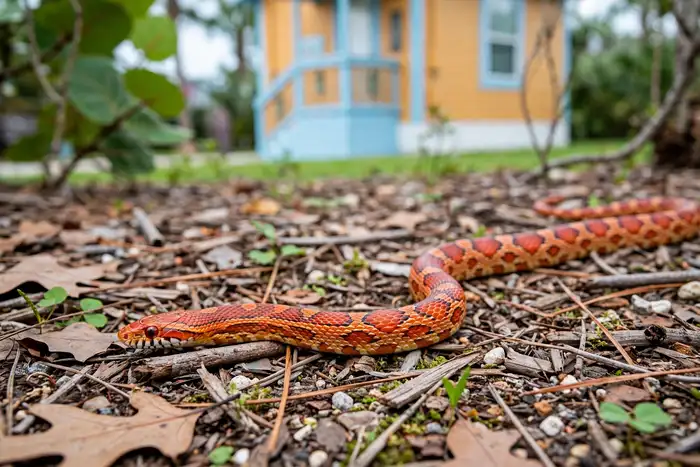
The common harmless cast is worth knowing by name: the southern black racer that patrols yards by day, the corn snake or red rat snake around sheds and pool equipment, the eastern rat snake, and the Florida banded water snake at docks and canal edges — the banded, heavy-bodied look-alike that is mistaken for a cottonmouth more than any other snake on this coast.
The dockside identification that matters most
A thick, banded snake at the water's edge triggers one word — cottonmouth — and is very often a Florida banded water snake, a harmless fish-eater that flattens its head in bluff when cornered, which deepens the confusion. Real cottonmouths do live along the lagoon and canals, so the answer is never a guess from the dock. A photo from a safe distance, the snake's behaviour and its exact location let us separate the two before anyone gets close.
The four venomous species, briefly and plainly
The cottonmouth is the waterside one. The eastern diamondback is the large, heavy rattlesnake of dry, open and scrubby ground, increasingly uncommon near housing. The dusky pygmy rattlesnake is small, thick and grey with a reddish stripe — the venomous snake Jensen Beach gardeners are likeliest to meet at close range among plantings. The eastern coral snake is slender, red-yellow-and-black banded, shy and burrowing, and rarely seen at all. Each calls for distance and a professional, not a closer look.
Racers and rat snakes: the working neighbours
A black racer crossing the yard at speed is hunting, and a yard with racers usually has fewer rodents and fewer of the snakes that follow rodents. Rat snakes climb — expect one occasionally at a pool-cage corner, in a palm or along a fence line after birds or rats. Our advice for both is usually to let them work, while we correct whatever drew prey to the house: spilled seed, rodent harbourage in stacked materials, dense ground cover against the walls.
The protected snake we will not touch
The eastern indigo snake — large, glossy blue-black and entirely harmless — is protected, and if the snake at your place is an indigo, we do not handle it; we will help you contact the FWC instead. Indigos shelter in tortoise burrows and open sandy ground, so the identification matters on the mainland lots especially. Photograph from a distance, keep dogs away, and let the protected animal go about its day.
What a snake call actually involves
We identify first, from your description or photo. A venomous snake in a yard, lanai or pool cage is removed by a professional with the right equipment. A harmless snake is usually left or guided out with an explanation of why it came. Then we walk the property for the conditions that invited it — rodent sign, wood and debris piles against the house, gaps under doors and at the pool-cage frame — because removing one snake from a yard that still feeds snakes is a short-term result.
Hurricane debris and displaced snakes
After a storm, lagoon and canal snakes move with the water and shelter in the debris, fallen fronds and stacked materials the storm leaves behind. Jensen Beach cleanup crews and homeowners meet more snakes in the fortnight after a hurricane than in a normal season. Gloves, boots, looking before reaching into a pile, and calling rather than handling anything banded or thick-bodied are the whole safety briefing.
Common snake questions in Jensen Beach
Is the banded snake at my dock a cottonmouth?+
A black snake crosses my yard every day. Should I worry?+
What should I do if a snake is inside the pool cage or house?+
Can you make my yard snake-free?+
How much does snake removal cost in Jensen Beach?+
Other Jensen Beach problems that come with snakes
Our wildlife crew handles these closely related problems — the ones that most often turn up with a snake issue.
Got more than snakes in Jensen Beach?
Snakes are rarely the only thing using an attic or yard in Jensen Beach. See everything we handle locally on the Jensen Beach wildlife removal hub, or jump to Florida wildlife removal.
Serving all of Martin County
Jensen Beach is one part of Martin County. See wildlife removal in Martin County, FL for the county-wide picture — the animals we get called about most, and the other towns we cover.
One call to your Jensen Beach snake crew
The longer snakes stay in the attic, the more they chew and the bigger the cleanup. Call us and tell us about the job — we will confirm the local crew for your county before any work starts.
- Local to Martin County. FWC-compliant handling — call to ask about licensing and insurance.
- Humane exclusion. One-way doors and steel sealing, not poison.
- Done right. Removal, exclusion and cleanup.