Iguana Removal in Jensen Beach, FL
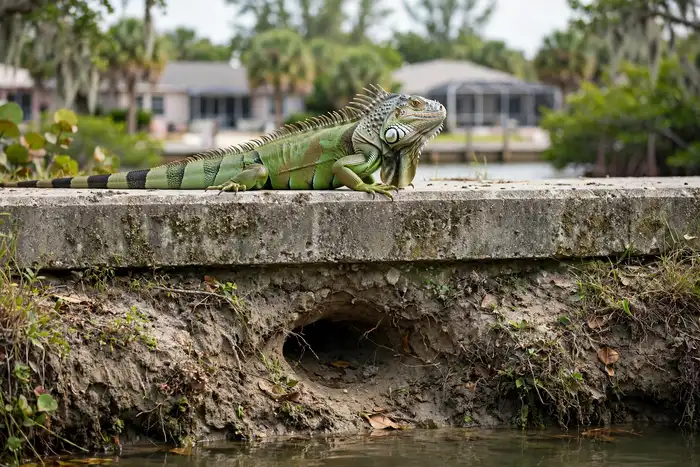
A four-foot lizard on the seawall, burrow mouths opening along the canal bank, droppings on the pool deck every morning. Jensen Beach is established iguana country — this is not a stray pet problem, and it is handled accordingly.
Iguanas in your Jensen Beach home
Martin County is where green iguanas are established on this coast — a breeding, self-sustaining population, not a scattering of escaped pets. Jensen Beach gives them everything they require: canal and lagoon banks to burrow into, seawalls and docks to bask on, year-round landscaping to eat and pool decks to foul. Homeowners meet them as a property problem first and an animal second: undermined banks, collapsing edges, stripped hibiscus and ornamental plantings, and droppings where people walk barefoot.
The legal position is clear and unusually direct. The green iguana is a Prohibited species under Florida rules, it is not protected beyond the ordinary anti-cruelty laws, and the FWC encourages its removal from private property year-round with the landowner's permission. The other half of that position is just as firm: a captured iguana can never be relocated or released anywhere in Florida. Every part of our Jensen Beach iguana work is built on those two sentences.
Burrowing: the structural damage nobody expects
Iguanas dig like they mean it. Females excavate nesting burrows and both sexes maintain shelter burrows in canal banks, at the landward foot of seawalls, under docks, sidewalks and pool decks. A burrow system removes soil the structure was standing on, and Jensen Beach owners discover it as a seawall path that has begun to slump, a dock apron cracking at the edge, or a bank that gives underfoot. Removing the animals without addressing open burrows invites the next iguana to move into a ready-made home, so burrow entrances are part of the job, not an afterthought.
Pool decks, docks and the daily mess
An iguana that basks on your deck defecates on it, daily, in quantity — the complaint that turns tolerance into a phone call in most Jensen Beach households. Around pools that is a hygiene problem as well as a housekeeping one, and on docks the droppings land where hands and bare feet go. Iguanas also startle: a large male dropping from a dock piling or a palm into the water beside a swimmer is an experience a household only needs once before calling.
Landscaping is the food supply
Hibiscus, bougainvillea, orchids, vegetable gardens and freshly planted annuals are iguana forage, and a Jensen Beach yard planted generously is a yard on the iguana map. Removal reduces the residents; planting choices reduce the recruitment. After a removal we walk the property and name the worst attractants honestly — the flowering hedge along the canal is usually feeding the very burrows beneath it — so the owner can decide what to replant, protect with mesh, or simply accept as shared.
How removal is carried out
Iguanas are wary, fast in short bursts and most catchable by people who work them regularly. Removal visits are timed to their habits — basking sites in the morning sun, feeding routes, the burrow entrances a colony actually uses. Because the population here is established, a single visit rarely ends a canal-bank problem for a whole street; we scope the work by the property, tell you what one visit can and cannot achieve, and set follow-up where the burrow count says it is needed.
Cold snaps: why the line stops at Martin County
Iguanas are cold-limited animals. Below about fifty degrees they grow torpid and famously lose their grip in trees, and a hard cold snap kills numbers of them outright. That intolerance is exactly why the established population ends around Martin County while the counties north of here see only scattered individuals. A Jensen Beach winter cold snap thins the population, but the survivors recolonise the same warm banks in spring — weather is a pause in iguana pressure, not a solution to it.
What we will not tell you
We will not tell you the iguanas will be taken somewhere and released — the rules forbid it and the FWC's position is removal. We will not tell you one visit clears an established canal bank for good, because burrows and neighbouring properties keep the pressure on. What we offer instead is the honest version: removal of the animals on your property, burrows addressed, attractants named, and a follow-up pattern that matches how established iguanas actually behave along this waterfront.
Common iguana questions in Jensen Beach
Are iguanas really established in Jensen Beach, or are these escaped pets?+
Can the iguanas be caught and released somewhere else?+
Are iguanas dangerous?+
Will a cold winter solve my iguana problem?+
The burrows are under my seawall path. Is that urgent?+
How much does iguana removal cost in Jensen Beach?+
Got more than iguanas in Jensen Beach?
Iguanas are rarely the only thing using an attic or yard in Jensen Beach. See everything we handle locally on the Jensen Beach wildlife removal hub, or jump to Florida wildlife removal.
Serving all of Martin County
Jensen Beach is one part of Martin County. See wildlife removal in Martin County, FL for the county-wide picture — the animals we get called about most, and the other towns we cover.
One call to your Jensen Beach iguana crew
The longer iguanas stay in the attic, the more they chew and the bigger the cleanup. Call us and tell us about the job — we will confirm the local crew for your county before any work starts.
- Local to Martin County. FWC-compliant handling — call to ask about licensing and insurance.
- Humane exclusion. One-way doors and steel sealing, not poison.
- Done right. Removal, exclusion and cleanup.