Wildlife Removal in Wadsworth, OH
Wadsworth is growing outward from an older center, and wildlife notices both parts: the in-town houses with deep porches and old chimneys, and the new streets where back yards still end in fields and tree lines. The entry points differ, the fix has to fit the house. Call us and tell us about the job — we will confirm the local crew for your county before any work starts.
Why Wadsworth homes see the wildlife they do
In-town Wadsworth has the settled feel of a place built in layers. There are older houses on tree-lined streets with front porches, detached garages and crawlspaces that have shifted a little with every decade, alongside mid-century homes whose additions and converted spaces created seams an animal can find. Mature trees lean over roofs, chimneys stand uncapped, and the quiet spaces under porches have sheltered generations of skunks and opossums.
A short drive out, the city is visibly newer. Subdivisions keep rising on ground that was recently open, and the houses there back onto drainage swales, retention areas, undeveloped lots and strips of woods. That edge is where groundhogs dig, where skunks make their evening rounds, and where squirrels travel a fence line from the remaining trees to a brand-new roof.
Our crew starts by deciding which Wadsworth you live in, because the inspection follows the housing. Then the work is the same in spirit everywhere in town: locate the real opening, get the animal out in the manner Ohio law allows, shut the opening with material that holds up to weather and chewing, and clean the den, attic or crawlspace the animal was using. A quick patch over the one hole you can see from the driveway rarely ends the story on either kind of street.
In-town Wadsworth: porches, crawlspaces and old chimneys
The older housing near the center of Wadsworth offers wildlife shelter at every level. At the top, tall attics and masonry chimneys — some serving fireplaces that are lit a handful of times a year — draw big brown bats in summer and raccoon mothers in spring. At ground level, porch voids and crawlspaces behind tired vent covers shelter skunks, opossums and, in the walls above them, mice that entered at a pipe and climbed.
These houses also carry the marks of their age in places animals notice first. Mortar softens, a sill plate settles, flashing loosens where a porch roof meets the wall, and each freeze-thaw cycle nudges a tight joint toward an opening. None of it looks dramatic from the street, which is why an in-town call often begins with a puzzle — droppings by a basement wall, a smell under the porch, noises that seem to move floors.
The in-town inspection works level by level: chimney and attic, then the main roofline, then porch, crawlspace and foundation. Sealing is done in metal and masonry-grade materials sized to the opening, so an older house can be closed tight without being wrapped in anything unsightly.
The growing edge: new houses beside old habitat
On Wadsworth's newer streets, the wildlife was there first and the houses arrived quickly around it. Ground that was field or woodlot a few seasons ago still carries groundhog burrows, skunk trails and squirrel routes, and construction leaves features animals use at once: sunny slopes for digging, retaining walls with loose backfill, drainage areas that stay green, and sheds and play structures set on open ground.
Newer houses are tighter than the in-town stock in some ways and looser in others. Wall and roof vents often wear light covers, trim corners can flex, and an attached garage shares openings with the house itself. A family neighborhood also feeds wildlife generously without meaning to — grills, bird feeders, gardens, pet doors and trash set out the night before pickup.
For these homes the job starts outside the walls. The crew walks the lot line, the shed, the slope and the fence, reads the digging and the trails, and then inspects the envelope with that pressure in mind. Closing a vent while a burrow system advances toward the foundation treats the symptom and leaves the cause in place.
Family neighborhoods and the animals that share them
Wadsworth's neighborhoods are busy places for people and, after dark, for wildlife. Raccoons learn the trash schedule. Skunks cross lawns grub-hunting and den under the lowest deck on the street. Opossums pass through nightly and stay only when a garage or porch gives them a daytime bed. Children and dogs find all of this fascinating, which is a practical reason to keep a respectful distance and call early: a cornered raccoon or a skunk surprised at close range is a problem nobody in a family neighborhood needs.
Autumn concentrates the calls. Cooling nights send squirrels and mice looking for a way into walls and attics, and they test every weakness that last winter's freezing and thawing created. A house that stayed quiet for years can have animals overhead within a week of the first hard frost — the roofline finally opened enough, at the exact moment animals went looking.
Spring reverses the flow: groundhogs emerge and dig, skunks raise litters under porches, raccoons settle into chimneys, and bat colonies return to attics just as the legal window for excluding them is about to close for the summer.
Ohio rules that shape the work: licensing, bats and rabies
Anyone doing this work for hire in Ohio must hold an ODNR Commercial Nuisance Wild Animal Control Operator license under Ohio Revised Code section 1531.40 — ask us about licensing and insurance when you call. Bats carry their own calendar: exclusion is closed from May 16 through July 31 when five or more bats are present, because the pups cannot fly, and from October 15 through March 31, when big brown bats may be hibernating inside the attic, in either case without prior written ODNR permission. The windows when exclusion can proceed are April 1 to May 15 and August 1 to October 15.
Raccoons, skunks, foxes and bats are Ohio's principal rabies vectors, so a strange-acting animal or a bat found in a sleeping room is a distance-and-advice situation, not a close inspection. Under Ohio Administrative Code 1501:31-15-03(E)(3), a captured raccoon, skunk or opossum cannot be taken off the property for release elsewhere: the lawful outcomes are release on the same property or humane euthanasia. Our crew leads with exclusion — one-way doors that let an animal leave a structure under its own power where that is possible — and handles the rest exactly as Ohio rules require.
Wildlife we remove in Wadsworth
From chimney raccoons on the older streets to groundhogs digging at the newest lot lines, these are the calls Wadsworth homeowners make most.
🐿️ Squirrels
Street trees in-town and tree lines behind new subdivisions both deliver squirrels to Wadsworth roofs, and fall sends them looking for a winter attic. Gray squirrels work the openings freezing and thawing left at soffits and vents, and the chewing that follows is the costly part. See our full Wadsworth squirrel removal guide →
🦝 Raccoons
In-town chimneys that rarely see a fire are ready-made raccoon nurseries in spring, and family neighborhoods supply the food. Ohio law bars taking a captured raccoon away for release, so the job is exclusion first, kits accounted for, and the den space cleaned. See our full Wadsworth raccoon removal guide →
🦇 Bats
Big brown bats summer in the attics of Wadsworth's older houses and hibernate inside some Ohio attics all winter. Exclusion is lawful only April 1–May 15 and August 1–October 15 without written ODNR permission, which makes early calling more than a slogan. See our full Wadsworth bat removal guide →
🦨 Skunks
The low space under a porch in-town or a deck in a new subdivision is the standard Wadsworth skunk den, and the smell does not stay outdoors. A rabies vector that Ohio rules say cannot be moved off the property once captured, so exclusion and buried screening carry the fix. See our full Wadsworth skunk removal guide →
🦫 Groundhogs
Groundhogs claim the sunny, freshly graded soil around Wadsworth's growing subdivisions, burrowing under sheds, decks and patio edges. They hibernate from late fall into late winter, then emerge hungry and dig through spring. See our full Wadsworth groundhog removal guide →
🐾 Opossums
Opossums drift through Wadsworth yards after dark and spend the day in garages, under decks and beneath porches if they can. Ohio law forbids carrying a captured opossum off for release, so the shelter gets closed once the animal is out. See our full Wadsworth opossum removal guide →
🐿️ Chipmunks
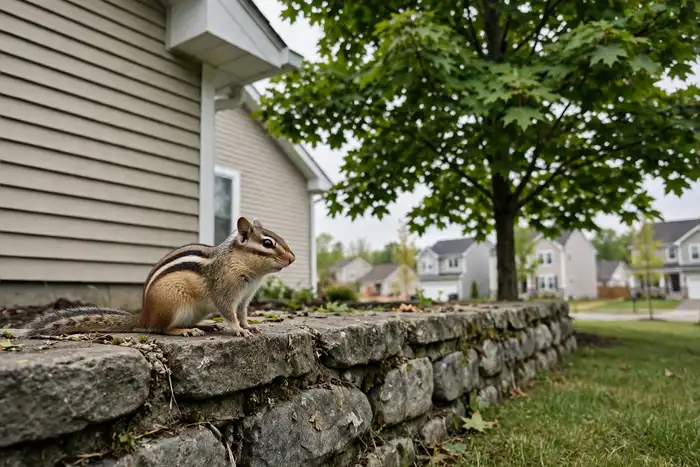
Chipmunks burrow along foundations, stoops and landscape walls in Wadsworth's leafier neighborhoods, moving soil so neatly that the tunnels go unnoticed until a step or walk edge loses support. Several animals share a mature system. See our full Wadsworth chipmunk removal guide →
🐀 Rats, mice & voles
House mice invade Wadsworth houses at first frost through gaps too small to notice, Norway rats appear around older housing and outbuildings, and voles pattern the lawns of new subdivisions under winter snow. Identification comes first, because the remedies diverge. See our full Wadsworth rodent removal guide →
🐍 Snakes
A snake in a Wadsworth basement or garage is almost always a harmless one — a rat snake or garter snake that followed mice in. The right call is identification and safe removal, plus a check of the opening and the rodent activity behind it. See our full Wadsworth snake removal guide →
🪰 Dead animals
An odor that builds in one room, often as the weather warms, usually means something died in a wall, an attic or a porch void over the winter. Our crew locates and removes it, cleans the area, and closes the opening it originally used. See our full Wadsworth dead animal removal guide →
Animal-specific help in Wadsworth
Deep, local guides for the problems we get called about most — with our wildlife crew behind every one.
How to get help in Wadsworth
Tell us what you're hearing
Scratching in the attic, a snake by the porch, holes in the yard — call with your problem and your Wadsworth address.
We connect you locally
Call us and tell us about the job — we will confirm the local crew for your county before any work starts.
They solve it — for good
Inspection, humane removal, full exclusion and cleanup — handled by our wildlife crew, following Ohio rules.
Common wildlife removal questions in Wadsworth
Who do I call for wildlife removal in Wadsworth?+
Why do the newer subdivisions get so many groundhog and skunk calls?+
When are animals most likely to get into a Wadsworth house?+
Can bats be excluded from my Wadsworth attic in the middle of summer or winter?+
Can you trap a skunk or raccoon here and let it go outside town?+
How much does wildlife removal cost in Wadsworth?+
Serving all of Medina County
Wadsworth is one part of Medina County. See wildlife removal in Medina County, OH for the county-wide picture — the animals we get called about most, and the other towns we cover.
One call to your Wadsworth wildlife crew
Whether it's squirrels in an older in-town attic or a raccoon in a new subdivision crawlspace, the fastest fix is our wildlife crew, who knows Medina County wildlife. Call us and tell us about the job — we will confirm the local crew for your county before any work starts.
- Local to Medina County. ODNR-compliant handling — call to ask about licensing and insurance.
- One company, one call. Call us and tell us about the job.
- Done right. Removal, exclusion and cleanup.