Wildlife Removal in Stow, OH
Stow grew up in the decades of the ranch and the two-story colonial — houses with low rooflines, attached garages and decks out back, set on lots where the woods were never fully cleared. Animals read that landscape as an extension of the creek corridors and the river valley at the city's edge. Call us and tell us about the job — we will confirm the local crew for your county before any work starts.
Why Stow homes see the wildlife they do
A Stow wildlife call usually starts at the edge of the woods. The city's neighborhoods were built from the 1960s through the 1980s among mature trees, and many lots still back onto wooded slopes, creek corridors or undeveloped green that connect, a few streets away, to the Cuyahoga River valley. Raccoons, squirrels, skunks and groundhogs live in that green full-time; the houses along it are where they come to den, feed and get out of the weather.
The houses themselves are at the age where wildlife finds the seams. Ranches carry long, low rooflines with wide soffits and attic vents that have weathered forty-plus winters; colonials add tall chimneys and dormers; nearly all of them have an attached garage, and a generation of added decks, sheds and sunrooms whose junctions with the original house were never sealed for animals. Freeze and thaw works on all of it, a little more each year.
Our crew works a Stow house from the tree line inward: how the lot connects to the corridor behind it, where the garage, deck and roofline give an animal its way in, and what has to be sealed in metal so the route closes for good. Removing an animal without closing a ranch's long soffit line or a deck's open edge rarely holds here — the corridor sends the next one up the same path.
Ranches and colonials at the age where seams open
Mid-century and late-century houses fail differently from the century-old stock farther north. A ranch spreads its attic under one long, low roof, so a single soffit gap can give squirrels the run of the whole ceiling, and its vents and exhaust caps are now old enough to rust, crack or lose their screening. A colonial concentrates its risk higher: chimney flashing, dormer cheeks and the upper gable ends, all reached easily from the mature trees that now tower over both styles.
Attached garages are the third pattern. The garage-to-house junction, the gap under a side entry door, and stored bird seed, pet food and trash inside make a garage both a feeding stop and a staging area; from a garage attic, many Stow houses offer a route onward into the main attic. Decks and sunroom additions complete the list — their roof ties and skirting were built for weather, not for a raccoon testing the seam with strong hands.
None of this is decay a homeowner caused. It is a housing stock reaching the age where original vent materials and sealants give out, roughly all at once, on street after street.
Creek corridors and the valley edge move animals through Stow
Water is the organizing feature behind the tree line. Small creeks and drainage corridors cross Stow's neighborhoods on their way toward the Cuyahoga River, and wildlife travels those wet, wooded lines the way people use sidewalks. A lot that backs onto a corridor is not unlucky — it is simply on the route, and it will see raccoons following the water, skunks working the banks for grubs, groundhogs digging where the slope meets a shed, and opossums drifting through at night.
That geography explains why two identical houses get different results: the one mid-block may go years without a call while the one at the corridor's edge gets three in a season. It also shapes the sensible plan. You cannot clear the corridor, and you would not want to — the answer is to make the house itself a dead end: sealed soffits, screened deck edges, a capped chimney and a garage that does not feed anything.
Near the water, expect the cast to widen slightly — a watersnake along a creek bank, rodent pressure where banks are burrowed — while the upland streets lean more heavily to squirrels, bats and groundhogs.
Decks, sheds and garages take the ground-level pressure
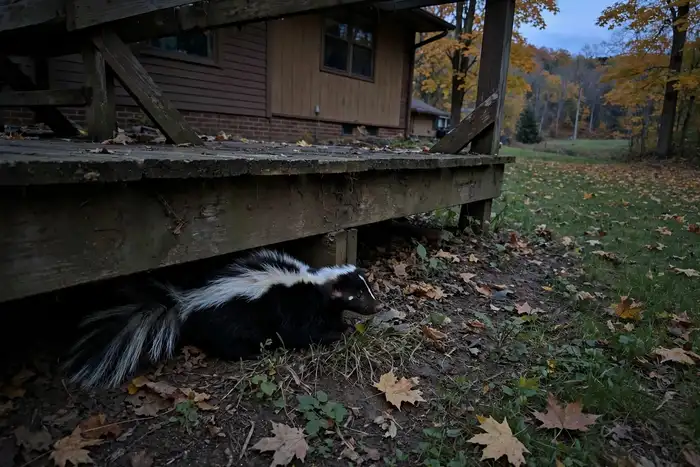
In Stow the ground-level story is told at the deck. Low decks built close to grade offer a dark, dry cavity at perfect skunk and groundhog height, and on wooded lots the deck is often the closest structure to the tree line. Sheds set at the back of a lot — frequently near the corridor — get burrows at their edges and opossums and raccoons testing their doors, and a shed that stores seed or pet food rewards them for it.
Garages deserve equal attention. Beyond the animals that den in them, garages are where mice winter beside stored seed, where squirrels stage into attic openings above, and where a raccoon that finds the side door gap learns the house in one night. Checking the garage as part of an attic job, and the deck as part of a skunk job, is standard practice on our crew's Stow inspections.
The fixes match the structures: buried screening at deck and shed perimeters, door sweeps and sealed junctions at the garage, and food stored in hard containers everywhere.
Ohio rules that shape the work: bats, rabies and relocation
Wildlife removal for hire in Ohio requires an ODNR Commercial Nuisance Wild Animal Control Operator license under Ohio Revised Code section 1531.40. Bats follow a fixed state calendar: exclusion is barred from May 16 through July 31 when five or more bats are present, because the pups cannot fly yet, and from October 15 through March 31, when big brown bats may be hibernating inside the attic — either period only with prior written ODNR permission. The open windows are April 1 to May 15 and August 1 to October 15, which is why a bat call in June usually means an inspection now and exclusion booked for August.
Rabies governs the rest of the handling. Raccoons, skunks, foxes and bats are Ohio's main rabies vectors, and northeast Ohio lies in the oral rabies vaccine baiting area working against raccoon-variant rabies. Under Ohio Administrative Code 1501:31-15-03(E)(3), a captured raccoon, skunk or opossum cannot be carried off the property: the lawful outcomes are release on the same property or humane euthanasia. Our crew leads with exclusion — one-way doors and sealing that let an animal leave on its own where that is possible — and handles the rest exactly as Ohio rules require.
Wildlife we remove in Stow
From squirrels crossing a ranch's long ceiling to groundhogs digging at a corridor-edge shed, these are the calls Stow homeowners make most.
🐿️ Squirrels
Mature trees over wooded lots send gray squirrels onto ranch and colonial roofs every fall, and one soffit gap can open a whole low attic. Flying squirrels work the smaller gaps at night. Chewed wiring is the urgent part. See our full Stow squirrel removal guide →
🦝 Raccoons
Raccoons follow Stow's creek corridors and den in chimneys and attics at the corridor's edge. A rabies-vector species Ohio law does not allow to be moved off the property — exclusion first, kits accounted for, latrine cleaned. See our full Stow raccoon removal guide →
🦇 Bats
Big brown bats roost behind dormers and at gable vents on Stow colonials, and some hibernate in the attic through winter. Exclusion is legal only April 1–May 15 and August 1–October 15 without written ODNR permission. See our full Stow bat removal guide →
🦨 Skunks
Low decks on wooded lots are the classic Stow skunk den — dry, dark and steps from the tree line. A rabies vector that cannot be moved off the property under Ohio law, handled by calm exclusion plus buried deck screening. See our full Stow skunk removal guide →
🦫 Groundhogs
Groundhogs burrow under sheds, decks and retaining edges where Stow lots meet the woods, then sleep from late fall to late winter. Spring emergence restarts the digging under whatever the burrow reaches. See our full Stow groundhog removal guide →
🐾 Opossums
Opossums drift up from the creek corridors at night and bed down in garages, under decks and beneath sheds. Ohio law does not allow them to be moved off the property, so removal is paired with closing the shelter. See our full Stow opossum removal guide →
🐿️ Chipmunks
Chipmunks tunnel along ranch foundations, front walks and retaining walls on Stow's wooded lots, moving soil away from footings one cheek-load at a time. A colony, not a single animal, is the usual finding. See our full Stow chipmunk removal guide →
🐀 Rats, mice & voles
House mice flood into garages and basements at first frost, Norway rats appear near water and older outbuildings, and voles map wooded lawns under the snow. The Stow rodent job starts in the garage and at the foundation. See our full Stow rodent removal guide →
🐍 Snakes
Almost always harmless — garter snakes in the garden, rat snakes after mice in garages and basements, watersnakes along the creeks. The Stow snake call is identification and removal, not fear. See our full Stow snake removal guide →
🪰 Dead animals
A smell in one bedroom of a ranch, often surfacing in spring, usually means something died in the attic, a wall or under the deck over winter. Our crew locates it, removes it, cleans up and closes the opening it used. See our full Stow dead animal removal guide →
Animal-specific help in Stow
Deep, local guides for the problems we get called about most — with our wildlife crew behind every one.
How to get help in Stow
Tell us what you're hearing
Scratching in the attic, a snake by the porch, holes in the yard — call with your problem and your Stow address.
We connect you locally
Call us and tell us about the job — we will confirm the local crew for your county before any work starts.
They solve it — for good
Inspection, humane removal, full exclusion and cleanup — handled by our wildlife crew, following Ohio rules.
Common wildlife removal questions in Stow
Who do I call for wildlife removal in Stow?+
My house backs onto woods and a creek — does that explain the repeat problems?+
When is wildlife season in a Stow ranch or colonial?+
Can bats be removed from my Stow attic in summer or winter?+
Will you relocate a raccoon or skunk to the river valley?+
How much does wildlife removal cost in Stow?+
Serving all of Summit County
Stow is one part of Summit County. See wildlife removal in Summit County, OH for the county-wide picture — the animals we get called about most, and the other towns we cover.
One call to your Stow wildlife crew
Whether it's squirrels in an older in-town attic or a raccoon in a new subdivision crawlspace, the fastest fix is our wildlife crew, who knows Summit County wildlife. Call us and tell us about the job — we will confirm the local crew for your county before any work starts.
- Local to Summit County. ODNR-compliant handling — call to ask about licensing and insurance.
- One company, one call. Call us and tell us about the job.
- Done right. Removal, exclusion and cleanup.